
CTAA: Solving the MOOC Completion Crisis via Crowdsourced Teaching Assistants
Crowdsourcing Based Teaching Assistant Arrangement for MOOC
This paper proposes a Crowdsourcing-Based Teaching Assistant (TA) arrangement for Massive Open Online Courses (MOOCs). It introduces the CTAA problem to optimize manpower by selecting proficient learners as TAs through expertise-ranking and flow-based assignment algorithms.
TL;DR
Massive Open Online Courses (MOOCs) suffer from a scaling paradox: millions can enroll, but only one teacher is available, leading to high dropout rates. This paper proposes a Crowdsourcing Based Teaching Assistant Assignment (CTAA) framework. By evaluating learners' expertise using PageRank-inspired logic and test scores, the system identifies "student TAs" and assigns them to courses using Maximum Flow algorithms, significantly improving the scalability of human-led instruction.
Background: The Instructor Bottleneck
In the traditional MOOC landscape, the ratio of teachers to students is often 1:10,000+. This imbalance results in poor engagement. While automated tests and filmed lectures provide content, they cannot provide the interaction critical for deep learning. Previous attempts focused on course design; however, this paper argues the solution lies in Manpower Disposal—utilizing the learners themselves as a workforce.
Methodology: Ranking and Routing Expertise
The core of the paper is a two-step process: Characterization and Assignment.
1. Characterizing Teaching Level
The system doesn't just look at grades. It uses a PageRank-style algorithm to determine the Expertise Level () of a learner, looking at how often they help others on the forum.
The final Teaching Level () is a balanced weight of academic performance () and interaction-based expertise ():
2. The Assignment Engine
To match the right TA to the right course, the authors move beyond simple greedy matching. They model the problem as a Maximum Flow Problem.
- Offline Analysis: Uses Minimum Cost Maximum Flow (MCMF) to account for the "Offline Rate"—the probability a student TA will log out.
- Online Analysis: For real-time enrollment, they propose a Partition Based (PB) algorithm. It splits learners into two groups: one for immediate greedy assignment and another reserved to find a global optimal match once a threshold of available candidates is reached.
 Note: The flow logic ensures that teaching capacity matches course demand while maximizing the overall Teaching Level.
Experimental Insights
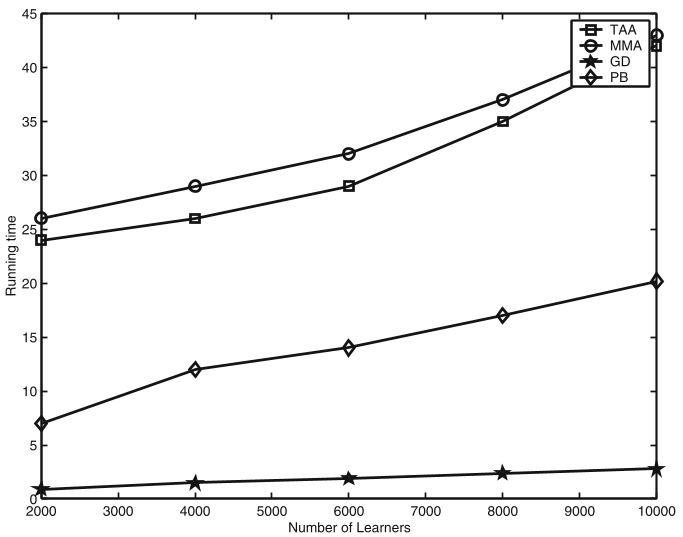
The authors tested four algorithms: TAA (standard flow), MMA (cost-based flow for offline rates), GD (Greedy), and PB (Partition-Based).
- Efficiency: The Greedy algorithm is the fastest but often "wastes" high-quality TAs on low-priority tasks. The PB algorithm offers a "sweet spot"—it handles dynamic logins efficiently while maintaining a high total teaching level.
- Resilience: As the "Offline Rate" (dropout rate) increases, the total teaching quality naturally declines. However, the MMA approach proved most resilient by prioritizing TAs with higher historical "online" reliability.
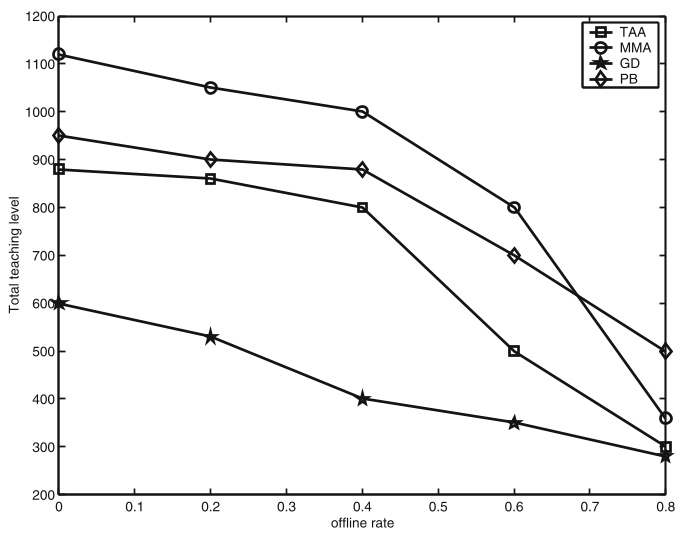 Figure 1: Running time comparison across different distributions (Uniform vs Mixture).
Critical Perspective: Beyond the Algorithm
Takeaway: The paper successfully shifts the focus from "how to teach better" to "how to scale the teaching workforce." By treating the MOOC community as a supply-chain of expertise, it addresses the fundamental human limitation of online education.
Limitations:
- Synthetic Data: The study relies on synthetic datasets. Real-world social nuances (e.g., cultural barriers in peer-to-peer help) are not yet modeled.
- Incentive Design: While the algorithm assigns TAs, it assumes learners are willing to serve. Future work should integrate "Crowdsourcing Incentives" (e.g., certificates or credits) into the flow model.
Future Outlook
As MOOCs evolve into "AI-assisted classrooms," the CTAA model provides a blueprint for how AI can act as a "Traffic Controller," routing human expertise where it is most needed, ensuring that no learner is left behind due to a lack of instructor attention.