
Adaptive Wi-Fi Fingerprinting: Leveraging Crowd Patterns and Unsupervised Learning for Indoor Localization
A Crowdsourcing-Based Wi-Fi Fingerprinting Mechanism Using Un-supervised Learning
This paper introduces a crowdsourcing-based Wi-Fi fingerprinting mechanism that utilizes unsupervised learning to maintain indoor localization accuracy. The core method, involving density-based clustering and Gaussian Process Regression (GPR), achieves a 9.3% average reduction in RSSI error by intelligently enriching current data with matched historical fingerprints.
Executive Summary
TL;DR: This paper tackles the "stale fingerprint" problem in indoor localization by treating crowd distribution as a periodic influence. Instead of relying solely on sparse real-time crowdsourced data, the authors use unsupervised clustering and particle filters to find "historical twins" of the current environment, merging them via Gaussian Process Regression to create highly accurate, real-time radio maps.
Positioning: This work moves beyond simple crowdsourcing—which often fails due to insufficient real-time data—by introducing a Scene-based Historical Data Enrichment framework. It occupies a unique niche between purely transfer-learning-based methods and real-time SLAM approaches.
Problem & Motivation: The "Human Blockage" Challenge
Wi-Fi signals in indoor environments are notoriously fickle. While walls and furniture are static, the crowd spatial distribution is a dynamic variable that drastically alters RSSI (Received Signal Strength Indication).
The authors identified three critical insights:
- Fingerprints change cyclically along with human activity (e.g., office hours vs. lunch breaks).
- Crowd distributions are not random; they can be categorized into a limited number of "scenes."
- Similar crowd distributions produce similar signal shifts.
Previous crowdsourcing attempts often ignore these historical patterns, failing when the current user data is too sparse to cover an entire building.
Methodology: The Scene-Matching Architecture
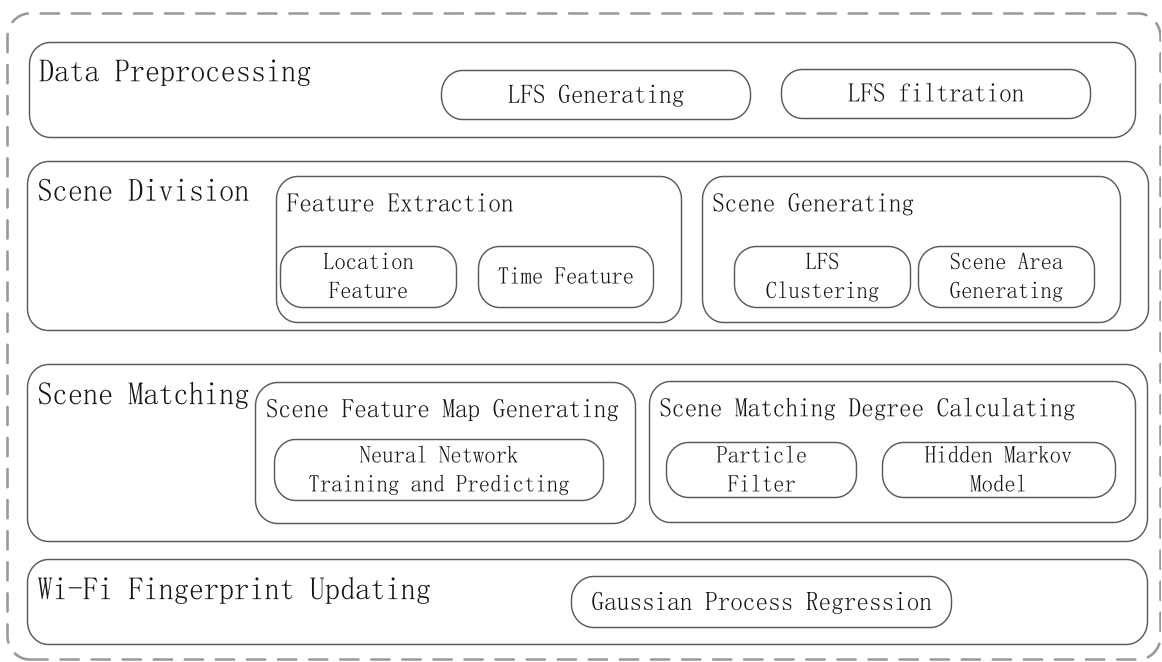
The proposed system operates in four sophisticated stages:
1. Scene Division (Clustering)
Historical Location Fingerprint Sequences (LFS) are analyzed for three feature types: RSSI Statistics (mean, std-dev, max), Time (cyclical hours), and Space. Using DBSCAN, the system clusters these into "Scenes" representing specific environmental states (e.g., "Full Classroom" or "Empty Lab").
2. Scene Matching (The Search Engine)
When new data arrives, the system must decide which historical "Scene" it belongs to.
- Neural Network Maps: Each scene builds a feature map representing the expected RSSI for every Access Point (AP).
- Particle Filter & HMM: A Particle Filter searches these maps for the most likely match, while a Hidden Markov Model (HMM) manages the transitions between scenes to ensure temporal consistency.
3. Fingerprint Generation via GPR
Once a scene is matched, Gaussian Process Regression (GPR) acts as the "interpolator." It takes the fragmented real-time data and the enriched historical data to predict RSSI values for fixed Reference Points (RPs) across the entire floor plan.
Experiments & Results
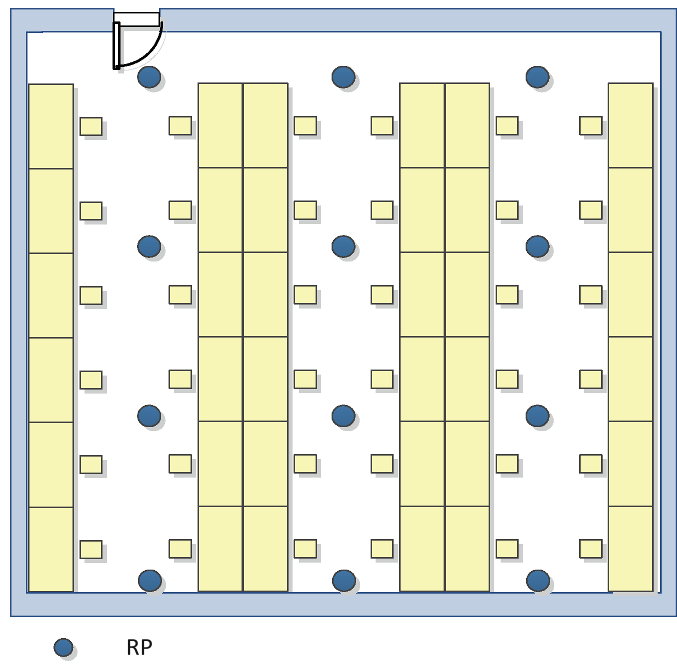
The authors validated their approach in two distinct environments: a laboratory and a classroom.
Key Findings:
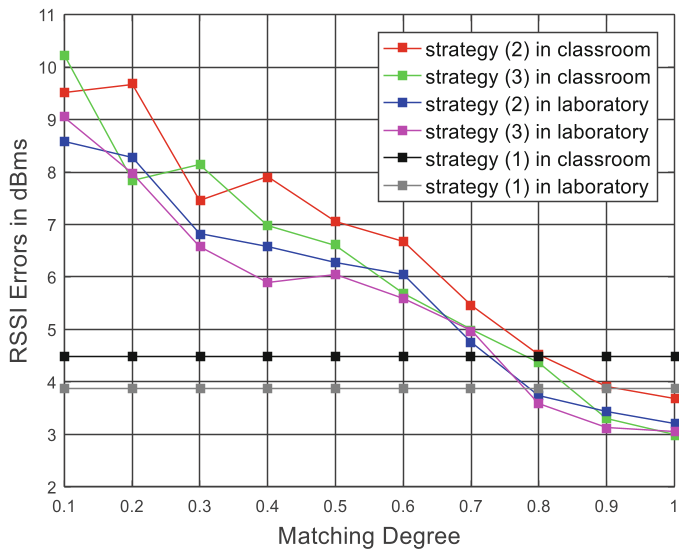
- RSSI Error Reduction: The method reduced RSSI error by an average of 9.3%, with some scenes seeing improvements up to 23%.
- Localization Accuracy: In the "A1" area (where historical data was successfully matched), the localization error was significantly lower compared to non-updated systems.
Ablation Insight: The study specifically notes that matching performance is significantly better when using Strategy (3)—which incorporates transition probabilities (HMM)—compared to just looking at instantaneous similarity.
Deep Insight & Conclusion
Takeaway
The genius of this paper lies in its utilization of the periodicity of human behavior. By acknowledging that "Thursday at 2 PM" likely looks the same as "last Thursday at 2 PM" in terms of signal interference, the authors effectively "multiply" their training data without requiring more sensors.
Limitations
A notable limitation mentioned is that in areas where real-time data is exceptionally dense ("A2" in the paper), the use of historical data can occasionally introduce noise if the match isn't perfect. This suggests that the weight of historical vs. current data should be dynamically tuned based on local data density.
Future Prospect
This mechanism could be extended to Multi-modal crowdsourcing, combining Wi-Fi with Bluetooth Low Energy (BLE) or Light Fidelity (Li-Fi), where the "Scene" clustering could account for heterogeneous sensor noise levels.