
Crowdsourcing Behaviors: How Autonomous Agents Can Learn Targeted Tasks from Strangers
On the crowdsourcing of behaviors for autonomous agents
This paper formalizes the "crowdsourcing of behaviors" for autonomous agents as a data-driven optimal control problem. It introduces a recursive algorithm that allows an agent to synthesize an optimal behavior by switching between multiple contributors to minimize tracking error (KL-divergence) from a target behavior while maximizing an agent-specific reward.
TL;DR
Instead of learning a complex task from scratch, could an autonomous agent "pick and choose" behaviors from a crowd of contributors? This paper introduces a formal control-theoretic framework where an agent crafts its own behavior by switching between contributor data models. By solving a recursive optimization problem, the agent achieves its specific goals while outperforming the very contributors it learns from.
Problem & Motivation: The Limits of Collaboration
In the world of autonomous systems, we often see Federated Learning or Multi-Agent Reinforcement Learning used to share knowledge. However, these paradigms usually assume that all participants share a common goal.
But what if the agent has a secret or specific reward function? What if the contributors (other cars, robots, or users) are just providing their own data without knowing what the agent is trying to achieve?
The author identifies a critical gap: there is no formal mechanism for an agent to "crowdsource" its behavior—effectively treating the data of others as a library of possibilities to be filtered and combined to solve a unique task.
Methodology: Crowdsourcing as Optimal Control
The paper reframes crowdsourcing as a design problem of probability density functions (pdfs).
1. The Mathematical Setup
The agent observes a Target Behavior () and has its own Internal Reward (). It must choose weights () to combine the behaviors provided by contributors ().
2. Overcoming Non-Convexity
The original problem of minimizing KL-divergence between the weighted combination and the target is non-convex, making it hard to solve in real-time. The author introduces a key technical insight: using Lemma 3 (based on the log-sum inequality), the cost function can be upper-bounded by a linear combination.
3. The Context-Aware Switch
The resulting Algorithm 1 acts as a "Context-Aware Switch." Instead of a complex blending of all data, the optimal solution (as per Corollary 1) often involves picking the single best contributor at each time step based on a backward recursion.
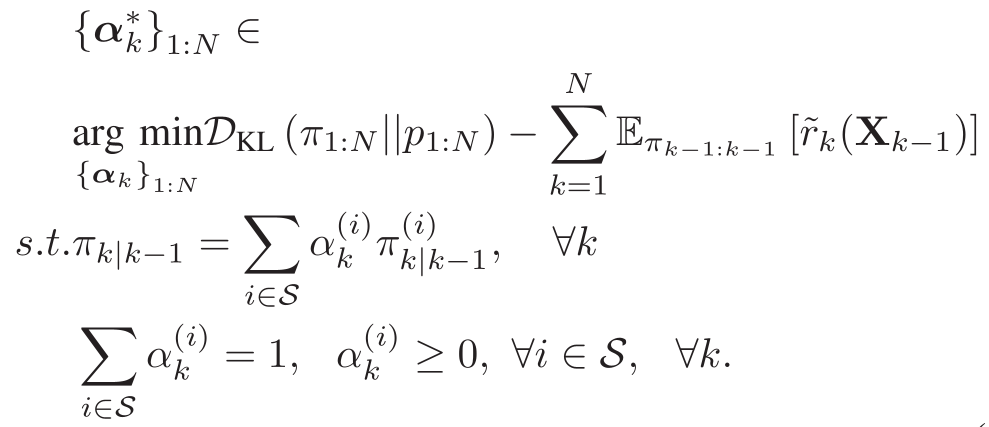 The core optimization: Balancing the distance to target behavior and the maximization of agent-specific rewards.
Experiments: Smart Routing for Connected Vehicles
To validate the theory, the author simulated a connected vehicle navigating a graph. The agent's task was to go from node 1 to node 6.
- Scenario A: The reward favors Node 2. The agent selects contributor paths that trend through the top of the graph.
- Scenario B: The reward shifts to favor Node 3. Without changing its contributor pool, the agent automatically switches its behavior to favor a route through Node 3 and 5.
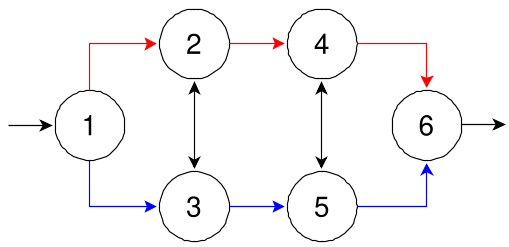 Fig 1: The road network where the agent (connected car) must choose between red and blue paths to optimize its own traffic/preference reward.
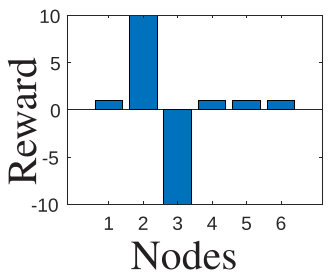 Fig 2 & 3: Demonstrating how the agent dynamically switches its path (bottom panels) based on internal reward changes (top-left panels), using the crowdsourced behavioral models (top-right panels).
Critical Insight & Future Outlook
The most striking result is Remark 5: the crowdsourced behavior can be better than any individual contributor. This is because the agent isn't just mimicking; it is optimally switching between the best available "expert" for every specific sub-segment of the task.
Limitations: The current approach relies on an upper-bound approximation for the KL-divergence. While this makes the algorithm efficient for real-time deployment, it might leave some performance on the table compared to a true global optimum.
Future Work: The author is moving toward Hardware-in-the-loop (HiL) testing, deploying this on real cars to see how it handles large-scale contributor pools in messy, real-world traffic.