
Crowdsourcing with Bounded Rationality: Why "Dumb" Workers Can Be a Smart Choice for Requesters
Crowdsourcing with Bounded Rationality: A Cognitive Hierarchy Perspective
This paper introduces the first study of crowdsourcing systems through the lens of Cognitive Hierarchy (CH) theory, moving beyond the traditional assumption of fully rational workers. By modeling workers as boundedly rational entities with finite reasoning levels, the authors characterize how a requester can optimize rewards and potentially achieve higher profits compared to the standard Nash Equilibrium (NE) benchmark.
TL;DR
Common sense says that smarter workers are better, but in the world of crowdsourcing incentives, "bounded rationality" is the requester's secret weapon. This paper explores how applying Cognitive Hierarchy (CH) Theory to crowdsourcing reveals that requesters can often extract more profit from workers who have limited reasoning capabilities than from those who are perfectly rational.
The "Full Rationality" Myth
In classical game theory, every worker on a platform like Amazon Mechanical Turk is treated as a logic machine. They are assumed to calculate exactly how many others will pick Task A versus Task B and find the Nash Equilibrium (NE).
The problem? Humans don't work that way. We have limited "cognitive bandwidth." We guess what others might do, but we rarely calculate to infinity. This paper argues that by ignoring these cognitive limits, current crowdsourcing models are leaving money on the table.
The Mechanism: Cognitive Hierarchy Theory
The authors replace the Nash Equilibrium with the Cognitive Hierarchy (CH) model. In this framework, workers are ranked by "levels" of reasoning:
- Level-0: These workers don't think about others at all; they choose tasks randomly.
- Level-1: They think everyone else is Level-0.
- Level-k: They believe everyone else is a mix of levels 0 to .
The requester, being "fully rational," knows this distribution (modeled as a Poisson distribution with mean ) and sets rewards to maximize their own profit.
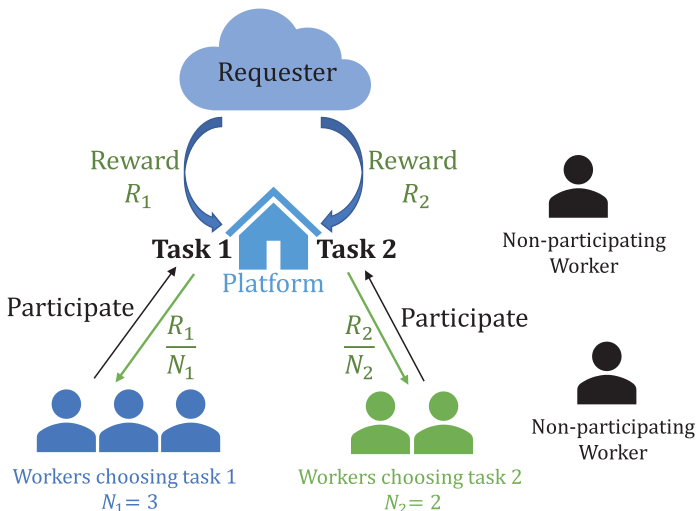 Fig 1: The two-stage game where the requester moves first, setting rewards , followed by workers selecting tasks based on their cognitive levels.
Methodology: Exploiting the Reasoning Gap
The paper compares two worlds:
- Fully Rational (FR) Model: Workers reach a Nash Equilibrium where rewards barely cover their costs ().
- Bounded Rational (BR) Model: The requester anticipates that Level-0 workers will show up even if the reward is low, because they don't realize the reward will be split among many people.
Key Mathematical Insight
A Level-k worker's expected payoff depends on their belief about how many lower-level workers have already "filled up" the task. If the population is huge, the number of Level-0 workers becomes a reliable source of "cheap labor" for the requester.
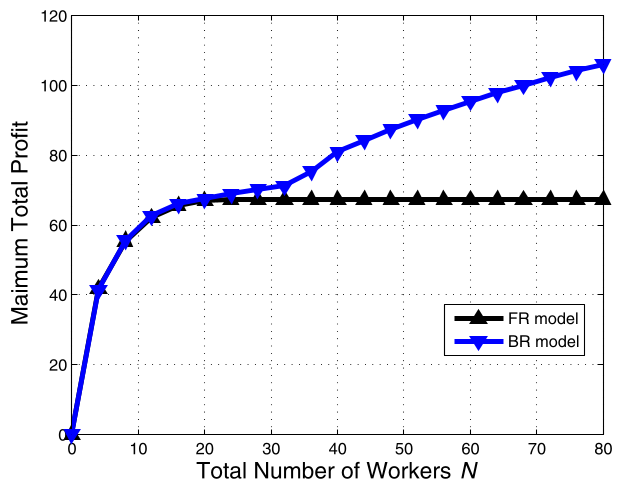 Fig 2: Optimal reward vs. . Note how the reward doesn't always increase with —at certain thresholds, the requester slashes rewards because they can rely on the influx of low-level reasoning workers.
Experimental Findings: The Profit of "Ignorance"
The study provides several counter-intuitive results:
- Profit Growth: In the FR model, profit eventually plateaus. In the BR model, as the population grows, the requester’s profit grows unboundedly. Why? Because the supply of "unthinking" Level-0 workers increases, allowing the requester to keep rewards low while still getting the work done.
- The Convergence: As (the average cognitive level) approaches infinity, the BR model converges back to the Nash Equilibrium. This proves that classical theory is just a "special case" of this more realistic behavioral model.
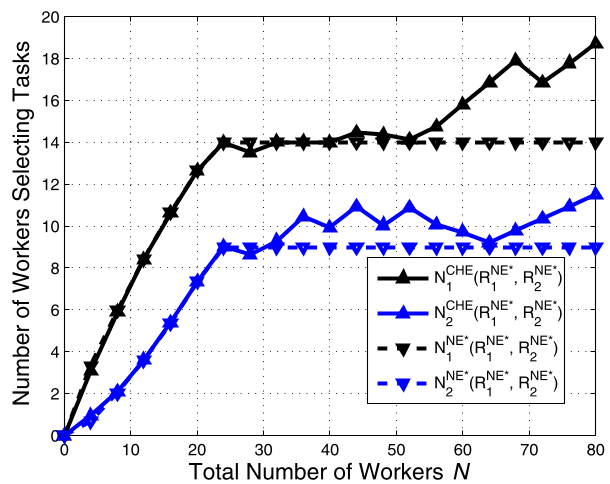 Fig 3: Total profit comparison. While the Fully Rational model (blue) hits a ceiling, the Bounded Rational model (red/green) continues to climb as increases.
Conclusion and Professional Insight
This paper is a wakeup call for mechanism designers. It suggests that over-engineering for rationality might lead to lower efficiency in human-centric sysytems.
Takeaway: If you are designing an incentive system for a large, heterogeneous crowd, don't just solve for the Nash Equilibrium. Solve for the "Cognitive Hierarchy." By understanding that a portion of your users will always act on "Level-0" logic, you can design systems that are more robust—and significantly more profitable.
Limitations: The model assumes the requester knows (the average cognitive level). In practice, estimating for a platform like MTurk would require significant empirical data or real-time learning algorithms.