
JURONT: Scaling Legal Knowledge via Crowdsourcing and Self-Organization
A crowdsourcing approach to building a legal ontology from text
The paper introduces JURONT, a Web-based software package designed to build a legal ontology for the Ukrainian jurisdiction. It leverages a crowdsourcing approach, utilizing law students to extract and structure legal concepts from unstructured text documents into a formal knowledge representation.
TL;DR
Building specialized knowledge bases like legal ontologies is traditionally a slow, expert-driven craft. This paper presents JURONT, a system that shifts the burden to the "crowd" (law students). By applying principles of information self-organization, the researchers successfully mapped the complex landscape of Ukrainian Criminal Law, achieving 90% completeness through decentralized, multi-user contributions.
Background: The Expert Bottleneck in Law
The legal domain is uniquely characterized by its massive volume, strict hierarchy, and high volatility. In Ukraine, the legal corpus exceeds 500,000 documents, constantly being updated. Traditional methods—where domain experts and ontology engineers manually define every class and relationship—cannot scale. Furthermore, language barriers make international tools like Protégé difficult for local practitioners.
The authors' core insight: Could the legal ontology evolve like Wikipedia? If order can emerge from the "fluctuations" of many users, we can solve the throughput problem of knowledge engineering.
Methodology: The JURONT Framework
The JURONT system is built on a "client-server" model with a Web interface specifically designed for Ukrainian and Russian legal semantics. Unlike simplified ontologies, JURONT treats concepts as sets of phrases and synonyms, linking them directly to source text segments.
The Formal Model
The ontology is defined as , where (concepts) is not just a list of labels but a complex structure of:
- Synonym Groups: Handling the high-synonymy nature of the Ukrainian language.
- Time-Legitimacy: Marking when a definition is legally valid.
- Direct Evidence: Concepts are mapped to legislative definitions in the original statutes.
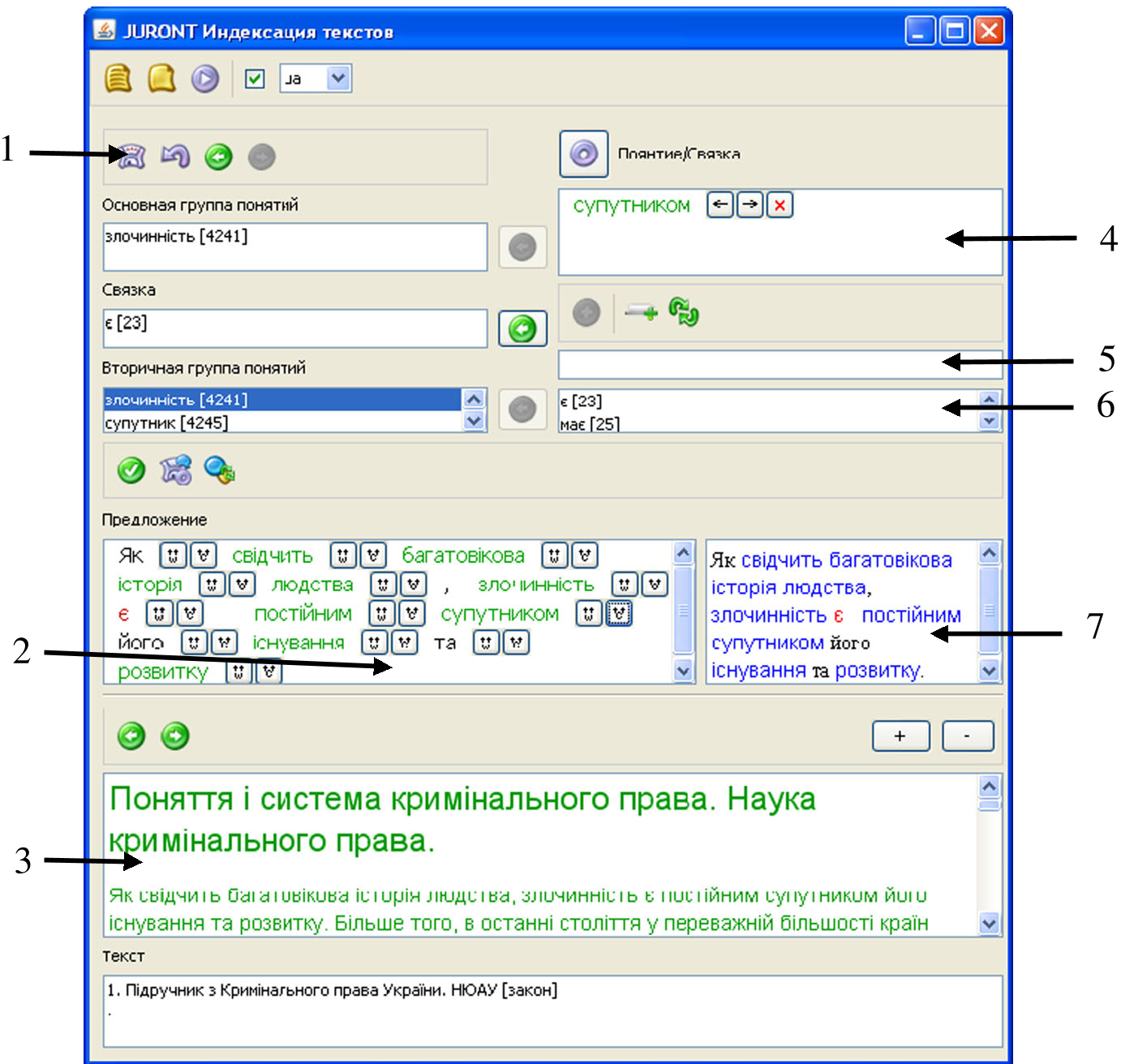 Figure 1: The JURONT interface showing the mapping between text fragments and ontological concepts.
Crowdsourcing as a Self-Organizing System
The paper argues that information systems exhibit synergetic properties. By allowing 20+ students to work semi-independently on different chapters of a textbook, the system acts as a "dissipative structure" where chaos (uncoordinated edits) transitions into order (a structured knowledge base).
They distinguish between:
- Independent Tasks: (e.g., Wikipedia) where one error doesn't break the whole.
- Dependent Tasks: (e.g., Ontologies) where a high-level error propagates. JURONT manages this risk by using "micro-tasks" and focusing students on specific textbook sections to ensure initial alignment.
Experimental Results & Critical Observations
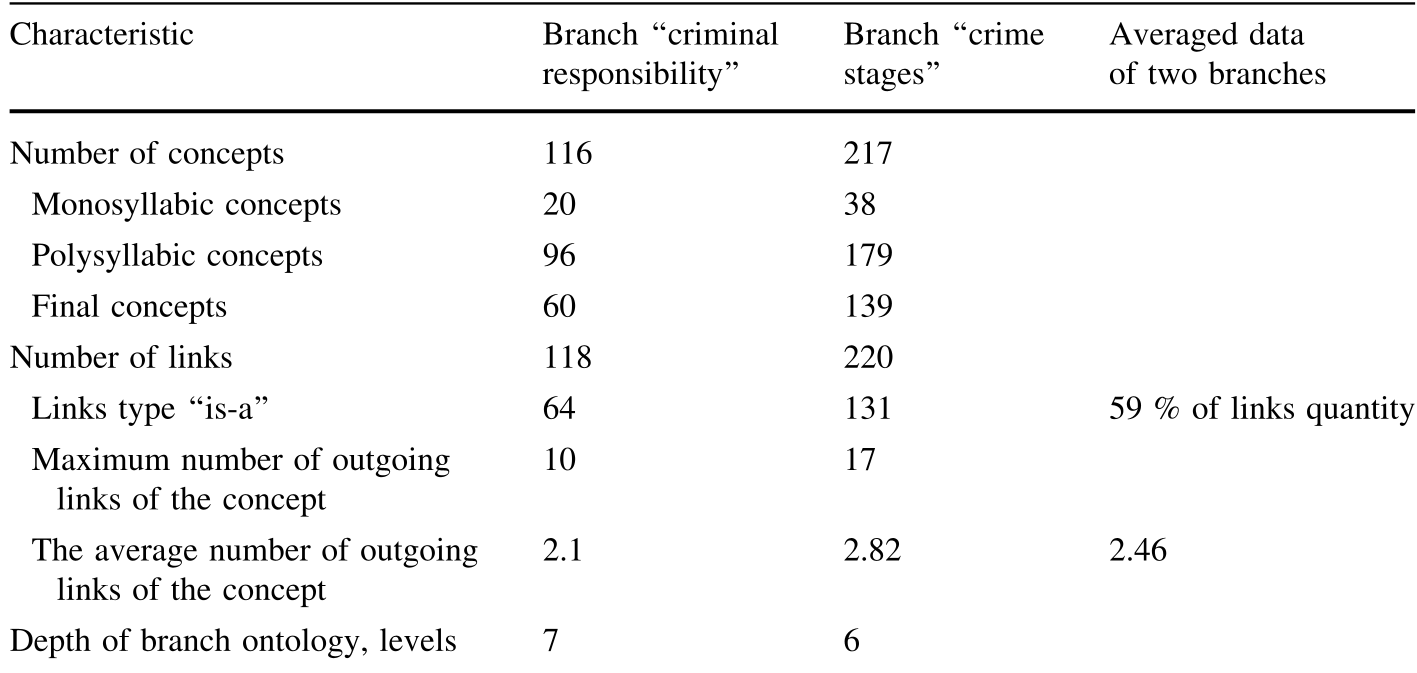
The pilot study focused on the "Criminal Law of Ukraine" textbook.
| Characteristic | Branch "Crime Stages" | Average (2 branches) |
|---|---|---|
| Total Concepts | 217 | - |
| "Is-A" Links | 131 | 59% of all links |
| Avg. Outgoing Links | 2.82 | 2.46 |
| Extraction Completeness | 90% | 90% |
Insights from the "Crowd"
While the 90% completeness is impressive, the experts identified three key challenges:
- Concept Verbosity: Users often entered long, descriptive phrases (e.g., "evasion of taxes and other payments") rather than atomic concepts.
- Synonym Fragmentation: Users created separate nodes for "Foreign Criminal Law" and "Criminal Laws of Other States" instead of merging them.
- Inter-branch Connectivity: While vertical hierarchies (Is-A) were strong, horizontal connections between different users' branches were initially weak.
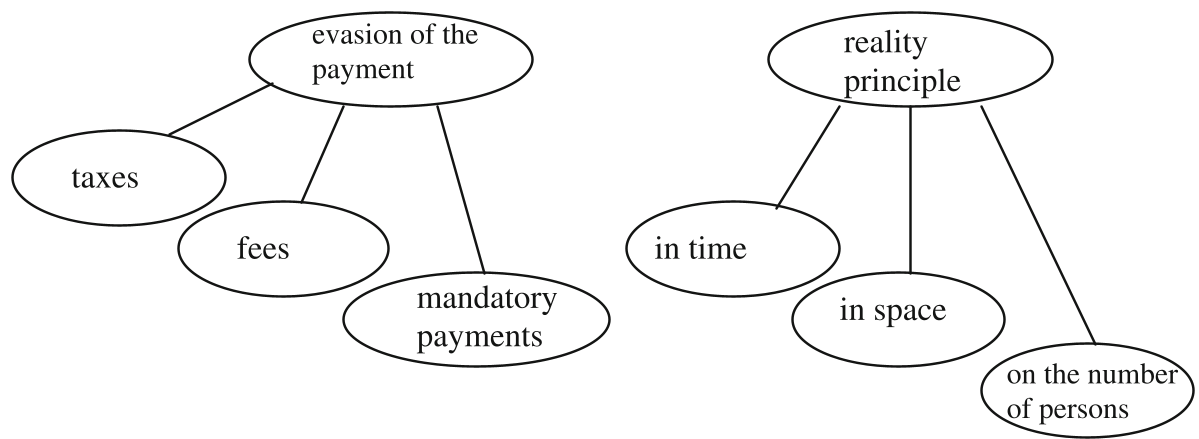 Figure 2: Example of moving from "verbose" user entries to structured, atomic ontological concepts.
Deep Insight & Conclusion
This study proves that crowdsourcing is a viable—and perhaps the only—way to maintain modern, large-scale legal knowledge bases. The transition from "Knowledge Engineering as Art" to "Knowledge Engineering as Process" requires software that doesn't just store data but actively suggests where new concepts fit into the existing manifold.
Future Outlook: The authors plan to implement automated distance-based suggestions to help users place new concepts, effectively using AI to curate the crowd's output. This hybrid "Human-in-the-loop" approach is the blueprint for future domain-specific semantic webs.