
Thunder Crystal: Revolutionizing Content Delivery via Crowdsourced "Mini-CDNs"
Design, Implementation, and Measurement of a Crowdsourcing-Based Content Distribution Platform
The paper introduces "Thunder Crystal," a large-scale crowdsourcing-based content distribution platform that rents bandwidth and storage from user-owned "agents" (PCs or Smart APs). By utilizing distributed edge resources incentivized through monetary rewards, the system achieves a 11-15x capacity amplification compared to its server bandwidth.
TL;DR
The insatiable demand for HD video has made traditional Content Delivery Networks (CDNs) prohibitively expensive. This paper presents Thunder Crystal, a massive-scale platform that bypasses traditional infrastructure by renting spare bandwidth and storage from ordinary users. By turning user devices into "agents" fueled by cash rewards, the system slashes distribution costs by 50% while amplifying delivery capacity by up to 15 times.
The Motivation: Why CDNs and P2P Fall Short
In the current landscape, content providers face a dilemma:
- CDNs: Reliable but extremely expensive to deploy and maintain.
- P2P Networks: Cheap but plagued by "free-riders," unstable uptimes, and copyright risks.
The authors identified a massive untapped resource: the surplus upload bandwidth of home and enterprise internet plans. Thunder Crystal fills this gap by acting as a managed "Crowdsourced CDN," providing the stability of a professional service with the low cost of a distributed network.
System Architecture: The Agent-Server Symbiosis
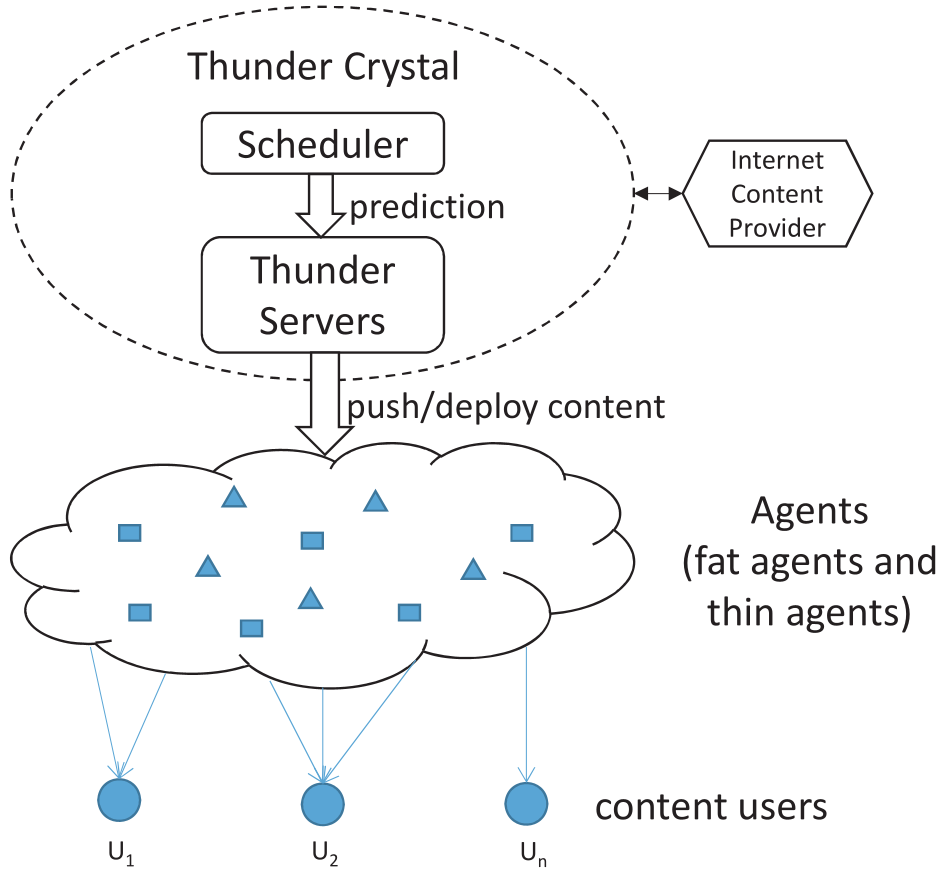
At its core, Thunder Crystal consists of Thunder Servers (the brains) and Agents (the muscle). Agents are split into "Thin Agents" (home PCs) and "Fat Agents" (enterprises or high-capacity smart APs).
Key Innovation: Decoupling Caching from Consumption
Unlike P2P where you share what you watch, Thunder Crystal agents cache what the system needs them to share. This allows for:
- Active Content Pushing: Servers push popular content to agents proactively.
- Security & Copyright: Chunks are encrypted and reorganized into segments before storage, preventing agents from consuming the content for free or pirating it.
Strategic Core: The Intelligence Behind the Distribution
The system relies on three sophisticated strategies to maintain efficiency:
- Content Replication: Uses a heuristic formula to determine how many copies of a file are needed based on historical popularity. This prevents over-taxing storage while ensuring high "hit rates."
- Content Pushing: Thunder servers use 80TB of daily bandwidth to update the "inventory" on agent devices, prioritizing the most popular new releases.
- Request Scheduling: When a user requests a video, they are directed to a pool of ~200 agents. The transfer happens in 2MB blocks, allowing multi-source parallel downloading for HD-quality speed.
Measurement Results: Real-World Performance
Over a one-month study of 11,000 devices, the performance metrics were staggering:
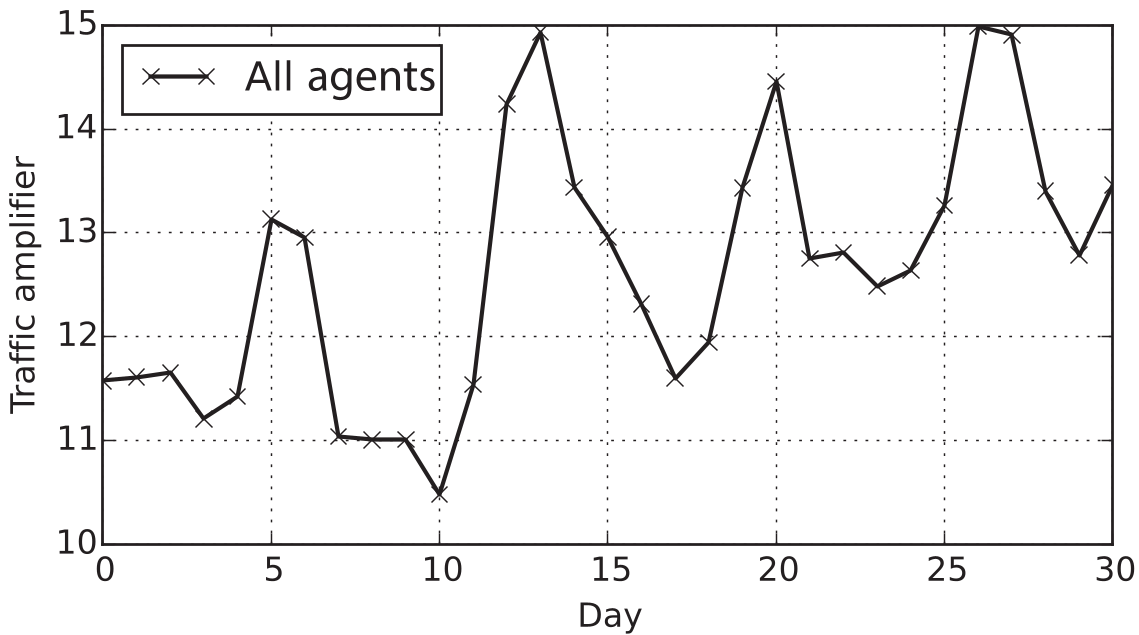
- Traffic Amplification: The system consistently generated 10x to 15x more upload traffic than the server-side push traffic, peaking during weekends.
- Storage Efficiency: "Fat Agents" were found to be more efficient at utilizing storage, though "Thin Agents" were more aggressive in allocating space to earn more rewards.
The Economic Insight
By paying agents roughly 0.011 USD per GB (0.07 RMB), the system creates a win-win scenario. Users monetize idle resources, and content providers pay half the rate of traditional commercial CDNs (0.13 RMB vs 0.26 RMB).
Critical Analysis & Future Outlook
The success of Thunder Crystal proves that monetary incentives are far more effective than the "reputation" or "tit-for-tat" systems used in legacy P2P networks.
Limitations:
- Centralization: The system still relies on centralized Thunder Servers for coordination, which could become a bottleneck.
- Fairness: Lucky agents who receive "trendy" videos earn more, potentially leading to agent dissatisfaction if not balanced.
Conclusion: Thunder Crystal represents a paradigm shift in the sharing economy for digital infrastructure. As Smart Home devices (APs/NAS) become more powerful, the potential for crowdsourced distribution will only grow, potentially making the traditional, hardware-heavy CDN model obsolete for static content delivery.