
CCID: Turning the Audience into a Piracy Detector for Live Streams
Crowdsourcing-Based Copyright Infringement Detection in Live Video Streams
The paper introduces CCID (Crowdsourcing-based Copyright Infringement Detection), a novel framework for detecting unauthorized live video streams in real-time. By leveraging audience live chat messages and video metadata as "crowd sensors," it achieves superior performance over traditional content-based systems like YouTube's ContentID.
TL;DR
Detecting copyright infringement in live streams (like sports or TV premieres) is a race against time where traditional "fingerprinting" fails because the content is being created as it's watched. This paper proposes CCID (Crowdsourcing-based Copyright Infringement Detection), a system that ignores the video pixels and instead "listens" to the audience's live chat. By treating chat messages as sensor data, CCID detects pirated streams 20% faster and much more accurately than YouTube's proprietary ContentID.
The Problem: Why Pixels Lie and Fingerprints Fail
Current SOTA systems like YouTube's ContentID primarily use content-based detection. They compare a video's signature against a database of known copyrighted material. This has three fatal flaws:
- Temporal Lag: For live events, the "original" copy hasn't been indexed yet.
- Adversarial Evasion: Streamers are "sophisticated"—they mirror the screen, add borders, or change the audio pitch to fool the algorithms.
- Ambiguity: A stream titled "NBA Finals" might actually be someone playing NBA 2K (a video game). Pixels alone struggle to distinguish a high-fidelity game from a real broadcast, leading to high false-positive rates.
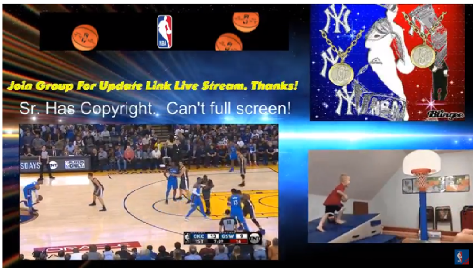 Figure 1: Examples of streamers using camouflage (e.g., "NBA 2K" vs real NBA) to bypass automated detectors.
Methodology: The "Crowd as a Sensor" Insight
The researchers' core insight is that while algorithms can be fooled by visual tweaks, the audience cannot. If a stream is real, the chat will explode with relevant player names and reactions to specific plays. If it's a fake or a scam, the audience will post negativity or "colluding" messages (e.g., "Change the title so you don't get banned!").
1. Extracting Crowd Votes
CCID extracts four specific types of clues (Crowd Votes) from unstructured chat logs:
- Colluding Votes: "Change the title to bypass detection!"
- Content Relevance: Mentions of specific players or real-time game events.
- Video Quality: Complains about lag or praise for HD resolution.
- Negativity: Cursing and "fake" labels when the stream leads to a scam.
2. Bayesian Truth Analysis
Because chat data is noisy, CCID doesn't treat every message equally. It uses a Maximum Likelihood Estimation (MLE) framework to calculate the Weight of a Crowd Vote. This allows the system to ignore "spam" and focus on signals that consistently correlate with actual copyright infringement.
3. Feature Synthesis
The system combines these weighted chat features with metadata like View Counts (pirated streams attract massive crowds quickly) and Title Subjectivity (scam streams often use clickbait like "BEST QUALITY STREAM FREE!!!").
Results: Faster and Fairer
The team tested CCID on thousands of messages from NBA and Soccer streams.
SOTA Comparison
Using AdaBoost as the classifier, CCID achieved an 81.8% to 83.8% F1-score, compared to ContentID’s 66%–75%.
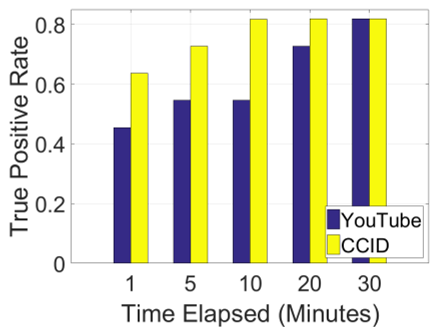 Table IV: Feature importance ranking shows that View Count and the weighted Chat feature (Chatocv) are the most powerful predictors.
The 5-Minute Threshold
One of the most impressive findings is the speed of detection. Within the first 5 minutes of a broadcast, CCID's Accuracy and True Positive Rate (TPR) skyrocket past YouTube's baseline. Moreover, it drastically reduces the "False Positive Rate"—meaning fewer legitimate streamers have their accounts wrongly flagged.
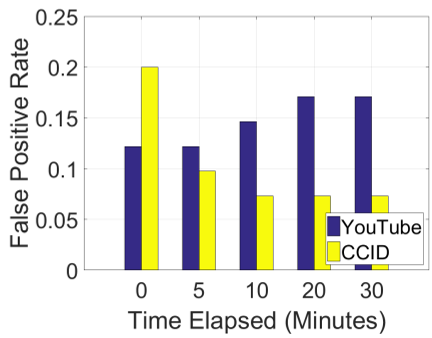 Figure 3: CCID outperforms YouTube in identifying real infringements (TPR) while maintaining a lower false-alarm rate after an initial 5-minute data-gathering window.
Critical Insight & Future Outlook
Takeaway: CCID proves that social context is more informative than raw data in adversarial settings. When bad actors try to hide their tracks from AI, they often inadvertently leave footprints in the way the "crowd" interacts with them.
Limitations: The system relies on having an active audience. For low-viewership pirated streams, the lack of chat volume might hinder detection. Future work could integrate "Multimodal" sensing—combining these social clues with the improved visual models of today (Transformers/ViMs).
Ultimately, this research shifts the paradigm from analyzing what a video looks like to analyzing how an audience reacts to it.