
Crowdsourcing vs. Speech Recognition: Building a Sustainable Path to Web Accessibility
9772_Crowdsourcing correction of speech recognition captioning errors.
This paper introduces a specialized tool for the Synote platform that utilizes crowdsourcing to correct Speech Recognition (ASR) captioning errors in educational videos. By leveraging collaborative human editing and a matching algorithm to verify accuracy, it seeks to provide a sustainable, low-cost SOTA solution for web accessibility.
TL;DR
Manual captioning is too expensive; AI captioning is often too inaccurate. This paper presents a "Middle Way": a crowdsourcing tool within the Synote platform that allows students and users to collaboratively correct Speech Recognition (ASR) errors. By using a matching algorithm to verify consensus, it turns the correction process into a sustainable, gamified, and educational activity.
The Accuracy Gap in ASR
While we often hear about the wonders of Speech Recognition, the reality in academic environments is harsh. In controlled environments (good mics, slow dictation), ASR can achieve a Word Error Rate (WER) of under 10%. However, in a real-world lecture involving conversational speed, "ums" and "ahhs," and poor acoustics, the WER often spikes to over 30%.
For a deaf student or someone with learning differences, a transcript that is 30% wrong is often worse than no transcript at all—it creates cognitive overload. The authors identify that the barrier to accessibility isn't just technology; it's the cost of human correction.
Methodology: How Crowdsourcing Tools Fix AI Failure
The core of this research is a tool that sits atop the Synote player. It utilizes a clever architectural shift from "monolithic" editing to "atomic" editing.
1. Atomic Utterances
The system splits the transcript into small, manageable "utterances." This prevents the "overwrite" problem where two people editing the same file lose each other's work. In this system, you aren't editing a file; you are editing a specific timestamped segment.
2. The Verification Algorithm
How do we trust a random student to get the correction right? The tool uses a Matching Algorithm:
- Agreement Threshold: Multiple users must submit the same correction for it to be "accepted."
- Visual Feedback: A red bar indicates a mismatch or pending verification, while a green bar signifies a successful match.
- Incentives: Users are awarded points for corrections that align with others, fostering a "wisdom of the crowd" effect.
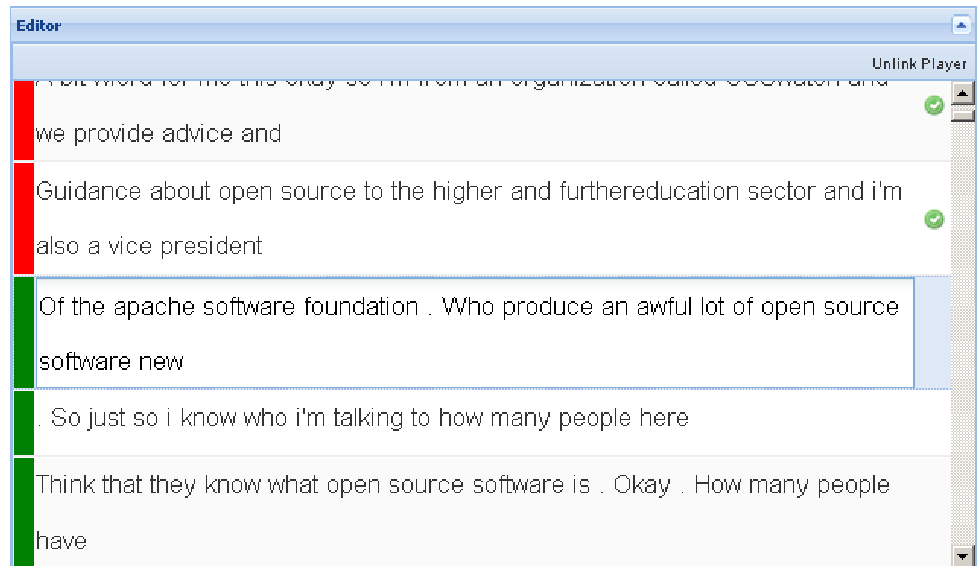 Figure 1: The Synote interface, showing the synchronized transcript and the editable 'utterance' panel on the right.
Why This Works: The "Study-to-Correct" Synergy
The paper highlights a fascinating pedagogical insight: editing transcripts is a form of deep learning.
Students who corrected lecture transcripts performed better on tests than those who just watched the video. This creates a "Double Win":
- The University gets high-quality, free captions for accessibility compliance.
- The Student engages more deeply with the material and earns academic credits or points.
Experimental Setup
The authors are currently testing the best ways to present these utterances for correction. Should they be split by time, silence, or word count? Should the system auto-capitalize the first word? These UX decisions are critical to reducing the friction of correction.
Critical Insight & Conclusion
This work represents a pivot from purely algorithmic solutions to Human-AI Collaboration. Instead of waiting for ASR to reach 100% accuracy (which may never happen given the diversity of human speech), we should focus on building interfaces that make human intervention effortless.
The limitation of this 2011 work, by modern standards, is its reliance on "exact matches" for consensus. In the era of Large Language Models (LLMs), one could imagine an AI "moderator" that judges if two human corrections are semantically equivalent even if punctuation differs. However, the fundamental takeaway remains: the most sustainable way to fix technology is to integrate its fix into the natural workflow of the end-user.