
Bridging the Gap: Integrating Crowdsourcing into Professional Crisis Management
17873_Crowdsourcing and crowdtasking in crisis management Lessons learned from a field experiment simulating a flooding in the city of the Hague.
This paper presents a comprehensive framework for integrating crowdsourcing tools (GDACSmobile, CrowdTasker, DEWS) into professional crisis management workflows. It defines four critical roles—Observing, Tasking, Informing, and Alerting—and validates their efficacy through cross-stakeholder pilot evaluations involving volunteers and professionals.
TL;DR
Mobile technology has turned every citizen into a potential first responder. This paper evaluates a suite of tools—including GDACSmobile and CrowdTasker—that bridge the gap between spontaneous citizen reports and professional crisis management. By categorizing interactions into four pillars—Observing, Tasking, Informing, and Alerting—the researchers provide a blueprint for high-precision, crowd-augmented disaster response.
The Motivation: From Passive Noise to Active Intelligence
During a crisis, professional agencies are often "blind" to the hyper-local reality on the ground. While citizens post updates on social media, this data is often too noisy or unstructured for official use. Conversely, citizens lack a direct channel to receive verified instructions or specific tasks. The core problem is a mapping gap: how do we turn a volunteer with a smartphone into a reliable extension of a professional emergency team?
Methodology: The Four-Pillar Framework
The authors move beyond simple data collection. They categorize the interaction between the "Crowd" and the "Crisis Center" into four distinct functional roles:
- Observing: Citizens provide ground-truth data (photos, GPS coordinates).
- Tasking: Professionals send specific requests to volunteers (e.g., "Check the water level at Bridge X").
- Informing: Providing citizens with verified updates to prevent panic.
- Alerting: Targeted, high-priority notifications about immediate threats.
System Architecture mapping
The researchers mapped specific tools to these roles to fill existing operational gaps:
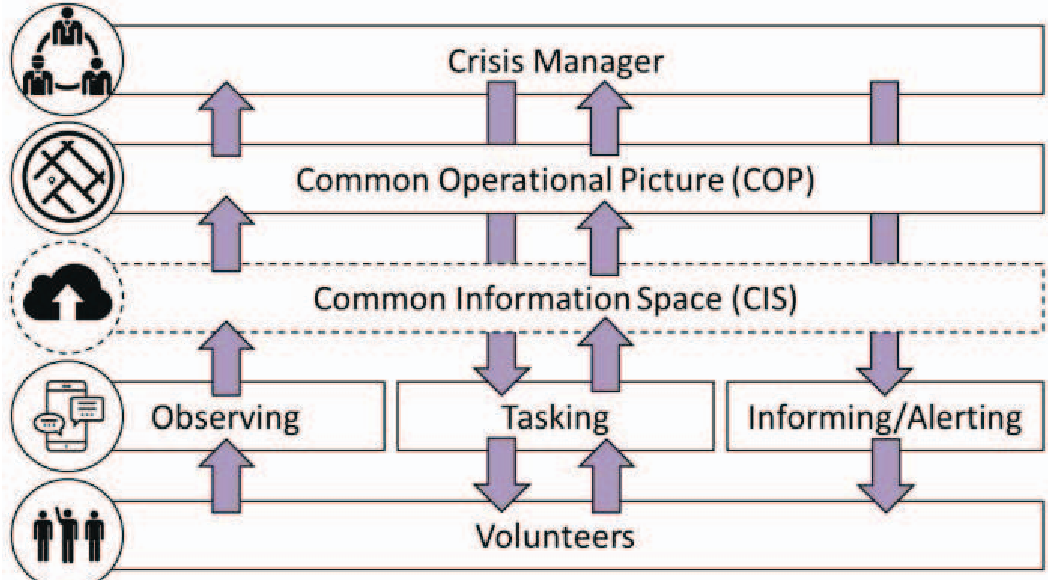
The table above illustrates how tools like CrowdTasker and GDACSmobile are assigned to fill specific information and tasking gaps.
Experimental Validation: Multi-Stakeholder Perspectives
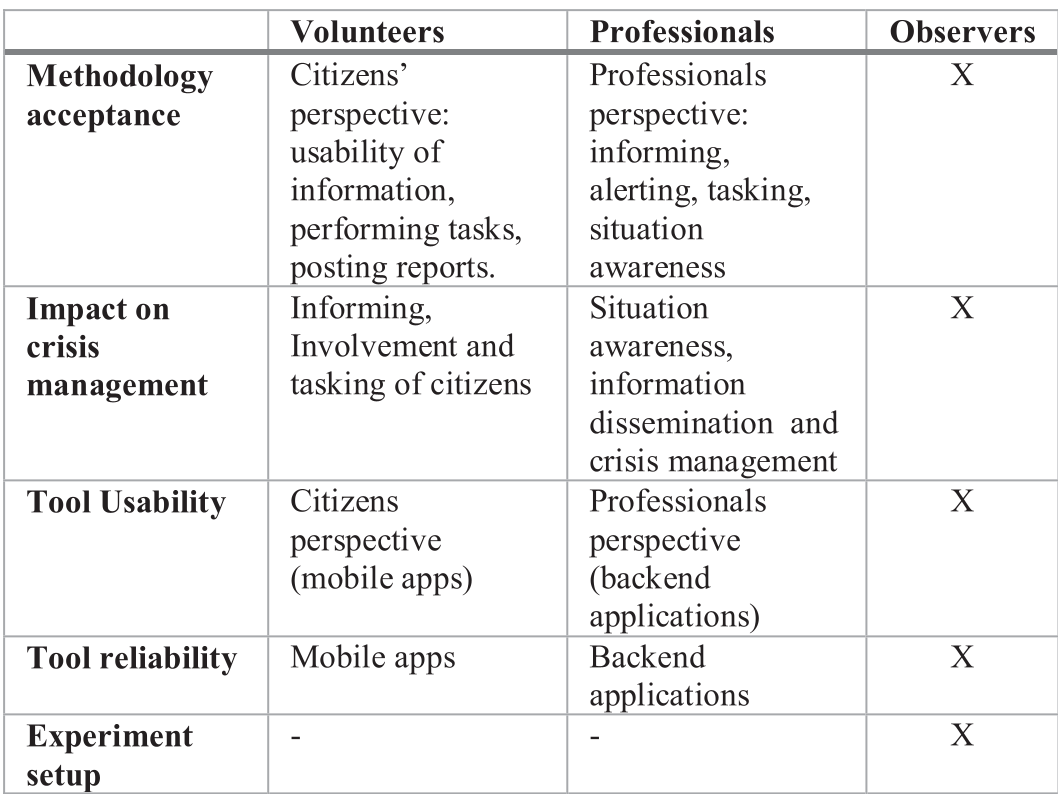
The study utilized a comprehensive evaluation matrix, distinguishing between the needs of Volunteers, Professionals, and Observers.
- For Professionals: The focus was on Situational Awareness. Did the crowd data help them make better decisions?
- For Volunteers: The focus was on Usability. Was the app intuitive enough to use under the stress of a crisis?
Key Results and Insights
The pilot tests demonstrated that bidirectional communication is the "holy grail" of crisis management.
- Tasking Accuracy: Using CrowdTasker, professionals could assign specific geographical zones to volunteers, significantly reducing redundant reporting.
- System Reliability: While the mobile apps (frontend) were praised for usability, the backend applications required robust reliability to handle the surge of professional queries during peak crisis periods.
Critical Analysis & Future Outlook
Summary: This work successfully systematizes the "Chaos" of citizen engagement. By providing a structured framework for roles like "Tasking," it moves the needle from "Citizen Science" to "Professional Crowd-Intelligence."
Limitations: A primary challenge remains the trust and verification of crowd data. While the "Observing" role is efficient, the framework still requires manual validation by professionals, which can create a bottleneck if the volume of data is too high.
Future Work: The integration of AI for automated verification and "Information Triage" is the next logical step. As these tools evolve, the line between "Volunteer" and "Professional" will blur, creating a more resilient, community-based emergency response ecosystem.