
Crowdsourcing Heritage: Unlocking the Cognitive Surplus of the Global Museum
Crowdsourcing in the cultural heritage domain: opportunities and challenges
This paper establishes a comprehensive typology for crowdsourcing in the Cultural Heritage domain (GLAMs). It introduces a six-category classification system—Correction, Contextualisation, Complementing, Classification, Co-curation, and Crowdfunding—and maps these activities against the Digital Content Life Cycle to demonstrate how public participation can transform institutional workflows.
TL;DR
Cultural heritage institutions are sitting on a goldmine of data they cannot process alone. This paper provides a strategic roadmap for GLAMs (Galleries, Libraries, Archives, and Museums) to transition from closed silos to "Open, Connected, and Smart" ecosystems by outsourcing labor-intensive tasks like transcription, tagging, and curation to the public.
The "Dark Archive" Problem: Why Professionals Aren't Enough
For decades, the standard for GLAMs was the "In-Situ" culture: professionals maintained absolute control over acquisition and metadata. However, mass digitization has created a bottleneck. Optical Character Recognition (OCR) for historical newspapers is often riddled with errors, and curators simply don't have the man-hours to describe every obscure artifact.
The authors argue that the "cognitive surplus"—the billions of hours people spend on passive activities like watching TV—is a shared global resource that heritage sites must tap into. The challenge isn't just "getting help"; it's doing so without eroding the institution's reputation for accuracy and authority.
Methodology: The Six Pillars of Participation
The paper categorizes crowdsourcing into six distinct types, ensuring that "participation" is more than just a buzzword:
- Correction and Transcription: Fixing OCR errors in newspapers or transcribing handwritten manuscripts (e.g., Transcribe Bentham).
- Contextualisation: Adding stories or wiki-style entries to objects (e.g., 1001 Stories Denmark).
- Complementing Collection: Inviting the public to submit their own artifacts (e.g., the UK_Soundmap).
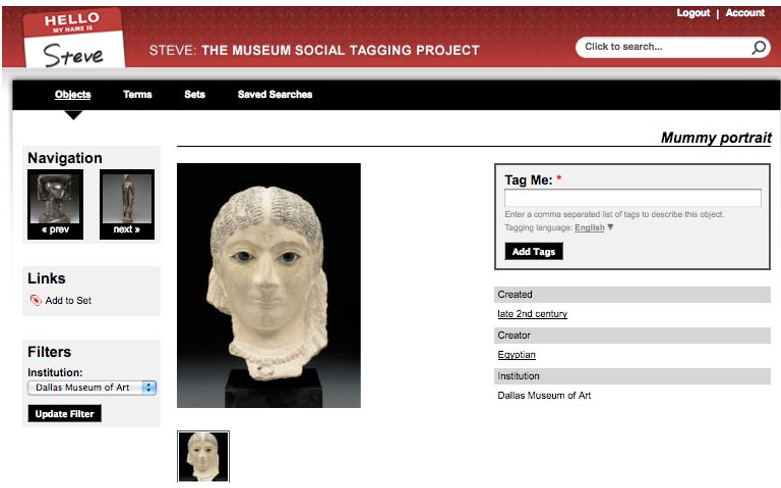
- Classification: Social tagging to improve searchability (e.g., steve.museum).
- Co-curation: Letting the public vote on/select exhibition themes (e.g., Brooklyn Museum’s Click!).
- Crowdfunding: Pooling community resources for acquisitions (e.g., the Louvre’s purchase of Cranach).
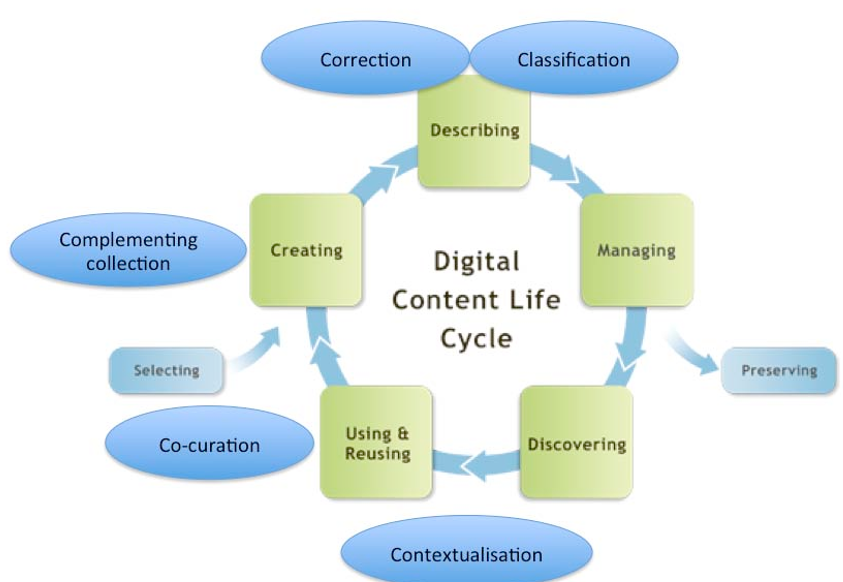
The core insight is that crowdsourcing isn't a separate activity; it maps directly onto the Digital Content Life Cycle, impacting everything from creation to reuse.
Critical Insight: Wisdom vs. Noise
One of the most profound findings is the impact of Social Tagging. In the "steve.museum" project, researchers found that 86% of the tags submitted by users were not present in the professional museum documentation. This suggests that professionals and amateurs "see" objects differently. While a curator might use technical art-history terms, the crowd uses descriptors that make the collection discoverable to the general public.
To combat "noise" or poor quality, the authors point to projects like Waisda?, a video labeling game. By requiring two players to agree on a tag (Mutual Agreement), the system automatically filters out spam and ensures a high degree of metadata reliability without manual professional oversight.
Strategies for Success: Motivation and Quality
How do you keep users coming back? The authors emphasize Intrinsic Motivation:
- Connectedness: Making users feel like "posse members" or part of an elite community of volunteers.
- Generosity: Explicitly stating that their contributions help preserve history "for the common good."
- Gamification: Using competition and rewards (as seen in Waisda?) to turn labor into play.
Critical Analysis & Conclusion
While the paper is optimistic, it doesn't shy away from the "Cult of the Amateur" critique—the fear that opening the gates will lead to a flood of misinformation. However, the evidence suggests that the benefits of relevance, visibility, and discoverability far outweigh the risks of a few bad tags.
Takeaway for the Future: GLAMs must stop being "fortresses of knowledge" and start being "platforms for conversation." By blending Semantic Web technologies with human intuition, the heritage domain can ensure its long-term survival in the hyperconnected age.
Future Outlook
As we move toward 2026, the next frontier will likely be the marriage of AI and Crowdsourcing, where human "e-volunteers" don't just create data, but audit and refine the outputs of Large Language Models and computer vision systems trained on our cultural history.