
Crowdsourcing in Crisis: Balancing Humanitarian Efficacy with Data Sovereignty
Crowdsourcing collection of data for crisis governance in the post-2015 world: potential offers and crucial challenges
This paper explores the integration of crowdsourcing into crisis governance and humanitarian aid in the post-2015 era. It highlights the transition from historical "outsourcing" to modern digital platforms like Ushahidi and Google Crisis Map, while proposing a regulatory framework to mitigate privacy and data protection risks.
TL;DR
In the wake of global crises, "the crowd" has become the ultimate first responder. This paper examines the evolution of crowdsourcing from the 1714 Longitude Prize to modern platforms like Ushahidi, arguing that while crowdsourcing accelerates disaster response, it creates a dangerous "surveillance state" vacuum. The author proposes a comprehensive regulatory framework to protect citizens in a post-Snowden world.
The Motivation: High Stakes, Low Privacy
The core tension in crisis governance is the Reaction-Privacy Paradox. Rapid response requires granular, real-time data (GPS, photos, victim IDs), but this same data is a goldmine for law enforcement and state surveillance.
The author highlights a disturbing trend: tools designed for safety, such as the LEEDIR app in the US or Internet Eyes in the UK, often mandate the collection of communication-related metadata and GPS data without providing pathways for anonymity.
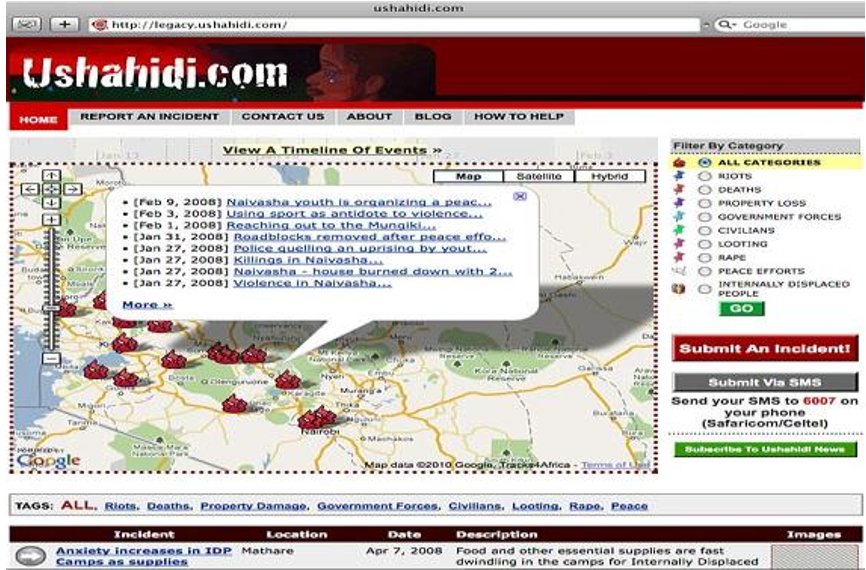 Figure 1: The 2008 Post-Election Violence Mapping in Kenya, a landmark use of the Ushahidi platform.
Methodology: The Global Safety Audit
To understand the "Safety Level" of current crowdsourcing, the researcher conducted a cross-jurisdictional analysis:
- The EU Standard: The GDDP (now GDPR transition era) provides a "Right to be Forgotten" and requires explicit consent, setting a benchmark for data portability.
- The BRICS Perspective: Countries like India and China lack comprehensive personal data protection laws, often prioritizing "National Security" to intercept digital communications lawfully or otherwise.
- The Surveillance Reality: The paper cites the PRISM program and RIPA (UK) as examples where governments bypass service providers to access raw citizen data directly.
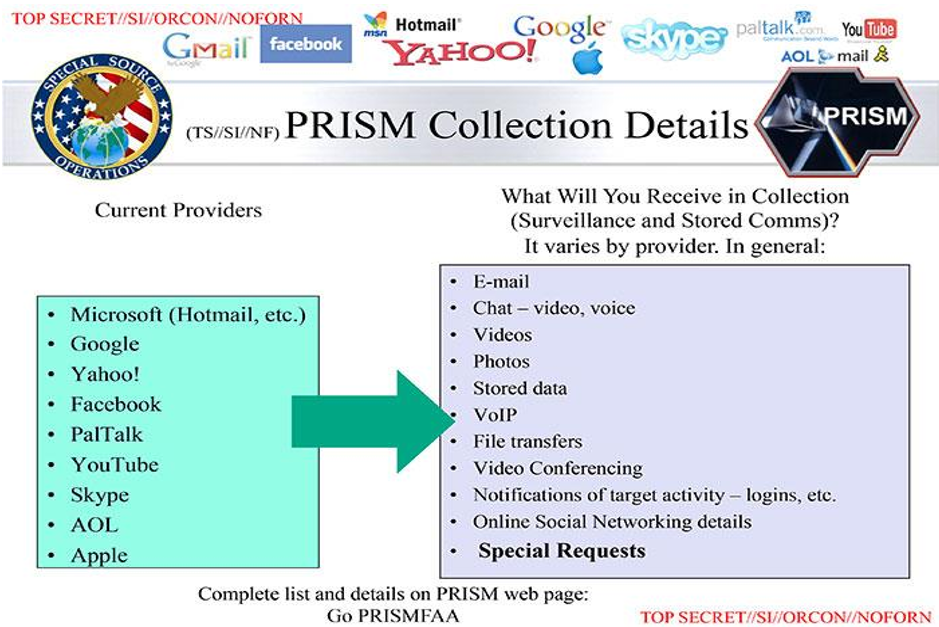 Figure 2: The architecture of data collection through major tech companies as revealed by the PRISM disclosures.
Key Results: Massive Data, Fragile Security
The scale of modern crowdsourcing is staggering. In just 14 hours during Typhoon Yolanda, over 182,000 tweets were collected. However, volume does not equal security. The author points to the Stand By Task Force (SBTF) findings in 2012, which revealed that even non-technical practitioners could "scrape" entire election monitoring datasets, including personally identifying information (PII).
| Deployment | Number of Reports | Impact |
|---|---|---|
| Queensland Flood | 99,772 | High |
| Ushahidi Haiti | 3,584 | Transformative |
| Sinsai.info | 4,000 | Critical |
The Solution: A New Regulatory Framework
The paper concludes by shifting from "What is happening?" to "How do we fix it?". It introduces a multi-tiered guideline:
- For Developers: Integrate Privacy Enhancing Technologies (PET) directly into the UI, allowing "Anonymous" reporting and location obfuscation.
- For Governments: Establish a "Judicial Authorization" requirement. No data should be accessed for law enforcement purposes without a specific warrant, even during crises.
- For Users: Treat online footprints as permanent; users must demand email/phone contact options that minimize physical risk in man-made crises (e.g., political conflicts).
Critical Analysis & Future Outlook
While the paper provides a robust legal roadmap, it overlooks the Technological Arms Race. As states deploy more sophisticated AI to de-anonymize crowdsourced data, simple PETs may not suffice. The future of crisis governance likely lies in Decentralized Architectures where no single entity—government or NGO—holds the "master key" to the crowd's data.
Takeaway: Data is the lifeblood of crisis response, but without a skeleton of legal protection, it becomes a weapon for surveillance.