
Trial-and-Learn: Why "Winner-Takes-All" Fails in Data Science Crowdsourcing
Crowdsourcing Data Science for Innovation
This paper introduces the "Trial-and-Learn" model to analyze data science crowdsourcing contests, moves beyond traditional innovation frameworks. It demonstrates that the seeker can maximize utility by using a "Top K" award structure combined with ensemble learning, rather than the conventional "winner-takes-all" approach.
TL;DR
In the world of data science contests like Kaggle, the traditional "Winner-Takes-All" model is no longer the gold standard. This paper introduces the "Trial-and-Learn" project type, proving that seekers gain more utility by rewarding the Top 3 solutions and combining them via ensemble learning. It also reveals a high "expertise threshold": only those with significant skills participate, and the best experts are actually the ones who try the hardest.
Beyond Ideation: The Unique Nature of Data Science
Crowdsourcing isn't just for logo design (Ideation) or simple clinical trials (Trial-and-Error). Data science contests have distinct characteristics:
- Multiple Submissions: Contributors iterate and learn from each attempt.
- Heterogeneous Expertise: Skill levels vary wildly and directly impact the "floor" of a solution's quality.
- Ensemble Potential: A seeker doesn't just want the best model; they want three models they can average to create a "super-model."
Existing research suggested that rewarding only the first place maximizes effort. However, this paper argues that in data-driven contexts, the ability to aggregate solutions changes the math.
Methodology: The Trial-and-Learn Model
The authors define a contributor's quality () as: Where is the Expertise and is the Stochasticity (luck/experimentation). This captures the "rugged landscape" of machine learning where talent sets your baseline, but repeated experiments (submissions) help you find the global maximum.
The Ensemble Shift
The most profound shift is in the Seeker's Utility. Instead of just looking at the top score, the seeker calculates utility based on the combined accuracy of winners. Using a Logit choice probability mapping, they show that three good models are often better than one "perfect" model.
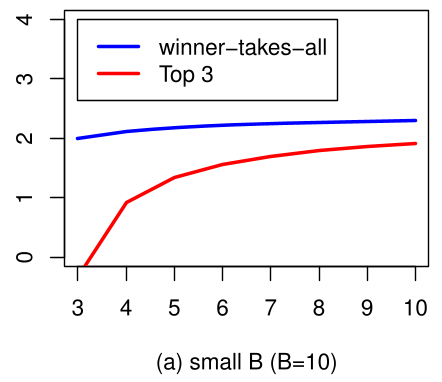 Fig 1: As the number of contributors (n) increases, the utility gained from the Top 3 ensemble (V') eventually overtakes the single best solution (V).
Key Findings: Expertise and Incentives
- The Expertise Threshold: There is a minimum level of skill required to even enter. If the "skill gap" between you and the top players is too wide, it's mathematically irrational to participate.
- Effort Follows Expertise: Contrary to some beliefs that experts "breeze through," the model proves that higher expertise leads to more submissions. Experts have a higher probability of winning, which justifies the cost of repeated attempts.
- The "Top 3" Advantage: Awarding multiple places attracts more participants (Corollary 1) and provides the raw material needed for ensemble methods.
Empirical Evidence from Kaggle
The authors analyzed 21 Kaggle competitions involving over 11,000 teams. The data confirmed:
- Award Amount: Directly increases the number of participants.
- Expertise Correlation: A team’s mean historical performance strongly correlates with their number of submissions—experts are indeed the "hardest workers" in the room.
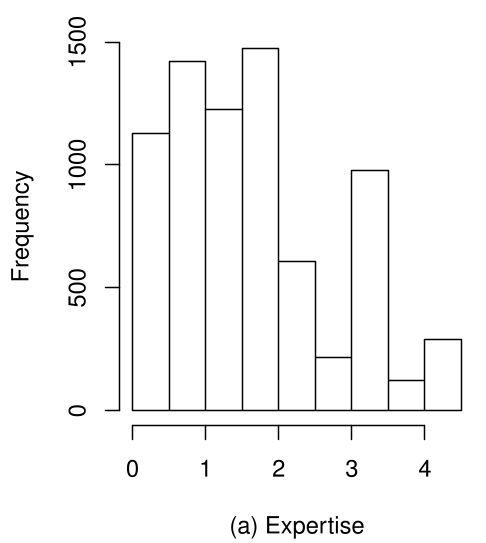 Fig 2: Distributions showing that while many participate, those with higher expertise clusters tend to exert higher effort (more submissions).
Critical Insight: The Seeker's Strategy
For organization leaders, the takeaway is clear: Don't be stingy with the prize pool distribution.
- Setting an award amount around (balancing marginal quality gain against cost) is optimal.
- Using a "Top 3" or "Top K" structure is superior because the synergistic value of ensembling models compensates for any slight reduction in "peak" individual effort.
Limitations and Future Outlook
The study assumes "no feedback," yet Kaggle’s live leaderboards are central to the experience. Real-time ranking creates a "psychological tug-of-war" that likely intensifies effort near the prize thresholds. Future research into dynamic feedback and multi-contest selection (how contributors choose between simultaneous projects) will further refine how we design the engines of open innovation.
Summary Conclusion
The "Trial-and-Learn" framework proves that data science innovation is a unique beast. Success isn't just about finding one genius; it's about creating an incentive structure that encourages a crowd of experts to experiment repeatedly and then harvesting the collective intelligence of the top tier.