
Breaking the Manual Bottleneck: Enterprise Crowdsourcing for Robust Document Digitization
Crowdsourcing in the Document Processing Practice
This paper introduces a specialized framework for document processing crowdsourcing, centered on the SmartKey methodology and the CONCERT engine. It optimizes OCR post-processing by aggregating low-confidence characters into visual "carpets" for rapid human validation, achieving significant throughput while maintaining enterprise-grade quality.
TL;DR
Despite the rise of Deep Learning-based OCR, manual validation remains the "last mile" for high-accuracy enterprise needs. This paper details a visionary framework for Virtual Service Delivery Centers (VSDC) that transforms the tedious task of document correction into a high-speed, privacy-preserving crowdsourcing engine. By abstracting data into "character carpets," they achieve massive productivity gains and rigorous quality assurance.
The Motivation: Why OCR Still Needs Humans
Automatic character recognition often hits a wall where the risk of substitution (e.g., misreading a '5' as an 'S' in a bank check) is too high. Traditional correction involves a human looking at the original image and typing the fix—a process that is slow, expensive, and reveals private information.
The authors identified two major roadblocks to scaling this via the crowd:
- Privacy: How do you let an anonymous worker see a tax form without leaking the owner's identity?
- Quality: How can you trust an unvetted online worker to achieve 99.9% accuracy?
Methodology: The SmartKey & VSDC Approach
1. The Power of Decontextualization (SmartKey)
Instead of showing a worker a full sentence or form, the system extracts only the characters where the OCR engine is "unsure." It groups all images identified as a "3" into a single grid.
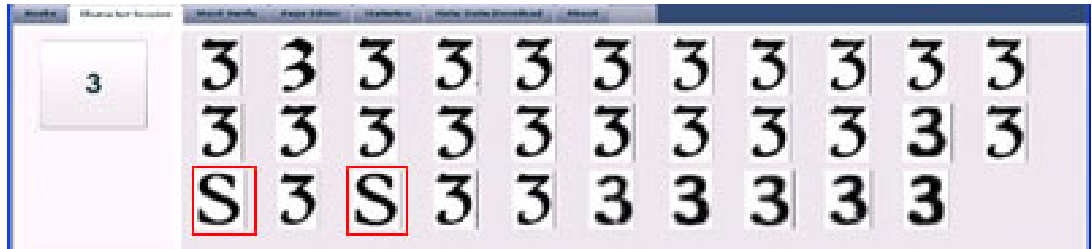
Why this works:
- Throughput: Validating 30 characters on one screen confirms 30 different documents simultaneously.
- Privacy: A worker sees a page of "3"s but has no idea if they belong to a birth date, a social security number, or a bank balance.
2. Algorithmic Quality Control
To manage the "crowd," the VSDC acts as an intelligent broker. It utilizes two core mechanisms:
- Golden Questions: The system injects known errors (pseudo-random errors) into the worker's session. If the worker misses them, their accuracy score () drops immediately.
- Redundancy Math: If a customer requires an error rate lower than , but a single worker has an error rate , the system sends the task to two workers. Under the assumption of independent errors, the new error rate becomes , satisfying the SLA.
3. The CONCERT System
The COoperative eNgine for Correction of ExtRacted Text (CONCERT) implements these ideas specifically for book digitization. It segments workloads based on difficulty: simple digits go to the general crowd, while complex words or medical terms are routed to workers with verified specialized skills.
Critical Analysis & Conclusion
The genius of this work lies in its structural layout of tasks. By moving from a "document-centric" view to a "character-centric" view, the authors solved the privacy problem not with encryption, but with visual abstraction.
Limitations:
- Context Loss: Some characters depend heavily on context (e.g., distinguishing "O" from "0"). While the authors mention "Word Sessions" as a fallback, the efficiency drop-off at that stage isn't fully quantified.
- Independence Assumption: The quality model assumes workers make errors independently. However, if a character image is genuinely ambiguous (a smudge), multiple workers will likely fail in the same way, breaking the logic.
Takeaway for Practitioners: When designing AI-human loops, don't just ask how the human can fix the AI. Ask how you can reformat the data to make the human's job faster and safer. Decontextualization is a powerful tool for scaling enterprise tasks to the public crowd.