
Beyond the Metadata: Why Your Emotion Recognition Model Might Be Hallucinating Truth
Investigating Crowdsourcing as a Method to Collect Emotion Labels for Images
This paper investigates the reliability of crowdsourcing for image emotion labeling, comparing the Plutchik Wheel (PW) and Geneva Emotion Wheel (GEW) models. It reveals critical discrepancies between active crowd-labeling and the "passive" harvesting of social media tags, while demonstrating that task design—such as interface orientation—significantly influences outcomes.
TL;DR
Is a photo tagged "#joy" on Instagram actually joyful to a viewer? New research from Tomsk Polytechnic and University of Trento reveals a startling gap in how we build AI datasets. The study shows that passive crowdsourcing (harvesting social tags) rarely matches human emotional responses, and even the way you rotate a labeling wheel can "trick" participants into choosing different emotions.
Positioning: This work is a crucial "reality check" for Computer Vision and Affective Computing, challenging the validity of large-scale datasets harvested from social media.
The Problem: The "Ground Truth" Illusion
In the race to build SOTA emotion recognition models, researchers typically look for the path of least resistance: scraping millions of images from Flickr or Instagram using their associated hashtags as labels. This is known as passive crowdsourcing.
The authors argue this is dangerous for two reasons:
- Subjectivity: Unlike identifying "a cat," feeling "nostalgia" is deeply personal.
- Context Gap: A social media tag reflects the uploader's context (e.g., "having fun at a party"), while a labeling worker only sees the image itself, leading to a massive misalignment.
Methodology: Wheels of Emotion
The researchers compared two psychological frameworks for structured tagging:
- Plutchik Wheel (PW): 8 basic emotions with varying intensities.
- Geneva Emotion Wheel (GEW): Emotions mapped along dimensions of Valence and Dominance.
They didn't just ask "which is better?" They asked: "Does the interface itself change the data?"
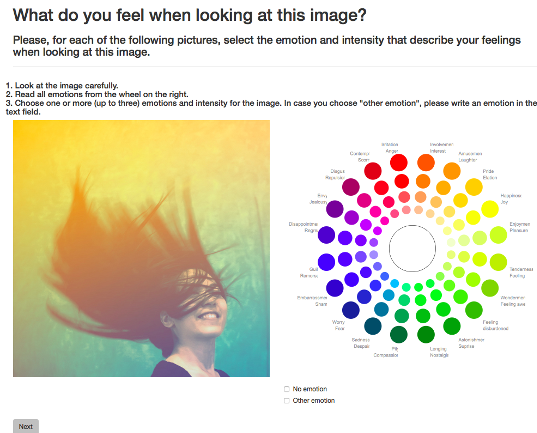 Figure 1: The experimental setup using the Geneva Emotion Wheel (GEW) for active labeling.
Key Findings: The Design Sensitivities
1. The Rotation Effect
In one of the most intriguing parts of the study, the team rotated the labeling wheels by 90, 180, and 270 degrees. Theoretically, a "happy" image should be labeled "happy" regardless of where that button sits.
The Reality: The rotation had a statistically significant impact (). Workers were influenced by the physical position of the labels relative to their cursor or visual starting point, suggesting that "neutral" UI design for emotions is nearly impossible.
2. Active vs. Passive: The Great Disconnect
The most damning evidence against current SOTA datasets came from comparing Instagram/Flickr tags (Passive) to Worker labels (Active).
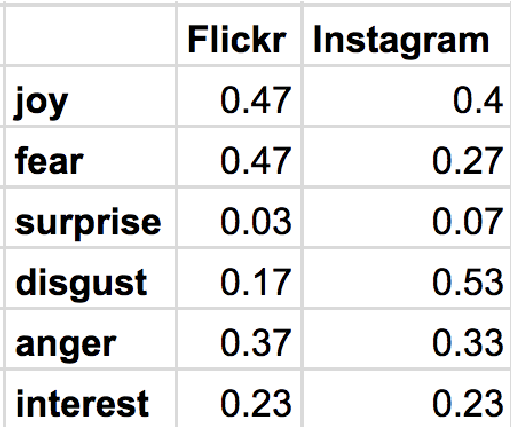 Table 1: Hit rates showing how often social media tags matched crowd-worker emotional responses.
The "Hit Rate" for Surprise was as low as 0.03 (3%) on Flickr. Even the most "obvious" emotion, Joy, only reached a 47% match. This proves that a vast majority of social media tags do not represent the emotional reaction of an objective viewer.
Critical Analysis: Why This Matters for AI
The study reports a Fleiss’ kappa of 0.12 to 0.14, indicating "slight agreement." In the world of objective labeling (e.g., "is this a stop sign?"), this would be considered a failed experiment. In the world of emotions, however, it confirms that there is no single ground truth.
Limitations
- The study used a relatively small set of 32 images for the primary comparison.
- Worker motivation (or boredom) might contribute to the rotation bias, which needs further isolation from emotional response.
Future Outlook
This paper serves as a warning for the next generation of Multimodal LLMs. If we train models on social media scrapes, we aren't teaching them emotions; we are teaching them social media tagging behavior. Future research must move toward "distributional ground truths," where an image isn't labeled "Happy," but rather "40% Joy, 10% Interest, 50% Neutral."
Conclusion
Emotion recognition is perhaps the most human task we've assigned to machines. This research proves that we cannot take shortcuts. If the interface design and the source of our labels are fundamentally biased, our AI will be too.
Takeaway: Stop harvesting, start asking.