
Crowdsourcing the Emotional Wardrobe: Bridging the Digital Sensorial Gap
Crowdsourcing an emotional wardrobe
This paper presents "Wardrobe Malfunction," a crowdsourcing platform designed to bridge the sensorial gap in online fashion by collecting multi-modal descriptions of clothing. By integrating subjective self-reports (tactile/emotional words), visual imagery (moodboard textures), and implicit physiological data, the study establishes a SOTA framework for communicating the complex "feel" of garments in digital environments.
TL;DR
Researchers from UCL and Brunel University have developed a platform called Wardrobe Malfunction that uses crowdsourcing to capture the "un-capturable": the tactile and emotional experience of clothing. By combining a refined multi-modal language with biometric visualizations, the project transforms static online shopping into a rich, shared sensory experience.
Contextual Positioning
In the landscape of Human-Computer Interaction (HCI), this work moves beyond traditional recommendation engines (like "people who bought this also liked...") and enters the realm of Affective Design. It is a pioneering attempt to apply "Ambiguity in Design" to the fashion industry, seeking to replace cold clinical data with evocative, crowd-sourced human perception.
The Core Problem: Sensorial Poverty
When we shop online, we are "sensory-blind." We can see the color and the price, but we cannot feel the crispness of a cotton shirt or the organic weight of a wool sweater. Textual descriptions like "100% Cotton" are often too technical and fail to convey the "hand feel."
The authors argue that this gap leads to a lack of connection between the designer's intent and the consumer's experience. Current social networks for fashion focus on looks, but ignore the feel.
Methodology: A Multi-Modal Language for Touch
To solve this, the researchers built a prototype website that allows users to describe garments using three distinct layers of information:
- Lexical Layer: A curated list of 13 emotions (e.g., Proud, Interested, Amused) and 38 tactile words (e.g., Clingy, Fine, Spongy).
- Visual Layer: Moodboard-style images that represent textures—using ice cubes to represent "Cool" or weathered stone for "Rough."
- Physiological Layer: Using an Affective Q-sensor, the system visualizes the wearer's physiological state through animated shapes.
The Architecture of Perception
The following table illustrates how the system prompts users to "digitize" their physical sensations.
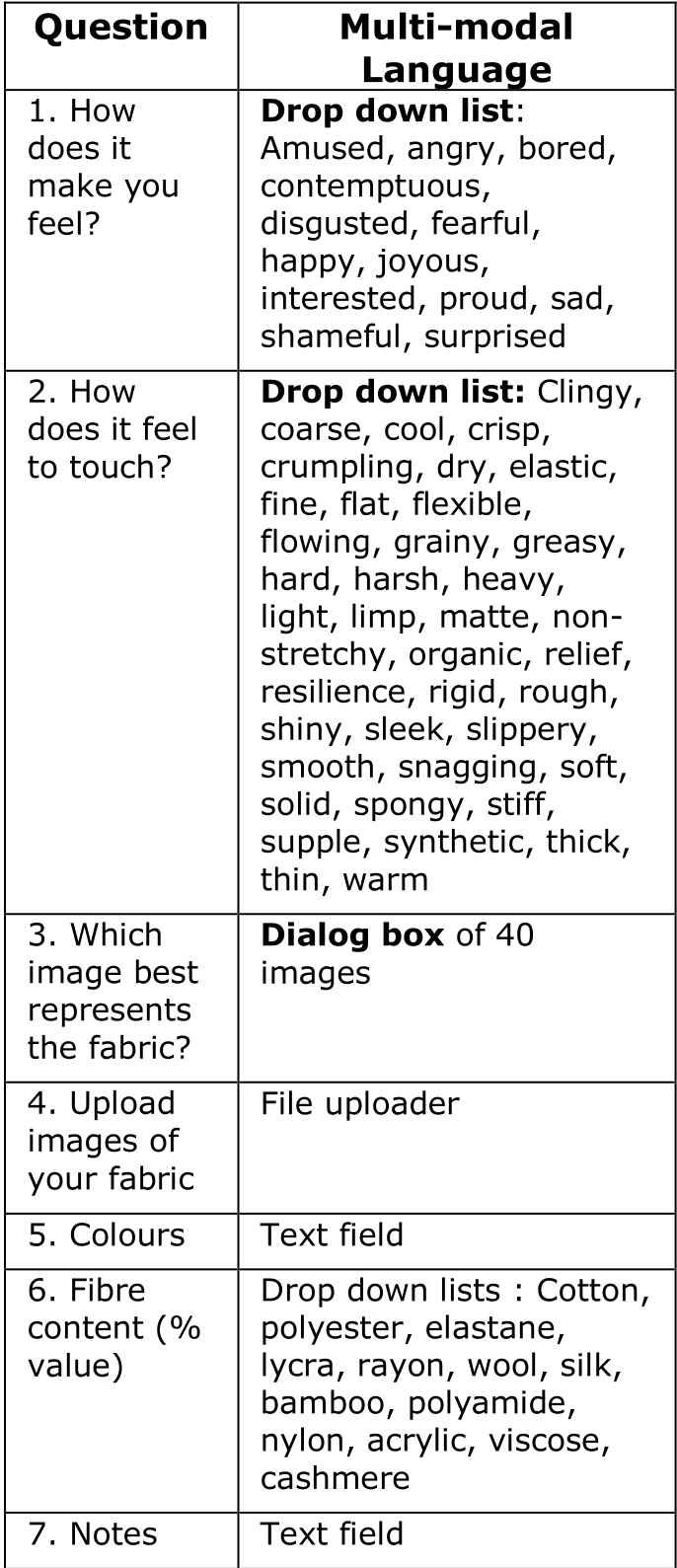
The genius of the method lies in the Wizard-of-Oz implementation: the animations shown to users (triangles changing speed and color) were actually mapped to their word choices, making them believe their inner physiological state was being shared. This revealed a deep human desire to use biometrics as a "truth-telling" mechanism for subjective feelings.

Experimental Insights: Ambiguity vs. Data
The study found a fascinating tension:
- The Power of Imagery: Participants used texture images (like the "ice cubes") to infer what kind of person would wear a garment.
- The Desire for Data: 95% of users wanted to see their own physiological data, but many (contrary to the authors' expectations) wanted scientific graphs instead of abstract animations. They wanted "proof" of their feelings.
- Privacy & Sociality: While users were wary of sharing their biometrics with strangers, 60% were happy to share within their social circles to help friends make better "outfit decisions."
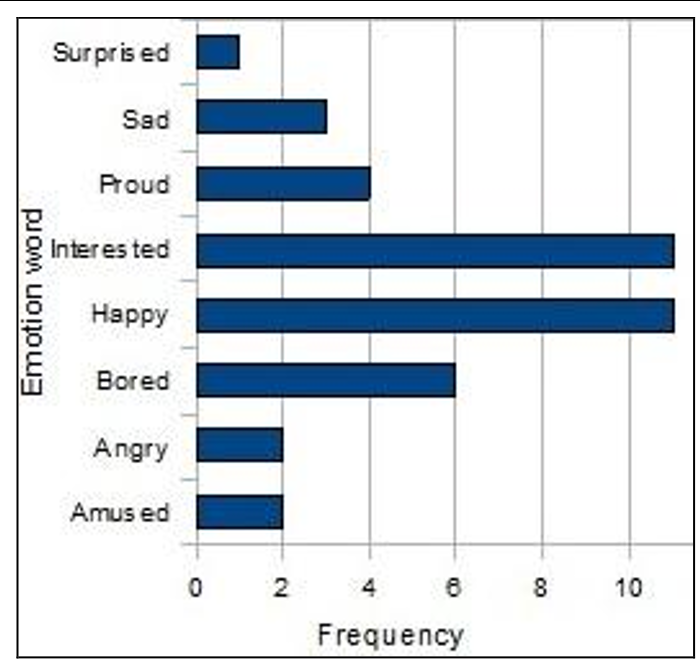 Figure: The most frequent emotions reported were "Happy," "Interested," and "Proud," highlighting the positive social signaling of clothing.
Critical Analysis & Future Outlook
Takeaway: This paper proves that "The Crowd" is capable of describing complex sensory data if given the right multi-modal tools. It shifts fashion from a 2D visual task to a 3D emotional experience.
Limitations: The study notes that a single emotion word is often too simplistic. Future iterations would benefit from a more fluid "emotion taxonomy" mined from real fashion forums. Furthermore, the ethical implications of "physiological sharing" remain a hurdle—identity and anonymity must be carefully balanced.
The Future: Imagine an Amazon or ASOS where, alongside reviews, you see a "Sensory Heatmap" generated by hundreds of users. This research is the first step toward a Digital Sensoria, where the "feel" of a fabric is as searchable as its price.