
EMMA: Scaling Empathetic Intelligence via Crowdsourced Mood Recognition
1449_Crowdsourcing Empathetic Intelligence The Case of the Annotation of EMMA Database for Emotion and Mood Recognition.
The paper introduces EMMA, a novel multimodal database for emotion and mood recognition consisting of 180 long, acted videos. It leverages large-scale crowdsourcing to obtain both continuous emotional traces (via G-trace) and discrete mood annotations (via SAM and AffectButton), achieving a reliable ground truth for long-term affective states.
TL;DR
Researchers from Delft and Eindhoven have released the EMMA database, a rich multimodal dataset (Face, Body, Kinect) specifically designed for mood recognition. By pivoting from short "emotional bursts" to long-form "pervasive moods," and proving that crowdsourced non-experts can match expert performance in affective labeling, this paper provides a blueprint for scalable ground-truth generation in affective computing.
Background: Why Mood and Not Just Emotion?
In the world of AI-driven environments (e.g., smart care centers or empathetic lighting), reacting to every micro-expression or fleeting emotion is a recipe for jittery, unpleasant adaptation.
The authors argue that Mood—a lower-intensity, longer-lasting state—is the far more important signal for well-being systems. However, mood is notoriously difficult to capture because:
- It is subtle and manifests over minutes, not seconds.
- Annotating minutes of video is exhausting for experts.
- Most datasets (like IEMOCAP or SEMAINE) are optimized for interactions, not passive, daily-life behavior.
Methodology: The EMMA Database
The EMMA database consist of 180 improvised videos. Unlike scripted content, these videos involve actors performing mundane tasks (reading, eating) after undergoing Mood Induction Procedures (MIP).
Multi-Sensory Approach
One of the key strengths of EMMA is its sensory variety:
- Close-up facial camera: Capturing micro-expressions.
- Scene camera: Capturing global posture.
- Kinect Skeleton Data: Providing 3D joint coordinates (x, y, z) for postural analysis without the need for high-cost MoCap systems.
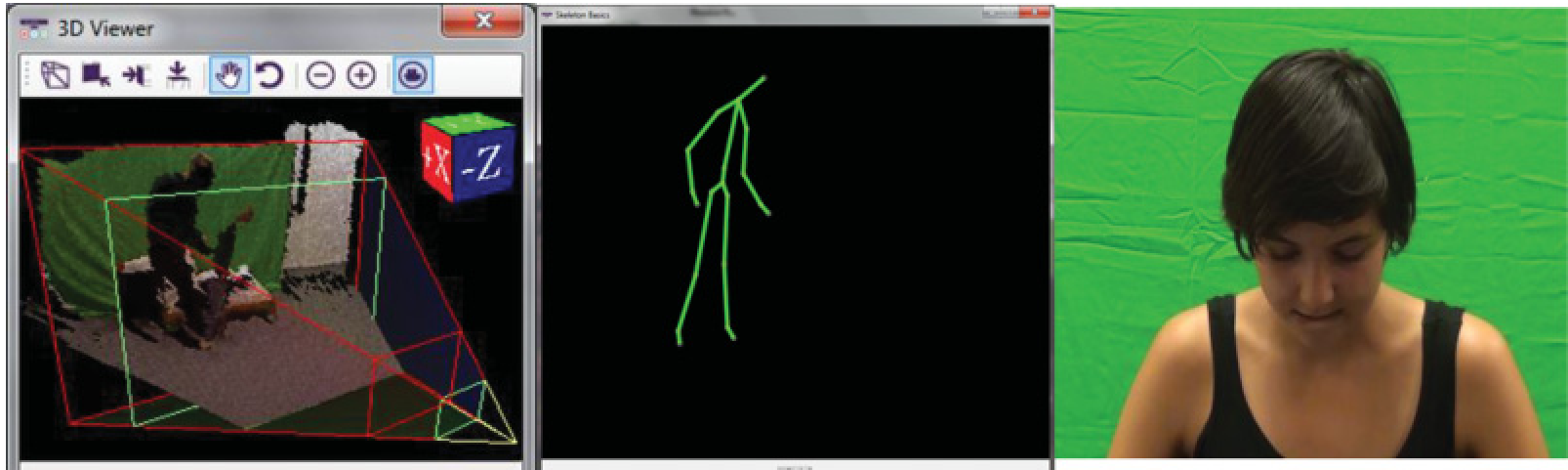 Figure 1: Examples of the facial, scene, and Kinect joint data captured in the EMMA database.
The "Crowd" vs. The "Experts"
The most controversial and interesting part of the Methodology is the use of Microworkers to provide the ground truth. To ensure this didn't result in "garbage data," the authors designed a sophisticated filtering cascade.
The Filtering Cascade
- Qualification Test: Only workers who could pass a pre-test with "obvious" emotional clarity videos were allowed.
- Gold Standard Content Questions: Three objective questions (e.g., "What was the actor doing?") to ensure they actually watched the video.
- Cross-Tool Consistency: Workers had to rate using SAM (Self-Assessment Manikin), the AffectButton, and categorical words. If these didn't align (e.g., scoring high valence on SAM but picking "negative" in categories), the data was flagged.
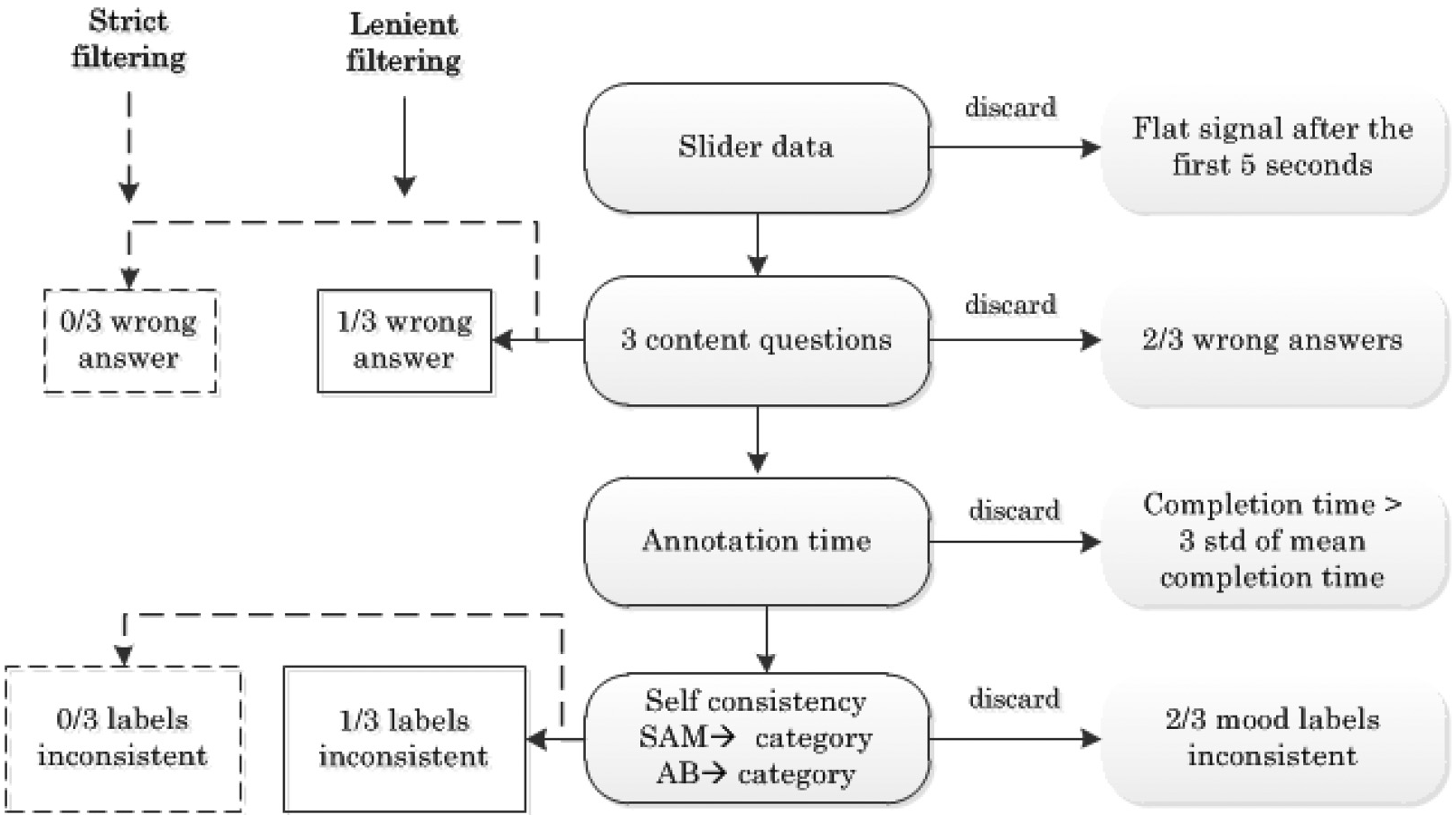 Figure 2: The sequential filtering stages implemented to clean the crowdsourced data.
Experimental Results & Validation
Does the crowd actually match the experts? The authors conducted a side-by-side comparison using a subset of 11 videos.
- Statistical Parity: A Generalized Linear Mixed Model (GLMM) showed no significant difference between lab experts and the filtered crowd.
- Ranking Consistency: Spearman correlations reached 0.94 for valence, showing that the crowd is exceptionally good at ranking how positive or negative a person looks.
- Dynamic Traces: While continuous G-trace annotations (tracking "emotion" second-by-second) had lower correlations, the overall mood average remained robust.
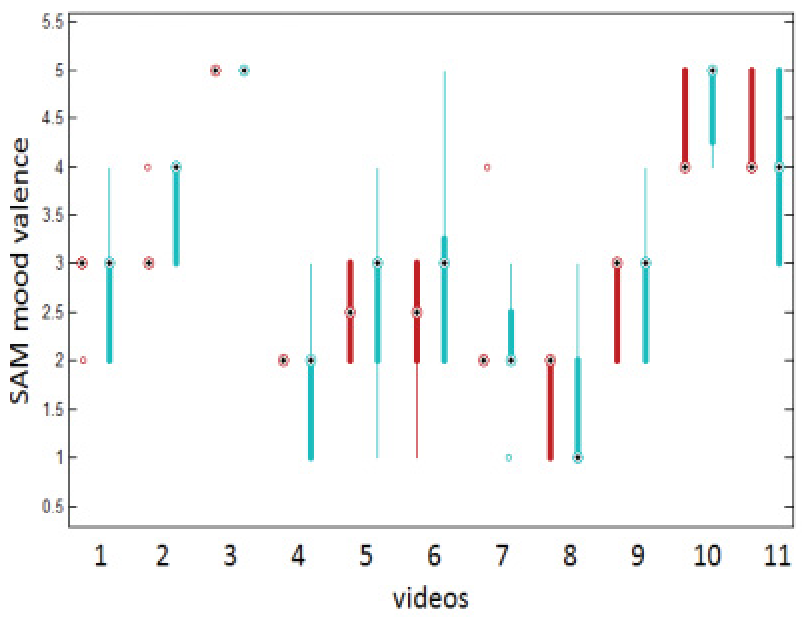 Figure 3: High alignment between Lab and Crowd median scores across Valence and Arousal.
Critical Insight: The "Valence Bias"
A recurring finding was that humans (both experts and the crowd) are more consistent at judging Valence (positive/negative) than Arousal (high/low energy). This suggests that computer vision models for mood may find higher success in detecting "unhappiness" than "agitation," a crucial insight for those designing smart-home healthcare tech.
Conclusion
The release of the EMMA database provides a significant public resource for the affective computing community. Beyond the data itself, the paper provides a rigorous validation of crowdsourcing as a scientific instrument. It proves that by using diverse tools and strict filtering cascades, we can achieve high-quality, large-scale labeling that captures the "wisdom of the crowd" in a domain as subjective as human emotion.
Future Outlook: The next step for researchers is to leverage the Kinect joint data to build Postural Mood Detectors that work even when a user's face is obscured or turned away from the camera.