
Crowdsourcing Energy: Turning Your Smart Shirt into a Power Bank
Crowdsourcing Energy as a Service
The paper introduces a novel framework for "Crowdsourced Energy as a Service" (EaaS), enabling IoT and wearable devices to share spare or harvested energy wirelessly. It proposes a spatiotemporal quality model and a temporal composition algorithm based on a fractional knapsack variation to satisfy user energy requirements through multiple providers.
TL;DR
Imagine being in a coffee shop with a dead phone and no outlets. What if the person next to you could "beam" energy from their smart shoes or watch to your phone? This paper proposes Crowdsourced Energy as a Service (EaaS)—a framework that treats the spare battery and harvested energy of wearable IoT devices as a composable, on-demand service. By using a 3D R-tree for discovery and a fractional knapsack algorithm for time-based composition, the authors show we can build a self-sustaining energy ecosystem.
Background: The Infrastructure Gap
While we have moved computation to the Edge and the Cloud, Energy remains a tethered resource. Traditional IoT devices are limited by their battery life. However, a new generation of "Harvesting Wearables" (like smart shirts using body heat) often have surplus energy. The challenge? Mobility and time. A provider might only be near you for 10 minutes. How do we orchestrate these "micro-moments" of energy availability into a reliable service?
The Core Innovation: Spatiotemporal Quality Model
The authors define EaaS not just as "having power," but as a set of dynamic Quality of Service (QoS) attributes:
- Transmission Success Rate (): A physics-based calculation of energy loss over distance using path-loss coefficients.
- Deliverable Energy Capacity (): Crucially, this accounts for the provider's own usage pattern (Suspend, Casual, or Regular usage).
- Temporal Availability: Calculating the real end time of a service based on current intensity and battery thresholds, rather than just what the user "promises."
Methodology: The Fractional Knapsack Approach
A single person's watch might not charge your iPhone. You need a Composition of multiple services.
1. Spatiotemporal Discovery
The system uses a 3D R-tree index, where the three axes represent Latitude, Longitude, and Time. This allows the system to query a "cube" of availability: "Who is within 2 meters of me for the next 30 minutes?"
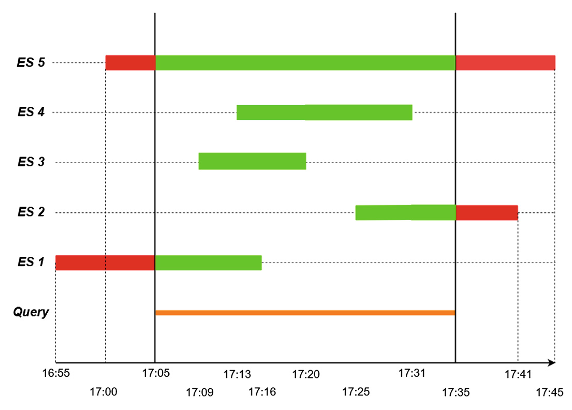 Fig 1: Identifying overlapping service windows within a query duration.
2. Temporal Composition Algorithm
The "Crowdsourcer" algorithm treats the user's requested charging time as a "knapsack." Since time can be divided, they apply a Fractional Knapsack strategy. They divide the query duration into "time slots" based on when providers arrive or leave. In each slot, the algorithm greedily picks the provider offering the highest Effective Current ().
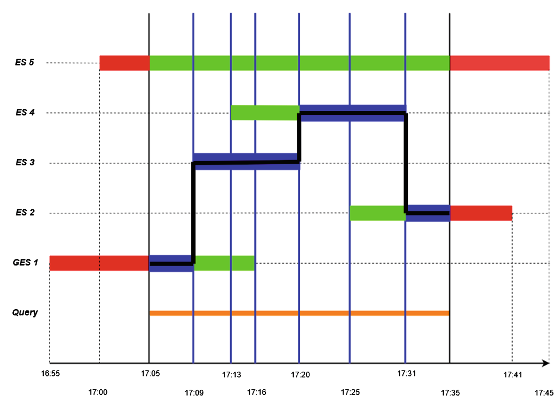 Fig 2: The "Crowdsourcer" algorithm divides the timeline to pick the optimal sequence of providers.
Experimental Validation
Using real-world check-in data from Yelp to simulate user movement in coffee shops, the authors compared their Temporal Composition against a standard Greedy Selection (which just picks the single best provider).
Key Findings:
- High Demand Efficiency: When users need a lot of energy (), the composition approach serves significantly more queries because it "stitches together" multiple small providers that a greedy algorithm would ignore.
- Short Duration Services: The framework excels when services are volatile (short-stay providers), which is the reality of urban crowdsourcing.
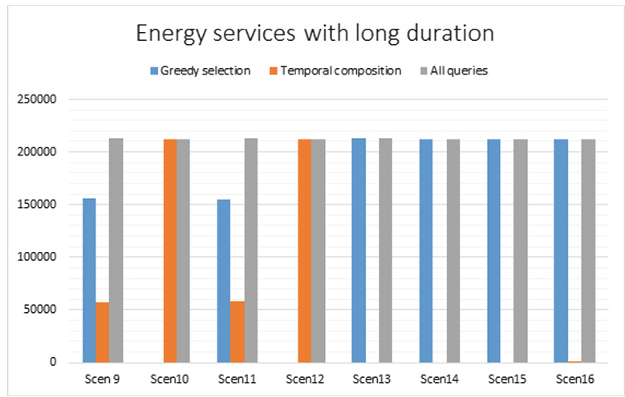 Fig 3: Results showing the number of served queries using composition vs. baseline.
Critical Insight: Why This Matters
The shift from "Device-to-Device charging" to "Service Composition" is the real breakthrough here. By mathematically modeling the usage patterns ( parameter), the authors move beyond the "idealistic" assumption that everyone wants to give away 100% of their battery.
Limitations & Future Directions: The current model assumes both the provider and consumer are stationary during the transfer (e.g., sitting in a cafe). The "Mobility-aware" version of this (charging while walking) remains the next frontier in EaaS research.
Conclusion (Takeaway)
This paper provides the mathematical and algorithmic foundation for a "Sharing Economy" of electricity. As wireless power transfer (WPT) technology matures, the "Temporal Composition" logic presented here will be essential for managing the chaotic, moving grid of the future.