
Crowdsourcing Energy Efficiency: Saving Battery by Leveraging Other Users' Signal Traces
Utilize Signal Traces from Others? A Crowdsourcing Perspective of Energy Saving in Cellular Data Communication
The paper introduces a crowdsourcing-based predictive scheduling framework designed to enhance the energy efficiency of cellular data communications on mobile devices. By leveraging shared signal strength traces from other users, the system optimizes transmission timing, achieving a significant reduction in energy consumption (up to 35% improvement) compared to conventional opportunistic scheduling.
TL;DR
Researchers have developed a system that uses "collective intelligence" to save up to 35% of a smartphone's communication energy. By sharing signal strength data among a "crowd" of users, mobile devices can predict upcoming "dead zones" and "golden zones" for data transmission, ensuring the radio only works hard when the signal is most efficient.
Context & Motivation
Despite advances in battery technology, the "energy hunger" of mobile apps—especially video streaming and background syncing—remains a major bottleneck. In HSPA (3G+) networks, the power consumption of cellular radios isn't just about how much data you send; it's about where you send it.
The core problem is that wireless environments are noisy and unpredictable. While "opportunistic scheduling" (sending data only when the current signal is good) helps, it is reactive. It doesn't know if a better signal is coming in 10 seconds or if it's about to enter a 2-mile dead zone. The authors ask: Can we use other people's past signal experiences to predict our own energy future?
The Hidden Physics of Signal and Power
The study reveals a critical "threshold" phenomenon in mobile hardware. Through systematic testing of six different Android devices (Samsung, HTC, Google), the authors found:
- Downlink (Download): Throughput varies wildly (5.3x), but power stays relatively stable.
- Uplink (Upload): Power consumption jumps by over 50% once the signal drops below a specific threshold (approx -77 to -79 dBm).
This threshold is incredibly consistent across different manufacturers, providing a hardware-level "sweet spot" for scheduling.
Methodology: From Raw Noise to Useful Intelligence
The system follows a four-step pipeline to turn crowdsourced data into battery savings:
- Trace Collection & Smoothing: Raw signal data from different phones can vary by 20 dBm due to hardware differences. The authors use a Moving Average algorithm (span of 31) to smooth out this local "noise" and reveal the underlying geographic path loss trend.
- Digitization: The smoothed signal is converted into a binary map of "Good" (1) and "Bad" (0) areas.
- Low-Power Positioning: Instead of battery-draining GPS, the system uses Cell ID, signal matching, and accelerometers to track location relative to the crowdsourced map.
- Predictive Scheduling: The device adaptively shifts data transmissions to "Good" areas, significantly reducing the transmission power required.
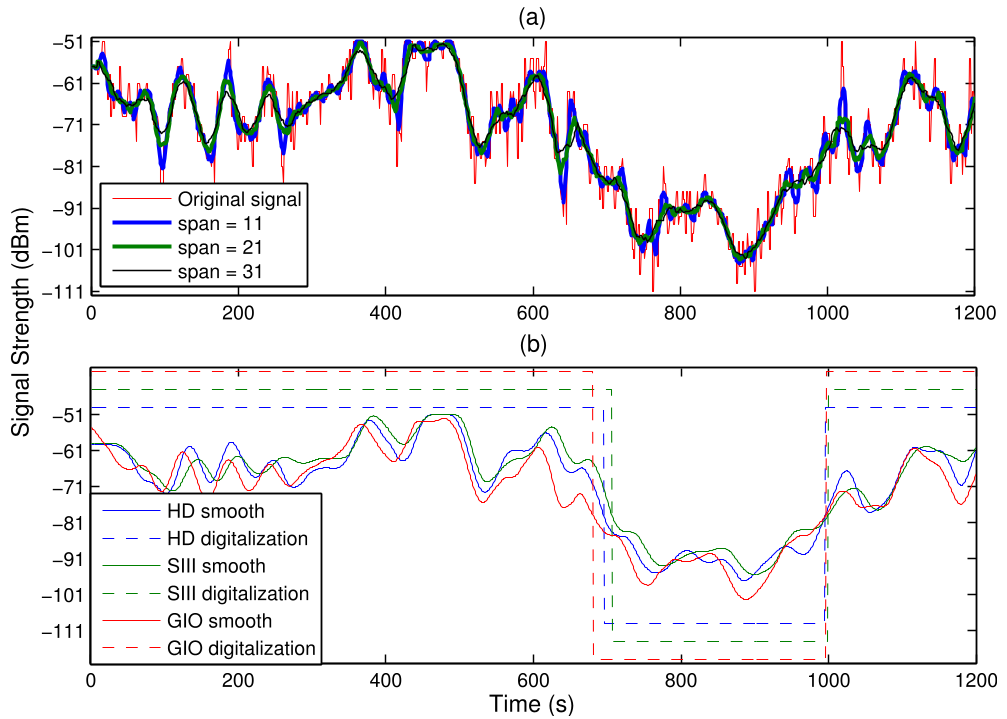 Figure: The process of smoothing raw signal traces to extract consistent geographic trends across different devices.
Experimental Results
The authors prototyped this on Android devices in real-life driving tests. The results were categorized by application type:
- Sync-up Apps (e.g., Email/Dropbox): Predictive transmission reached up to 40% energy savings compared to continuous transmission and 27.8% savings over the best existing opportunistic methods.
- Streaming Apps (e.g., YouTube): By managing a buffer and predicting signal peaks, the system saved roughly 22.4% energy.
The study also highlighted that as more users contribute (the crowdsourcing effect), the "Reference Trace" becomes more accurate, reaching peak efficiency with just 3 to 5 unique user traces per road segment.
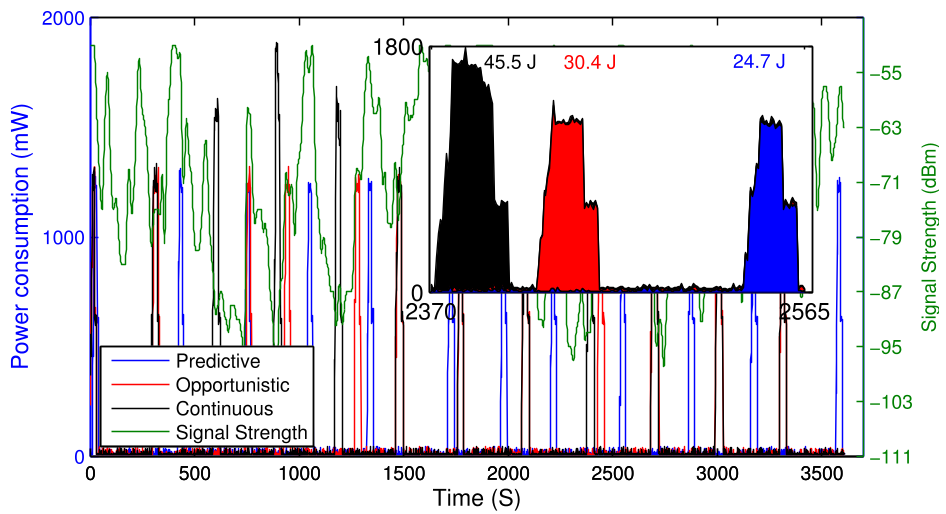 Figure: Power consumption comparison shows how predictive scheduling (the green bursts) avoids high-power "bad signal" areas compared to continuous methods.
Critical Insight & Future Outlook
The beauty of this work lies in its scalability. By proving that signal trends are fundamentally tied to geography rather than specific phone models, the authors unlocked a way to build a "Global Energy Map."
Limitations & Future Work:
- Dynamic Environments: The current study focuses on moving vehicles. High-speed trains or highly congested urban foot traffic may require more complex smoothing.
- Network Evolution: While the study focuses on HSPA, the principles of power control and "good/bad" areas apply equally to 4G LTE and 5G, though the threshold values will differ based on the frequency bands used.
Conclusion
This paper demonstrates that your phone's battery life isn't just about your hardware or your apps—it's about the collective data of the people who walked the path before you. By turning signal strength into a shared social resource, we can make mobile devices significantly more "green" without sacrificing connectivity.