
Beyond ROUGE: Is the Crowd Reliable Enough for Summary Evaluation?
A Crowdsourcing Approach to Evaluate the Quality of Query-based Extractive Text Summaries
This paper explores the feasibility of using micro-task crowdsourcing to evaluate query-based extractive text summaries. The authors assess five linguistic quality factors and find that crowdworkers can provide reliable quality judgments that correlate significantly with holistic assessments, particularly for low-quality outputs.
TL;DR
Evaluating the quality of text summaries has long been a manual, "expert-only" bottleneck. This study investigates whether the "crowd" (micro-task workers) can replace experts in assessing query-based extractive summaries. The findings? The crowd is surprisingly good at spotting bad summaries, but lacks the nuance of experts when it comes to the "best" ones. Crucially, the ubiquitous ROUGE metric once again proves significantly disconnected from human perception.
The "Expert Bottleneck" in Summarization
In the era of information overload, automated summarization is essential. However, developing these tools requires "Gold Standard" evaluations. Traditionally, this meant hired experts meticulously scoring summaries—a process that is slow, expensive, and unscalable.
While automatic metrics like ROUGE (Recall-Oriented Understudy for Gisting Evaluation) exist, they are often criticized for being too focused on word-overlap (n-grams) rather than the actual logical flow, focus, or grammatical "feel" of a summary. The authors ask: Can we use micro-tasks on platforms like Crowdee to bridge this gap?
Methodology: High-Stakes German Forum Summarization
The researchers didn't just pick easy texts; they used a German dataset from the Deutsche Telekom hilft customer forum. This involves technical queries where summaries must extract specific solutions from 6-10 different posts.
The Quality Pipeline:
- Qualification: Only workers with >0.9 German proficiency were allowed.
- Creation: Workers created 3-5 sentence extractive summaries.
- Evaluation: 203 workers rated the summaries across six dimensions:
- Overall Quality
- Grammaticality
- Non-redundancy
- Referential Clarity
- Focus
- Structure & Coherence
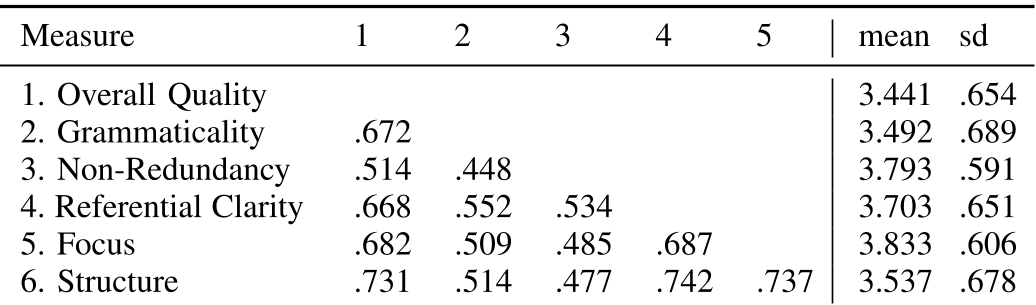 Table 1: Correlation between different linguistic factors and overall quality as perceived by the crowd.
Key Insights: What Drives "Quality"?
Using multiple linear regression, the authors discovered that Structure & Coherence and Grammaticality were the strongest predictors of whether a crowdworker liked a summary. Interestingly, Referential Clarity (knowing who/what a pronoun refers to) was not a significant predictor in this specific technical context, likely because forum posts are often fragmented and technical.
The "Threshold" Phenomenon
One of the paper's most fascinating findings is the comparison between Experts and the Crowd:
- Agreement on the Bad: When a summary was low quality, experts and crowds were in high agreement (rs = .727).
- Divergence on the Good: When summaries were high quality, the crowd tended to be more "forgiving" or less discerning than the experts. Experts were much more critical of subtle linguistic flaws that the crowd might overlook.
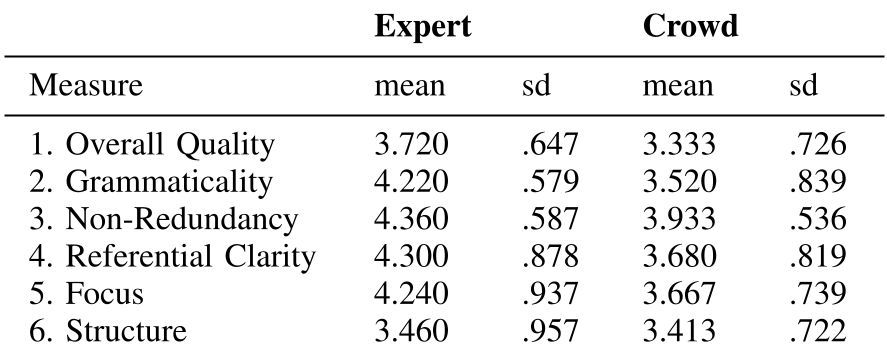 Table 2: Comparison of mean scores between Experts and Crowdworkers across various metrics.
The ROUGE Problem Resurfaces
The study confirms a brutal truth in NLP: ROUGE does not correlate with human-perceived linguistic quality. Whether it was an expert or a crowdworker doing the rating, there was "no significant correlation" with ROUGE scores. This highlights the urgent need for better automated metrics that look at semantics and structure rather than just word counting.
Critical Analysis & Future Outlook
The study proves that crowdsourcing is a viable "first filter." If the crowd says a summary is bad, it’s probably bad. However, if you need to rank the top 10% of your models, you still need experts.
Limitations:
- The dataset was specific to a German technical forum; linguistic behavior might differ in creative writing or news.
- The study focused on extractive summaries (copy-pasting sentences), which inherently limits "structure & coherence" compared to modern LLM-based abstractive summaries.
Takeaway for Practitioners: Don't rely solely on ROUGE to build your products. If you're on a budget, use a qualified crowd to weed out poor models, and save your expensive expert hours for the final "fine-tuning" of your evaluation.