
From PDFs to Knowledge Graphs: Crowdsourced Fact Extraction for the Open Science Era
Crowdsourcing Fact Extraction from Scientific Literature
The paper introduces a conceptual framework and prototype for "Crowdsourcing Fact Extraction," a system designed to mine empirical observations from scientific literature and transform them into an open knowledge base. It utilizes the RDF Data Cube Vocabulary to represent tabular data and leverages web-based visual analytics to facilitate human-in-the-loop quality control.
TL;DR
Scientific knowledge is currently trapped in the "digital paper" format (PDF), making it nearly impossible to aggregate empirical findings at scale. This paper presents a framework to extract these facts—specifically from tables—mapping them into semi-automatically generated RDF Data Cubes. By combining layout analysis with human-centric visual interfaces, the authors aim to build a structured, linked knowledge base of the world's research facts.
The "Dark Data" Problem in Research
Despite the open access movement, scientific data remains largely "dark." Facts are buried in the layout-rich but structure-poor PDF format. The authors note a sobering reality: even in fields like Information Retrieval, baselines are often so poorly tracked that improvement over decades is hard to verify.
The core challenge isn't just OCR; it's semantics. An automatic system can see a number, but it often struggles to understand if that number is an "Accuracy" (Measure) or a "Hyperparameter Setting" (Dimension).
Methodology: The Data Cube Pipeline
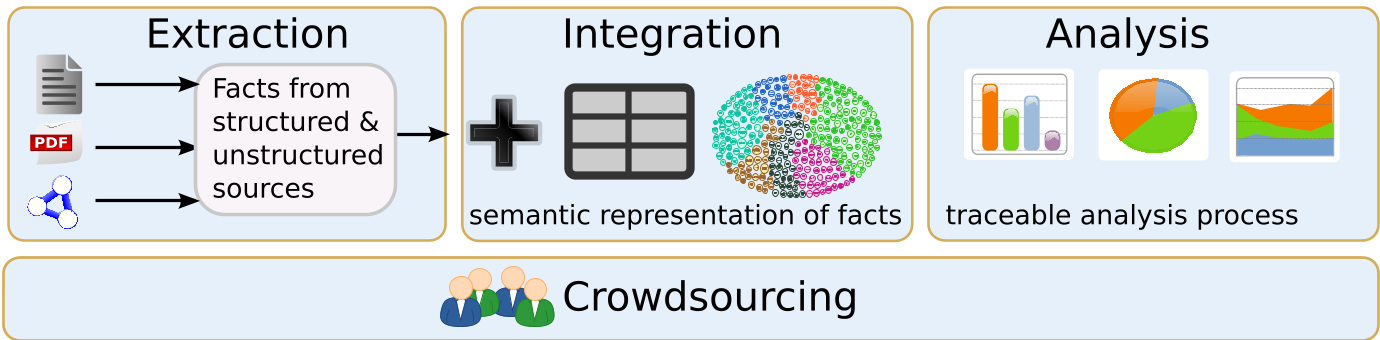
The authors shift away from attempting "perfect" AI, opting instead for a Human-in-the-Loop architecture centered on three pillars:
1. Semantic Representation via RDF Data Cubes
Instead of simple key-value pairs, facts are represented as triples :
- Dimensions (): The independent variables (e.g., Algorithm Type, Dataset).
- Measures (): The dependent/measured variables (e.g., F1-score, Precision).
- Observations (): The specific data point where dimensions meet measures.
2. Layout-Aware Extraction
Using clustering on font size and position, characters are merged into blocks. A Conditional Random Field (CRF) then classifies these blocks (e.g., Table, Caption, Main Text).
3. Collaborative Visual Analytics
Since extraction is imperfect, a web interface allows users to:
- Refine extracted table boundaries.
- Annotate cells as either Dimensions or Measures.
- Link entities to the Linked Open Data (LOD) cloud using services like Sindice or DBpedia Spotlight.
Experimental Insights & UX Hurdles
While the technical pipeline for extraction is robust (up to 0.9 recall), the human factor proved to be the bottleneck. A heuristic evaluation revealed that:
- Conceptual Friction: Non-experts struggle with the database-heavy terminology of "Dimensions" vs "Measures."
- State Visibility: Users found it difficult to track what had already been annotated in complex tables.
- Error Correction: The lack of a "back" button and undo functions in the prototype hampered the crowdsourcing efficiency.
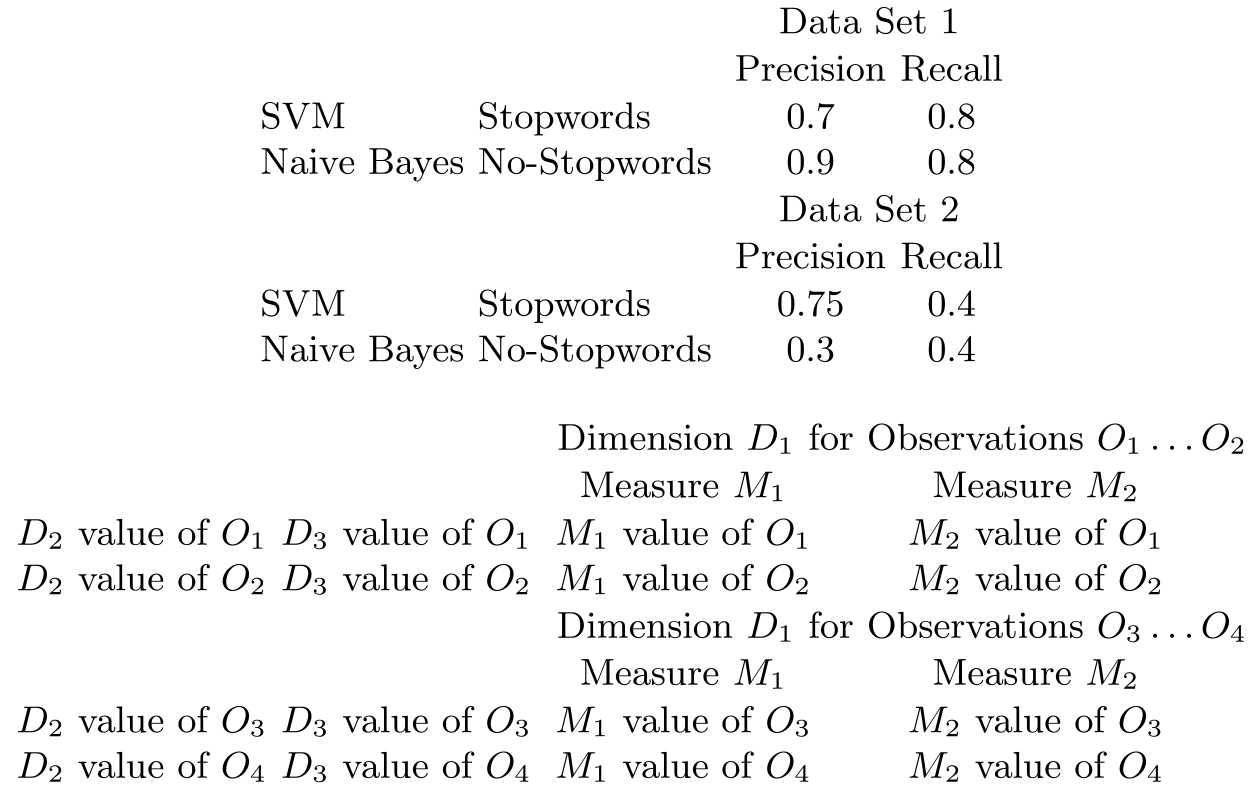 Fig: Converting a nested, human-readable table (top) into a machine-readable normalized Data Cube (bottom).
Critical Analysis: Is Crowdsourcing the Answer?
The paper correctly identifies that "Fully Automatic = Partially Wrong." In scientific facts, a 10% error rate in data extraction can lead to entirely false conclusions in Meta-studies.
However, the success of this approach depends heavily on the incentive structure. Why would a researcher spend time annotating tables? The authors suggest that by providing Visual Analytics tools (Multiple Coordinated Views) as a reward, users might be more inclined to clean the data in exchange for powerful insight-generation capabilities.
Conclusion
This work serves as a foundational blueprint for what we now call "AI-Assisted Knowledge Engineering." By leveraging the RDF Data Cube Vocabulary, the project moves scientific literature away from static text and toward a dynamic, queryable treasury of human knowledge.
Future Outlook: Integrating Large Language Models (LLMs) into the "Step 2" suggestion phase could likely solve many of the heuristic issues identified by the authors in 2012, significantly lowering the cognitive load for crowdsourced contributors.