
T-Crowd: Redefining Tabular Data Collection through Structured Intelligence
A Crowdsourcing Framework for Collecting Tabular Data
The paper introduces T-Crowd, a novel crowdsourcing framework specifically designed for collecting multi-type tabular data. It features a unified probabilistic model for truth inference across categorical and continuous attributes and a structure-aware task assignment strategy that exploits dependencies between data cells.
Executive Summary
Collecting structured data is a cornerstone of modern AI, yet traditional crowdsourcing methods fail to grasp the "tabular" nature of the information they gather. T-Crowd is a breakthrough framework that addresses this by treating a table not just as a collection of isolated questions, but as a web of dependent variables. By unifying worker quality across categorical and continuous data and leveraging attribute correlations, T-Crowd slashes crowdsourcing costs by nearly 50% while simultaneously boosting data accuracy.
The "Independence" Fallacy in Crowdsourcing
Most existing crowdsourcing platforms (e.g., Amazon Mechanical Turk) assume tasks are independent. If you ask a worker for a celebrity's "Age" and "Nationality," traditional systems treat these as two unrelated data points.
This is flawed for two reasons:
- Quality Consistency: A worker who is an expert on celebrities will likely be accurate across all attributes (categorical or continuous).
- Structural Dependency: If a worker misidentifies a celebrity's nationality, their confidence in that celebrity's age is also suspect. This "row-level" dependency is a goldmine for improving data quality that previous SOTA methods ignored.
Methodology: The Core of T-Crowd
T-Crowd’s innovation lies in its dual-engine approach:
1. Unified Truth Inference
The system uses an Expectation-Maximization (EM) algorithm to simultaneously estimate worker quality and the "true" value of cells. The breakthrough is the Unified Quality Model. Whether the data is categorical (labels) or continuous (numbers), T-Crowd maps worker answers to a unified variance-based probability. This allows the system to learn a worker's trustworthiness from their performance on a numeric "Age" task and apply it to a categorical "Nationality" task.
2. Structure-Aware Task Assignment
Instead of assigning tasks randomly, T-Crowd calculates Information Gain (IG). It focuses on tasks where the incoming worker's specific profile will yield the most "certainty." The "Structure-Aware" version takes this further by calculating the conditional distribution of errors—predicting a worker's answer on one attribute based on their answers to other attributes in the same row.
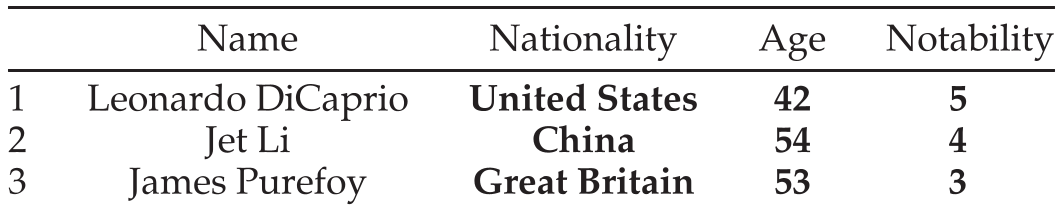 Table 1: Example of structured celebrity data where attributes are cross-linked.
Experimental Results: Faster Convergence, Lower Costs
T-Crowd was tested against industry standards like CRH, CATD, and AskIt!. The results across three real-world datasets (Celebrity, Restaurant, and Emotion) were conclusive.
- Accuracy: T-Crowd consistently achieved the lowest Error Rate and MNAD (Mean Normalized Absolute Distance).
- Efficiency: In the Celebrity dataset, T-Crowd converged to the true values with an average of only 3 answers per task, whereas competitors required 5 or more.
- Correlation Validation: The authors proved that knowing a worker's answer on one attribute provides significant predictive power for other attributes, justifying their structure-aware approach.
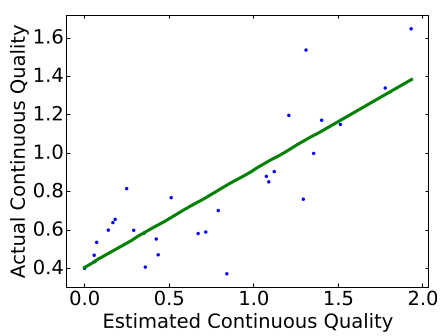 Figure 2: End-to-end comparison showing T-Crowd reaching lower error rates much faster than baselines.
Critical Insight & Future Outlook
The primary takeaway from T-Crowd is that context matters. By mathematically modeling the "geometry" of a table, we can extract significantly more signal from noisy human input.
However, the model does have limitations. It currently assumes entities (rows) are independent of each other (e.g., knowledge of one celebrity doesn't imply knowledge of another). Future iterations utilizing entity-level correlations or graph-based knowledge could push efficiency even further. For the industry, T-Crowd offers a practical path to high-fidelity data cleaning and database integration at half the current market price.
Conclusion
T-Crowd proves that sophistication in the "inference engine" and "assignment logic" pays off directly in monetary savings and data quality. It represents a significant step forward from "blind" crowdsourcing to "context-aware" data engineering.