
T-Crowd: Smart Crowdsourcing through Structural Awareness and Unified Truth Inference
A Crowdsourcing Framework for Collecting Tabular Data
The paper introduces T-Crowd, a comprehensive crowdsourcing framework for collecting tabular data that integrates categorical and continuous attributes. It leverages a unified probabilistic model for truth inference and a structure-aware task assignment strategy that accounts for attribute dependencies.
TL;DR
Collecting structured data (tables) from the crowd is traditionally expensive because typical systems treat every cell in a table as an isolated question. T-Crowd changes this by recognizing that table cells are related. By using a unified probabilistic model for mixed data types (categorical and continuous) and a "structure-aware" task assignment strategy, it settles on the ground truth twice as fast as previous state-of-the-art methods.
The Core Challenge: Columns Aren't Islands
When we ask workers to fill out a table—for instance, a list of celebrities including their Nationality (categorical) and Age (continuous)—most systems make two mistakes:
- Siloed Quality Estimation: They calculate worker reliability separately for each column. If a worker answers "Age" correctly but there are few "Nationality" tasks, the system fails to realize they are generally an expert on that celebrity.
- Ignoring Context: If a worker misidentifies a celebrity in one column, they are likely to provide incorrect data for every other column in that same row.
Methodology: The T-Crowd Approach
1. Unified Worker Quality Model
T-Crowd avoids siloed estimation by using a single parameter to represent a worker's inherent quality.
- For Continuous data, is tied to the variance of a Normal Distribution—better workers have tighter distributions around the truth.
- For Categorical data, represents the probability of selecting the correct label.
By mapping both to a unified scale using the Gauss error function, the system can use a worker's performance in one domain to predict their reliability in another.
2. Structure-Aware Task Assignment
This is the system's "secret sauce." Instead of randomly assigning tasks, T-Crowd calculates the Information Gain (IG). It doesn't just look for "uncertain" cells; it looks for cells where a specific worker—given their history with that row—is most likely to provide a high-value answer.
 The T-Crowd architecture integrates truth inference and task assignment into a continuous loop.
Experimental Results: Faster, Cheaper, Better
The authors tested T-Crowd against industry standards like CRH, CATD, and GLAD.
- Efficiency: T-Crowd reached higher accuracy levels with roughly half the number of worker assignments. In the world of crowdsourcing, half the assignments means 50% cost savings.
- Convergence: As shown in the performance charts below, T-Crowd (the solid red line) drops in error rate much earlier than competitors.
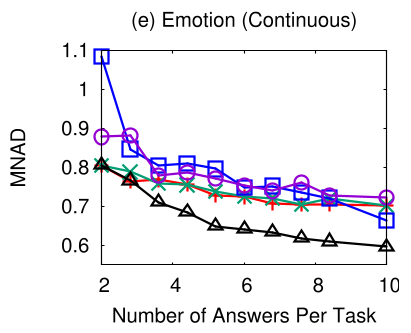 Performance metrics across Celebrity, Restaurant, and Emotion datasets.
Deep Insight: Why It Works
The brilliance of T-Crowd lies in its use of Correlation Coefficients between columns. For example, in a restaurant dataset, if a worker correctly identifies the Aspect of a review (e.g., "Food"), there is an 86% statistical probability they will also get the Sentiment right. T-Crowd quantifies these relationships and uses them to prioritize assignments.
Conclusion and Future Outlook
T-Crowd proves that "understanding the schema" is just as important as "understanding the worker." By treating a table as a structured entity rather than a collection of independent cells, the framework achieves SOTA results in both accuracy and efficiency.
Limitations: The current model assumes entities (rows) are already known. Future iterations likely need to address "entity discovery"—where workers also help define which rows should exist in the table in the first place.
Senior Editor's Note: T-Crowd is a landmark study for database researchers, bridging the gap between probabilistic modeling and practical human-in-the-loop systems.