
CROWDCHECK: Leveraging Crowdsourcing and Deterministic Replay to Solve the Cross-Browser Puzzle
A Crowdsourcing framework for Detecting Cross-Browser Issues in Web Application
This paper introduces CROWDCHECK, a novel crowdsourcing framework designed to detect Cross-Browser Incompatibilities (XBIs) in Web 2.0 applications. By integrating record/replay techniques with crowdsourced user sessions, it achieves superior detection of behavioral, structural, and content-based inconsistencies across diverse browser environments.
TL;DR
The "Works on my machine" (or "Works in Chrome") excuse is the bane of web development. CROWDCHECK is a short-paper contribution that moves Cross-Browser Incompatibility (XBI) detection out of the lab and into the wild. By using a crowdsourcing framework combined with deterministic record/replay technology, it captures real user interactions and replays them across a fleet of browsers to catch bugs that automated crawlers miss.
The "Invisible" State Space: Why Crawlers Fail
Modern Web 2.0 applications (like Google Docs or interactive games) are highly dynamic. Traditional XBI detection tools use crawlers to explore the application and compare how different browsers render the same page. However, this approach faces two critical hurdles:
- State Explosion: Crawlers explore randomly. In a game requiring a specific sequence of clicks (like the Countbeads example in the paper), a crawler might never reach the "winning" state where an XBI actually exists.
- Non-Determinism: If a page uses
Math.random()or dynamic timestamps, a crawler will see different content in Chrome vs. Firefox not because of a bug, but simply because the data changed. This leads to frustrating False Positives.
Methodology: The Three Pillars of CROWDCHECK
The authors break down the solution into a streamlined pipeline designed for web applications deployed in the field.
1. Deterministic Event Capture
Instead of simulating users, why not use real ones? CROWDCHECK injects a record.js library via a proxy. It intercepts virtually all sources of non-determinism:
- DOM Events: Mouse clicks, keyboard inputs, and scrolls.
- Timers & XHR: Wrapping
setTimeoutandXMLHttpRequestto log exact timings and server responses. - JS Functions: Overriding
Math.random()andnew Date()to ensure the replay environment sees the exact same "random" values as the user.
2. Remote Replay Architecture
Once a user session (trace) is uploaded, a central controller sends it to Remote Agents. These agents are daemons installed on various OS/Browser combinations.
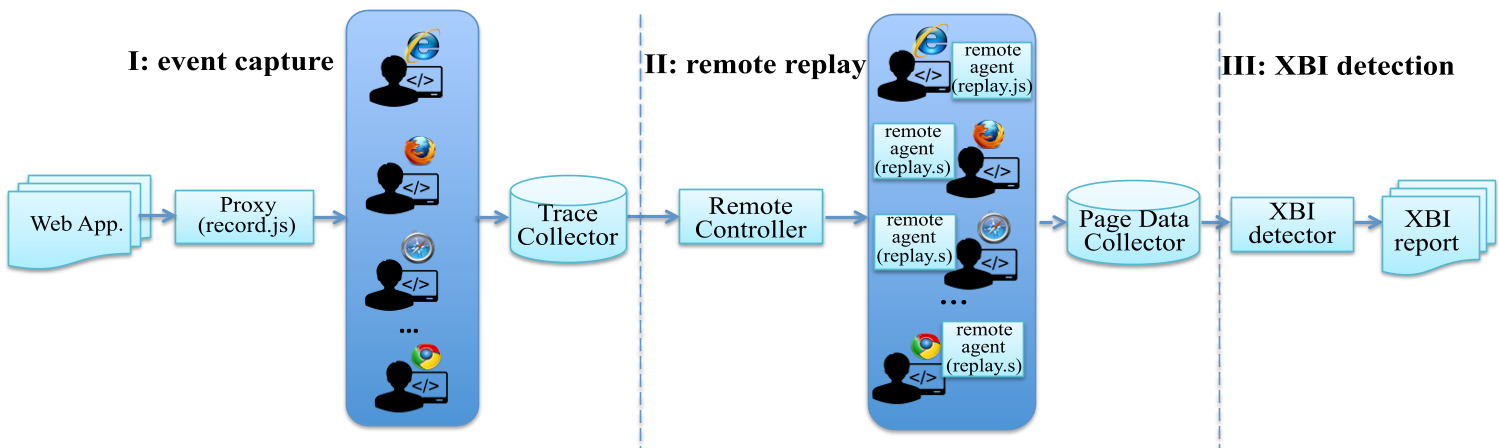 The image above illustrates the lifecycle of a trace from the user's browser to the remote testing cluster.
3. Incremental XBI Detection
Comparing the entire DOM tree after every event is computationally expensive. CROWDCHECK uses an Incremental Detection Algorithm. By observing DOM mutations, it only investigates nodes that actually changed after an event. It checks for:
- Behavioral XBIs: Does a click trigger an exception in IE but not in Chrome?
- Structural XBIs: Are elements aligned differently? (Using Alignment Graphs).
- Content XBIs: Are there text differences or visual styling mismatches (analyzed via OpenCV)?
Experimental Insights
The paper highlights a motivating example: the Countbeads game. Under traditional testing, Math.random() caused the tool to report errors that weren't actually bugs. CROWDCHECK successfully suppressed these false positives by replaying the exact "random" value captured from the user. Furthermore, it reached deep application states (like finishing a level) that a random crawler would likely never hit.
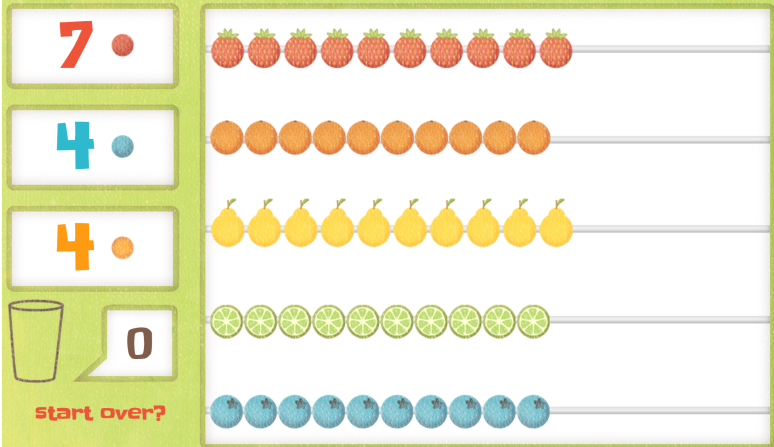 Fig 1: A complex interaction state in the Countbeads game, easily reached via replay but difficult for crawlers.
Critical Perspective
While CROWDCHECK is a significant step forward, its reliance on a Proxy (WebScarab) and library injection might face challenges with modern Content Security Policies (CSP) and encrypted traffic (HTTPS/HSTS). Additionally, as web applications move toward Shadow DOM and complex WebAssembly-based rendering, purely DOM-based comparison may need to evolve into more computer-vision-heavy approaches.
Conclusion: Toward Self-Healing Web Apps
The value of CROWDCHECK lies in its "Field-to-Lab" pipeline. By turning every user into a potential tester, organizations can identify regional or browser-specific issues without exhaustive manual QA. It shifts the paradigm from predicting what users might do to analyzing what they actually did.