
Games for Crowds: Turning Employees into Game Designers to Unlock Collective Intelligence
Games for Crowds: A Crowdsourcing Game Platform for the Enterprise
This paper introduces "Games for Crowds" (G4C), a novel enterprise crowdsourcing platform that enables non-technical employees to create, play, and share human-computation games. Deployed in a large global organization, the platform successfully harnessed collective intelligence to solve business tasks like taxonomy building and resource discovery.
TL;DR
The paper presents Games for Crowds (G4C), an enterprise platform that shifts the role of the employee from a mere "data worker" to a "game creator." By providing a simple wizard to build "human computation" games, the platform gathered over 28,000 corporate insights—ranging from organizational charts to technical glossaries—in just three months.
Academic Context: This work bridges the gap between Human-Computer Interaction (HCI) and Enterprise Social Computing. It moves beyond the classic "ESP Game" model by decentralizing the creation of crowdsourcing tasks.
The "Consent" Problem in Enterprise Gamification
Why don't most corporate games work? The authors highlight a critical friction point: legitimacy. Employees often feel guilty playing games at work unless they perceive a direct benefit to the organization. G4C solves this by aligning fun with "human computation"—tasks that computers struggle with but humans find intuitive, such as brainstorming or categorizing complex assets.
Methodology: The Wizard Architecture
The core innovation is the Game DNA abstraction. Instead of requiring employees to be game designers, G4C provides a template where creators only need to define:
- Topics: The "subject" (e.g., "Linux Kernel").
- Questions: The "action" (e.g., "Name as many system calls as you can").
- Reward Logic: Choosing between Popularity (to find consensus) or Originality (to find "black swan" ideas).
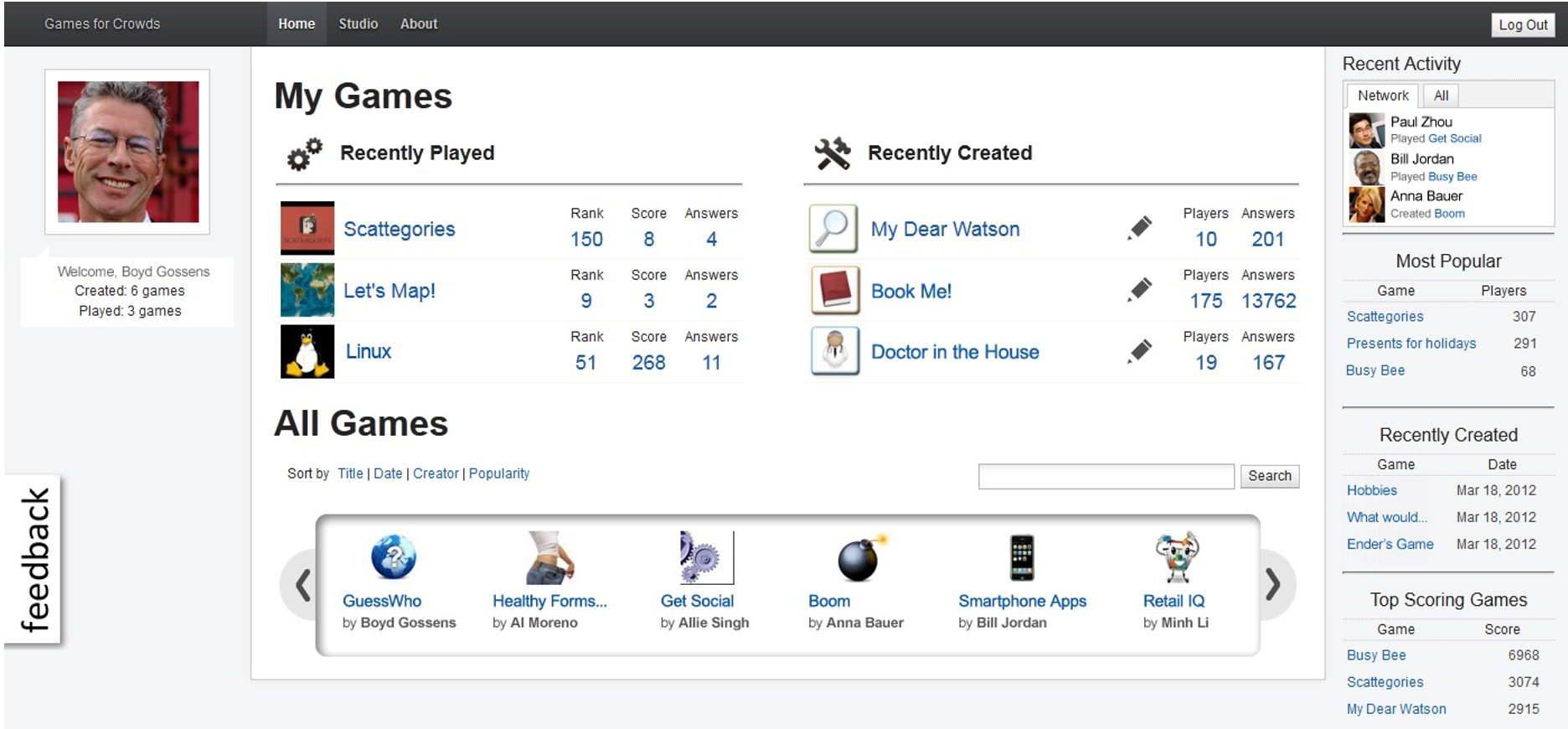 Figure 1: The G4C Home Screen integrates social feeds and leaderboards to drive viral engagement.
Experiments & Deep Insights
The authors conducted a three-month longitudinal study. The data revealed several counter-intuitive patterns regarding workplace behavior:
1. The Popularity vs. Contribution Trade-off
- Leisure Games (e.g., "Whisky Brands"): Attracted a massive number of players but had "shallow" engagement.
- Business Games (e.g., "Customer Challenges"): Attracted fewer players (the "domain experts"), but those players contributed 2.5x more answers per round.
2. The "Goldilocks" Zone for Instructions
The study found a non-linear relationship between instruction length and player performance.
- Too short (<10 words): Players were confused and gave up.
- Too long (>20 words): Players felt it was "too much like work" and skipped.
- Just right (11-20 words): Maximized the quality of human computation.
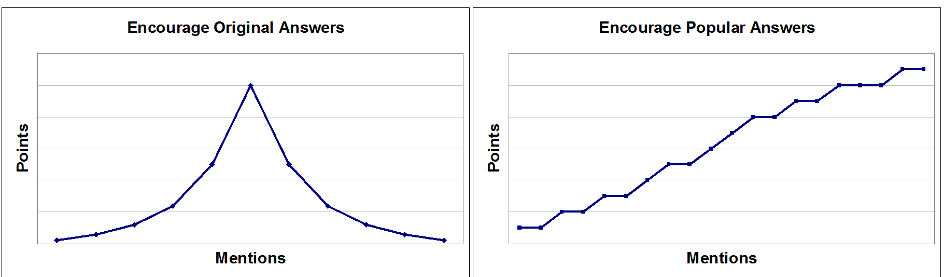 Figure 2: The platform supports two reward mechanisms—Encouraging Popularity (for consensus) vs. Originality (for diverse insights).
SOTA Comparison: Business Impact
Unlike Amazon Mechanical Turk (MTurk), which relies on monetary micro-payments, G4C relies on social capital and intrinsic motivation.
- Data Quality: 82% of games used custom thumbnails, and 70% included detailed manual instructions, proving creators were highly invested.
- Efficiency: One creator noted getting 84 valid business answers within 5 minutes of "launching" their game to the internal crowd.
Evaluation & Takeaways
The research proves that "Modding" culture (the ability for users to modify game content) is highly effective for solving enterprise cold-start problems in data collection.
Limitations:
- Identity Anxiety: Some employees avoided playing for fear of being at the bottom of the leaderboard (the "look dumb" factor).
- UI Rigidness: High-level users wanted more control over round duration and non-textual inputs.
Future Implications: As we move into the era of AI, platforms like G4C could serve as the primary engine for RLHF (Reinforcement Learning from Human Feedback) within the enterprise, allowing companies to fine-tune their internal AI models through "Play" rather than "Labor."
Reference: Guy, I., et al. (2015). Games for Crowds: A Crowdsourcing Game Platform for the Enterprise. CSCW '15.