
Crowdsourcing GO: Why "Where" and "How" You Are Matters More Than the Micropayment
Crowdsourcing GO: Effect of Worker Situation on Mobile Crowdsourcing Performance
The paper "Crowdsourcing GO" explores how real-world worker situations (busyness, fatigue, and social context) impact performance on mobile crowdsourcing platforms. Using a three-week field experiment with 50 participants, the researchers demonstrate that physical and social context significantly influence task completion rates, minimum acceptable pricing, and output quality.
TL;DR
Mobile crowdsourcing is not just traditional work on a smaller screen; it is work embedded in the chaos of daily life. This study proves that a worker’s busyness, fatigue, and social surroundings are primary drivers of performance. Being busy slashes completion rates by 30%, while being with friends makes workers "more expensive." Perhaps most critically, fatigue is the silent killer of quality, reducing accuracy by over 37%.
The Hidden Cost of the "On-the-Go" Workforce
In the world of Amazon Mechanical Turk, workers sit at desks. In the world of Mobile Crowdsourcing (e.g., Gigwalk, Field Agent), work finds you via a push notification while you’re at lunch, on a train, or in a meeting.
The authors argue that we currently ignore the Opportunity Cost of these moments. If you are busy, the "cost" of stopping a high-value activity for a $0.50 task is too high. If you are with friends, the "social cost" of being rude and looking at your phone raises your asking price. The researchers set out to prove these intuitions using rigorous economic and psychological frameworks.
Methodology: The "Quality of Service" Field Test
To test their hypotheses, the researchers built a custom crowdsourcing app and recruited 50 participants for a 21-day study.
- The Task: Workers watched a 3-minute video and reported on network "noise" (glitches).
- The Trap: 25% of videos had intentional, "gold standard" noise to measure if the worker was actually paying attention.
- The Variables: The system tracked:
- Busyness (Opportunity cost)
- Fatigue (Cognitive capacity)
- Companions (Social barriers)

Key Findings: Situation Trumps Salary
1. Busyness and the Vanishing Worker
When workers reported being "High Busyness" (HB), the completion rate plummeted. Even if the price was right, the friction of switching tasks was too great.
- Impact: 30.1% relative decrease in completion.
2. The "Companion Tax"
Interestingly, the presence of others didn't just stop people from working; it made them pickier. Mean accepted prices rose by 7.6% when workers were with someone. In short: "If I'm going to be rude to my friends, you better pay me more."
3. Fatigue: The Quality Destroyer
The most alarming finding involves Task Quality. Fatigued workers (HF) didn't necessarily stop working, but they stopped caring.
- F-Measure (Accuracy): Dropped by 37.4%.
- Invalid Tasks: Fatigued workers were twice as likely to "cheat" by submitting the survey before the 3-minute video even finished.
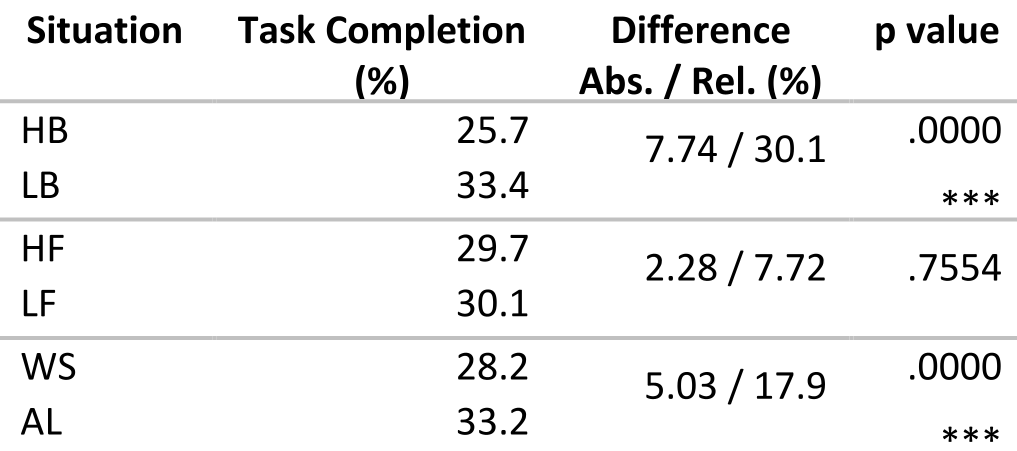 (Table showing the significant drop in completion rates in HB and WS situations)
The Temporal Dimension of Mobile Work
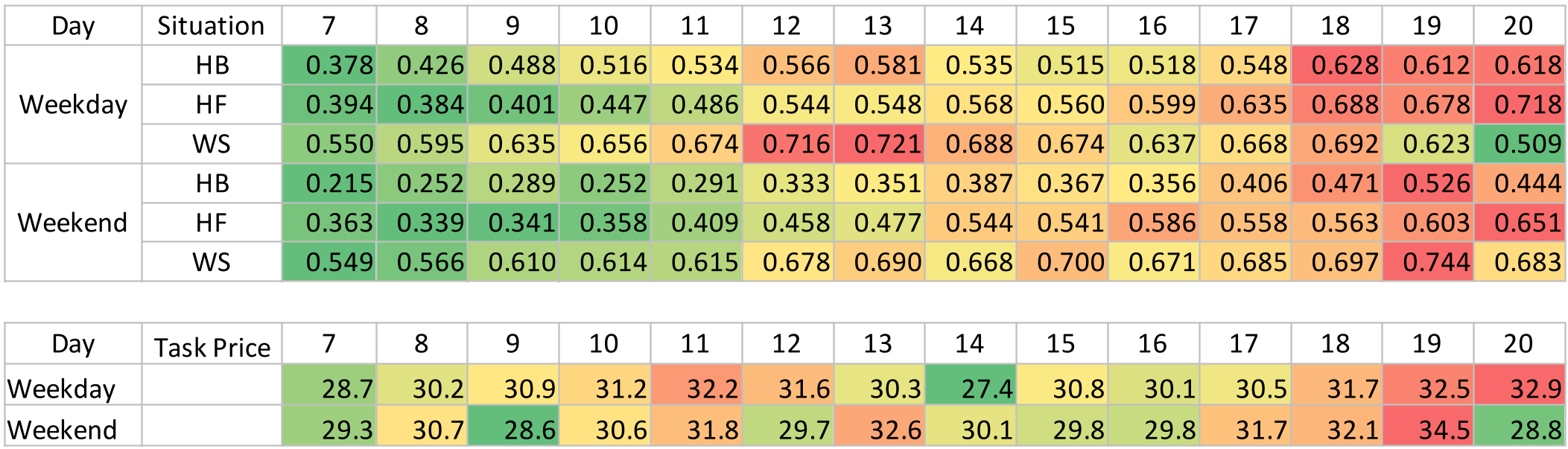
The study also mapped these situations to time of day. Busyness and fatigue peak in the late afternoon and evening, while companions are most prevalent during lunch hours and weekends. For task requesters, the "Golden Hour" for cheap, high-quality data is the morning, when workers are fresh, solo, and looking for a productive start.
Critical Insight & Future Outlook
This paper serves as a wake-up call for the "Human-in-the-loop" AI industry. If your training data is being labeled by mobile workers who are exhausted or distracted, your model is inheriting that "situational noise."
The Takeaway for Developers: Stop sending notifications blindly. Future platforms should leverage smartphone sensors to detect if a user is "In a Meeting" or "Walking with Others" and suppress notifications until a "Low Busyness" state is detected. This isn't just about being polite; it's about the economic efficiency of the entire crowdsourcing ecosystem.
Limitations
The study focused on stationary tasks (watching videos). As the authors note, "Physical Movement" tasks—like walking to a store to take a photo—introduce even more complex variables like weather and physical exertion, which remains a frontier for future research.