
Leveraging the Crowd: A Contract Theory Approach to Catching Social Media Bad Actors
6791_Leveraging Crowdsourcing for Efficient Malicious Users Detection in Large-Scale Social Networks.
This paper introduces a crowdsourcing-based approach to detect malicious users in large-scale social networks. By leveraging victim reporting and designing optimal incentive mechanisms based on Contract Theory, it achieves efficient detection while minimizing the system administrator's total cost.
TL;DR
Detecting "stealthy" malicious users in massive social networks is like finding a needle in a haystack. This paper suggests a radical shift: instead of the system administrator doing the hunting, why not pay the victims to speak up? By using Contract Theory, the authors design an incentive-optimized framework that overcomes the "hush money" provided by malicious users and minimizes the platform's detection expenses.
Background: Why Scanning Isn't Enough
In the era of large-scale social networks, traditional security measures face a scalability wall. Proactive scanning for behavioral anomalies is computationally expensive and prone to high false-positive rates because sophisticated attackers mimic normal users. Moreover, attackers often use "bribes"—such as coupons or small rewards—to prevent victims of spam or phishing from reporting them. This creates an economic barrier to security that technical algorithms alone cannot solve.
The Core Insight: Crowdsourcing the "SENSE"
The authors propose that the users who are directly targeted by malicious activities (spam, advertisement injection, etc.) are the most efficient sensors. However, reporting requires effort and costs. The problem then becomes: How much should the system pay users to report, given that different users have different tolerance levels (preferences) for malicious behavior?
Methodology: The Math of Incentivization
The paper models the interaction between three parties: the System Administrator, the Malicious User, and the Normal User.
1. The Utility Battle
A user faces a choice:
- Stay Silent: Receive a benefit from the malicious user plus their personal preference .
- Report: Receive an incentive from the system.
The system's goal is to ensure for at least users at the minimum possible total cost .
2. Scenario-Based Design
The paper dives deep into two information regimes:
- Full Information: The system knows every user’s preference. The solution here is straightforward: pick the "cheapest" users to incentivize.
- Partial Information: The system only knows the statistical distribution (Uniform or Gaussian) of user preferences.
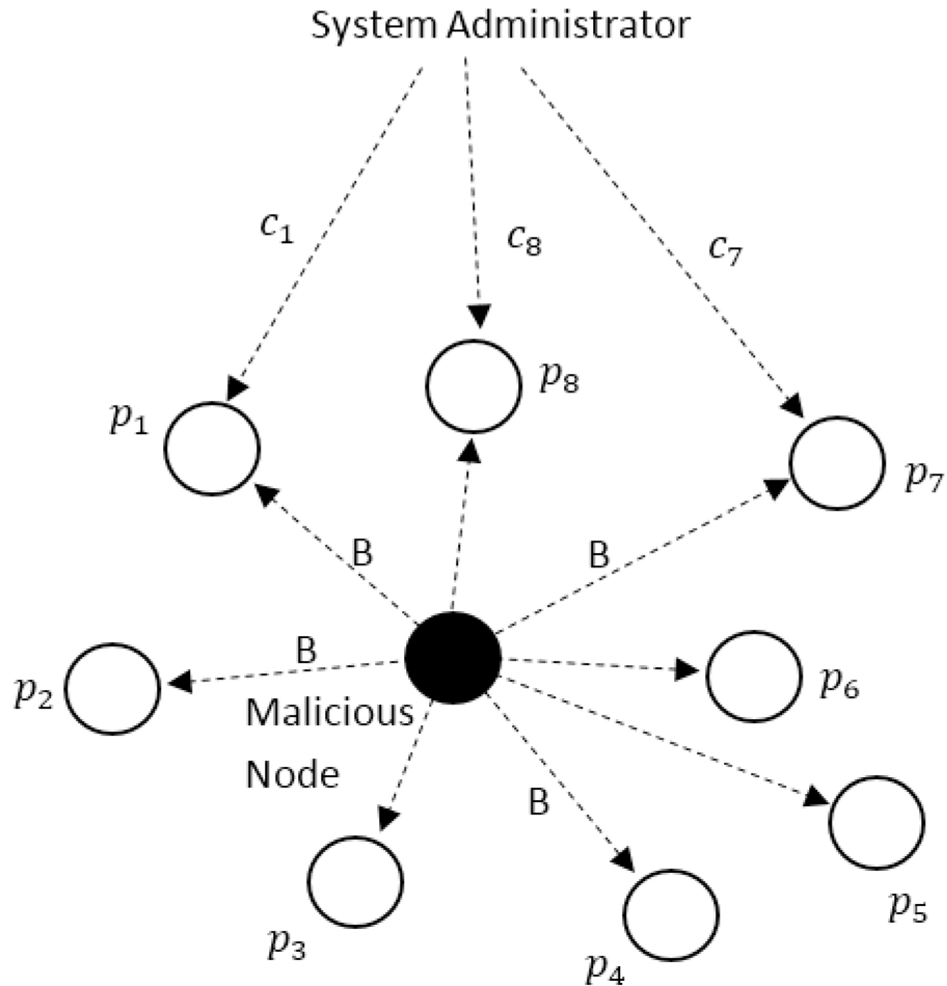 Figure 1: The interaction between users, the administrator, and the malicious entity.
3. The Gaussian Breakthrough
For the Gaussian distribution scenario, the authors use a series of lemmas to prove that the optimal strategy isn't to give everyone a small amount. Instead, if the population's average tolerance is high (positive mean ), the system should give to some users and a fixed, optimized amount to others.
```python
# Algorithm Snippet for Minimum Cost Allocation
for m in range(0, N):
    calculate s = (N - m) * [optimal_incentive_formula]
    # Find the 'm' that minimizes total cost 's'
```
Experimental Evidence
The simulations validate that the proposed mechanisms are highly sensitive to the malicious user's incentive and the required detection threshold .
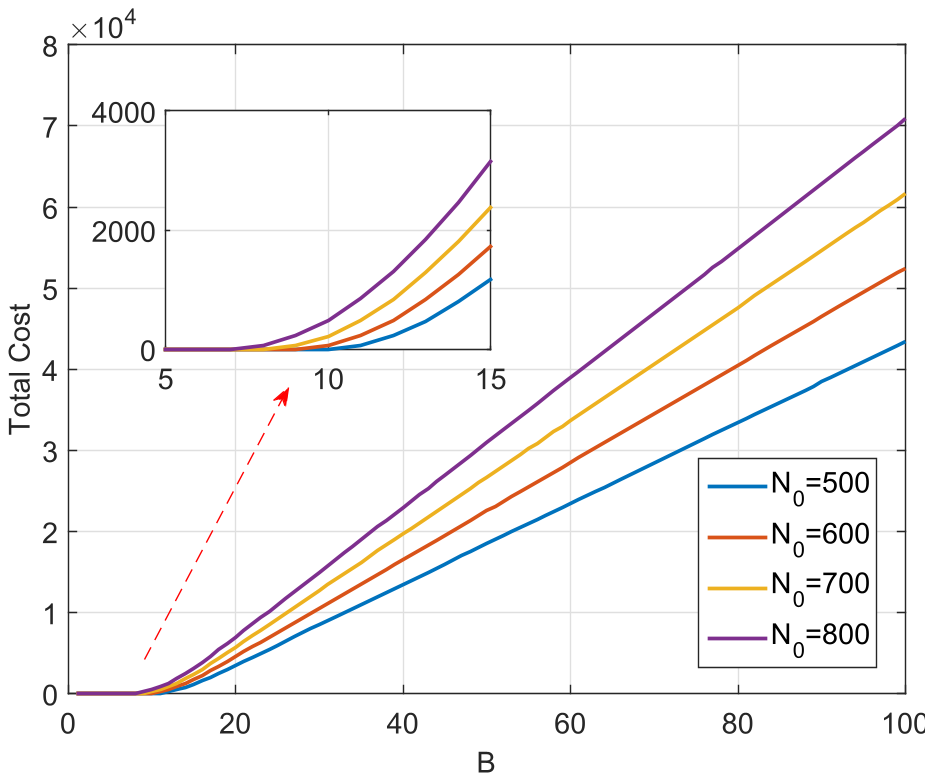 Figure 2: Total cost as a function of malicious incentive and threshold .
As shown in the experiments, there is a "free zone" where is low enough that users report for free. However, as the attacker gets more aggressive with their own incentives, the system cost rises sharply, following a piece-wise linear path in uniform distributions and a more complex curve in Gaussian ones.
Critical Insight & Future Outlook
This work highlights a critical Inductive Bias: security is an economic game, not just a pattern-matching task.
Limitations:
- Estimation of B: The system assumes the administrator can accurately estimate the malicious user's incentive , which is difficult in dynamic environments.
- Honesty: While the paper mentions punishments for dishonest reporting, a robust reputation system would be needed for real-world deployment.
The Takeaway: In the future, social media platforms may not just ask us to "Report Spam"—they might actually pay us for it (or offer platform benefits) using these mathematically optimized contract tiers to ensure maximum security at minimum overhead.