
HMC Framework: Bridging AI Limits with Expert Crowdsourcing for Reliable Medical Imaging
A Crowdsourcing-based Medical Image Classification Method
The paper introduces a Hybrid Machine-Crowdsourcing (HMC) framework for medical image classification. It utilizes a "range-threshold" method to identify ambiguous images near classification boundaries and delegates them to human workers, achieving superior accuracy compared to traditional SVM or symmetry-based algorithms.
Executive Summary
TL;DR: The HMC (Hybrid Machine-Crowdsourcing) framework optimizes medical image classification by identifying "ambiguous" cases that AI usually fails on and routing them to qualified human workers. This synergy results in higher diagnostic accuracy and significantly lower costs than manual review alone.
Positioning: This work acts as a practical integration layer, moving beyond "pure AI" by acknowledging the statistical limitations of algorithms near decision thresholds and introducing a robust worker-selection mechanism for reliable human-in-the-loop computing.
The "Threshold Trap": Why Pure AI Fails
In medical imaging (like Brain CT scans), algorithms often use a single threshold to distinguish between normal and abnormal tissues. However, images with feature values hovering near this threshold are prone to high error rates. This is the "Threshold Trap." While we can increase AI complexity, the marginal gain in accuracy often plateaus.
The authors argue that human intelligence should be treated as a strategic resource: don't use it for easy "steady-state" cases, but reserve it for the "ambiguous" ones where algorithms falter.
Methodology: The HMC Architecture
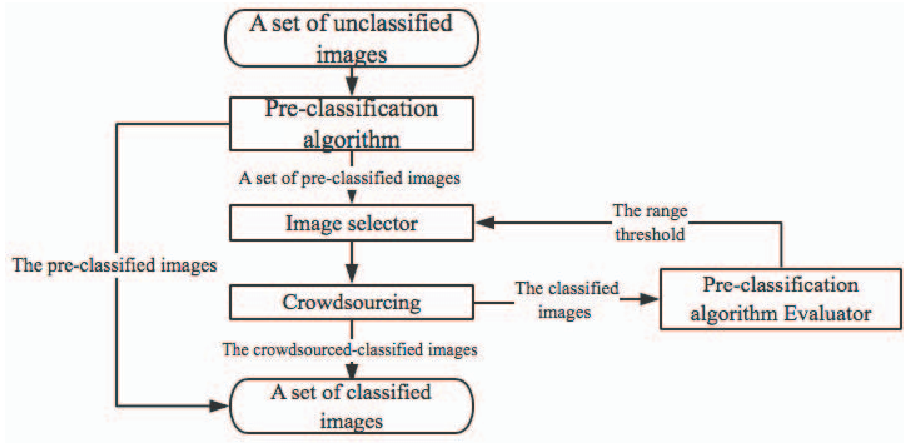
The core innovation lies in the Range Threshold (RT). Instead of a single point , the system defines an interval based on an Error Distribution Curve (EDC).
- Steady State: Images outside the range are classified instantly by the computer.
- Ambiguous State: Images inside the range are uploaded to a specialized medical crowdsourcing platform.
Ensuring Human Quality: WQEM & WPPM
Since not all crowd workers are medical experts, the paper introduces two filtering models:
- Worker Quality Evaluation Model (WQEM): Measures a worker's average score () and stability () over time.
- Worker Performance Prediction Model (WPPM): Uses exponential smoothing to predict a worker's next performance based on their recent trajectory, ensuring that only those currently "on their game" handle the hardest images.
Experimental Proof: Better Accuracy, Smarter Spend
Testing on 1,500 brain CT images, the HMC framework was compared against Morphological SVMs and Symmetry-based algorithms.

The results confirmed that most errors clustered around the threshold. By routing these to workers, the "Correction Rate" (C-Rate) reached 91.2% with only a moderate increase in cost. Furthermore, using WPPM to select workers resulted in significantly higher classification precision compared to random worker selection.

Deep Insight & Conclusion
Takeaway
The HMC framework proves that the future of medical AI isn't just "more data" or "deeper layers"—it's about optimal task allocation. By mathematically defining when an algorithm is "uncertain," we can build safety nets that leverage human expertise efficiently.
Limitations & Future Work
The model currently relies on a "weak symmetry" algorithm as the base classifier. Future iterations could replace this with State-of-the-Art (SOTA) Deep Learning models. Additionally, the framework assumes a steady supply of professional workers; scaling this to ultra-rare diseases where expert availability is low remains a challenge.