
OCTAB & MM-Eval: Scaling Micro-Level Behavior Annotation via the Crowd
Crowdsourcing Micro-Level Multimedia Annotations: The Challenges of Evaluation and Interface
The paper introduces MM-Eval, a novel evaluation framework for micro-level multimedia annotations, and OCTAB, a web-based tool integrated with Amazon Mechanical Turk. It demonstrates that crowdsourced fine-grained behavioral annotations (start/end times) can reach expert-level quality using a majority-vote mechanism.
TL;DR
Annotating the exact millisecond a person starts to frown or shake their head is historically an expert-only task. This paper changes that by introducing OCTAB, a frame-accurate web interface for Amazon Mechanical Turk, and MM-Eval, a metric framework that proves a majority vote of three "non-experts" can match the precision of professional annotators.
Background: The Granularity Gap
In the world of computer vision and human-behavior analysis, we are moving from Macro (e.g., "Is this video happy?") to Micro (e.g., "At exactly what frame did the user's eye gaze shift?"). Micro-level data is essential for training sophisticated AI, but it is notoriously expensive. Traditional expert tools like ELAN are too complex for crowdsourcing, creating a bottleneck for large-scale data production.
Problem & Motivation
The authors identified two primary hurdles:
- Interface Constraints: Most crowdsourcing tools lack the "frame-by-frame" control needed for micro-level work.
- Evaluation Deficiency: Standard metrics don't distinguish between a worker missing an event entirely (detection error) versus just getting the start/end times slightly wrong (segmentation error).
Methodology: The OCTAB & MM-Eval Framework
The researchers developed a two-pronged solution to bridge the expert-crowd gap.
1. OCTAB (The Interface)
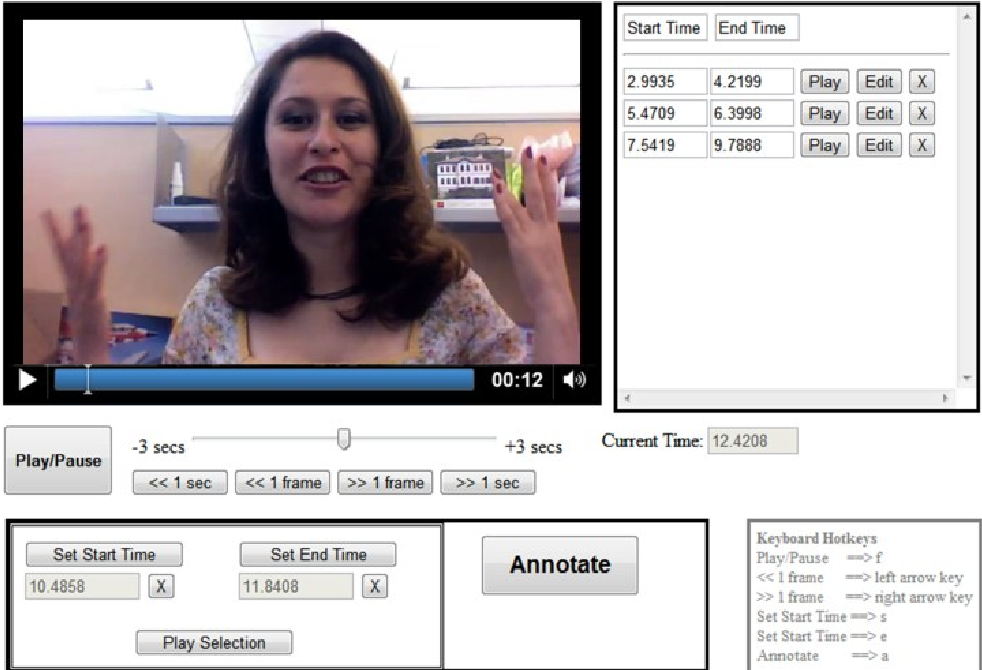
OCTAB (Online Crowdsourcing Tool for Annotations of Behaviors) is a lightweight, HTML-based player designed specifically for Mechanical Turk. It features:
- Frame-level precision: Buttons for fixed-interval jumps and a slider for fine-tuning.
- Low Barrier to Entry: Eliminated the "bloat" of professional software to ensure workers could start annotating within minutes.
2. MM-Eval (The Evaluation)
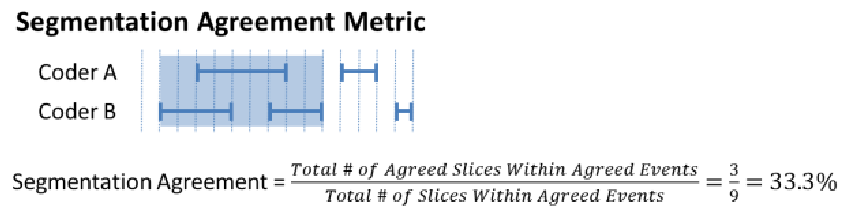
They adapted Krippendorff’s alpha to apply to "time-slices" (individual frames). To provide deeper insight, they added:
- Event Agreement Metric: Did both coders see the same frown? (The "What").
- Segmentation Agreement Metric: Did they agree on exactly when it ended? (The "When").
Experiments & Results
The study tested four behaviors: Gaze Away, "Um/Uh" pauses, Frowning, and Headshaking across 20 YouTube videos.
Key Findings:
- The Power of Three: By taking a majority vote of 3 workers, the final annotation quality was equivalent to the agreement between two local experts.
- Stability: The "Time-Slice Alpha" remained robust even when changing the frame sampling rate (1fps vs 25fps), proving it is a reliable metric for video data.
- Subtle vs. Obvious: Workers were excellent at spotting "obvious" cues like gaze shifts but needed better training for "subtle" cues like the exact boundary of a frown.
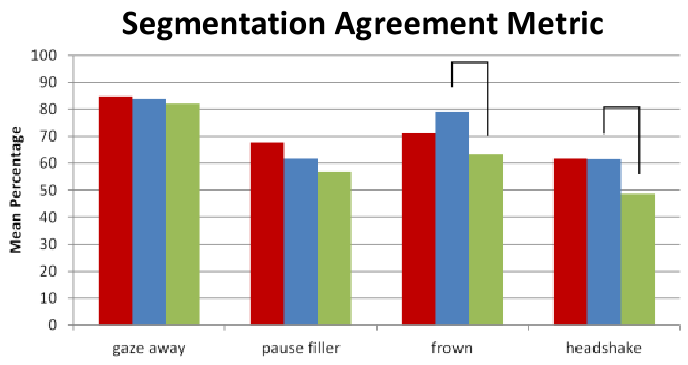 (The charts show that Crowdsourced Majority vs. Experts (blue bars) often meets or exceeds Expert-to-Expert agreement (red bars).)
Critical Analysis & Conclusion
Takeaway
The study proves that granularity is not the enemy of crowdsourcing. By designing interfaces for precision and using smart aggregation (majority voting), we can democratize the creation of high-fidelity temporal datasets.
Limitations & Future Work
- Complexity: This study focused on binary events (Presence/Absence). Scaling this to multi-class labels (e.g., differentiating between a "smirk" and a "grin") remains a challenge.
- Worker Training: The results suggest that "Segmentation" is where crowd workers struggle most. Future iterations should include interactive training modules that provide immediate feedback on boundary precision.
This work serves as a foundational blueprint for any researcher looking to build massive, time-aligned datasets without a massive budget.