
Mixed Elastic Systems: The Architecture of Hybrid Intelligence
Crowdsourcing, Mixed Elastic Systems and Human-Enhanced Computing–A Survey
This survey paper provides a comprehensive overview of Human-Enhanced Computing, specifically focusing on the intersection of Crowdsourcing and Hybrid Intelligence. It introduces the concept of "Mixed Elastic Systems," which enables the dynamic and automatic scaling of both human and machine computational resources to solve complex tasks.
TL;DR
This paper explores the evolution of Human-Enhanced Computing, moving beyond simple crowdsourcing toward Mixed Elastic Systems. These systems treat human intelligence and machine algorithms as unified, elastic resources that can be scaled dynamically to solve problems neither could handle alone.
Background & Motivation: The Gap Between Man and Machine
In the traditional computing paradigm, we face a binary choice: the brute-force scalability of machines or the nuanced intuition of humans. Machines excel at structured data processing but fail at "Human Intelligence Tasks" (HITs) like subjective analysis, complex pattern recognition (e.g., Galaxy classification), or linguistic nuance. Conversely, human crowdsourcing via platforms like Amazon Mechanical Turk (AMT) is often disorganized and difficult to integrate into automated workflows.
The authors argue that the industry is shifting toward a Mixed Elastic model. Here, "Elasticity" refers to the system's ability to provision human or machine units proactively based on demand, cost, and the required precision of the output.
Methodology: The Mixed Elastic Taxonomy
The core contribution of this paper is a rigorous classification of how humans are integrated into modern computational workflows.
1. Data-Driven vs. Computational Effort
- Data-Driven Elastic Effort: Humans act as sensors or data providers (e.g., using smartphones for urban noise mapping or crisis reporting). The human is usually at the beginning of the workflow.
- Computational Elastic Effort: Humans act as the processing engine—performing verification, labeling, or complex analysis within the workflow.
2. The Unified Service Model
The authors highlight a shift toward treating humans as Human-Provided Services (HPS). This allows for a service-oriented architecture (SOA) where a task can be routed to either an algorithm (Software-Based Service) or a human worker depending on which is "best suited" at that moment.
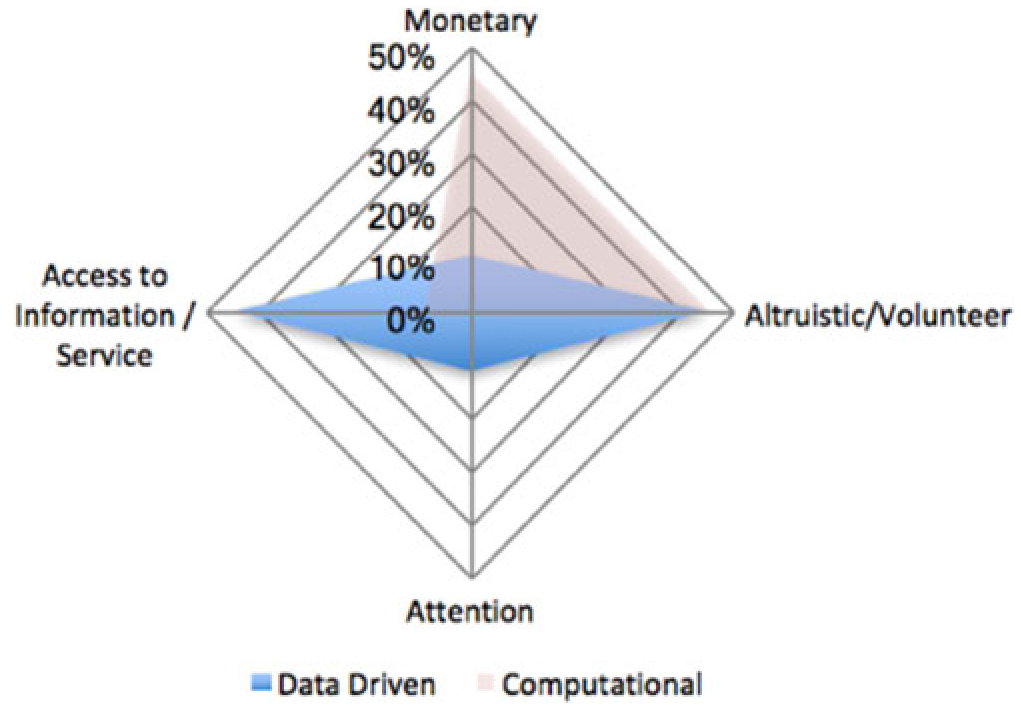 The diagram illustrates where human intervention typically occurs within data-driven vs. computational workflows.
Key Insights from the Survey
The survey analyzes a variety of state-of-the-art implementations, identifying several critical design patterns:
- Crowd Management & Ethics: The paper discusses the "Working Consumer" model and the risk of exploitation, emphasizing the need for robust Compensation Models (Monetary, Altruistic, or Access to Information).
- Quality Control: To counter the "untrustworthy" nature of anonymous crowds, systems like ExpertHITS and Galaxy Zoo use Bayesian models and gold-standard tests to filter low-quality human input.
- Scalability Metrics: Unlike traditional cloud computing which scales on CPU/RAM, Mixed Elastic Systems scale based on Precision, Complexity, and Time. If a machine's confidence score drops below a threshold, the system "elastically" scales by hiring human verifiers.
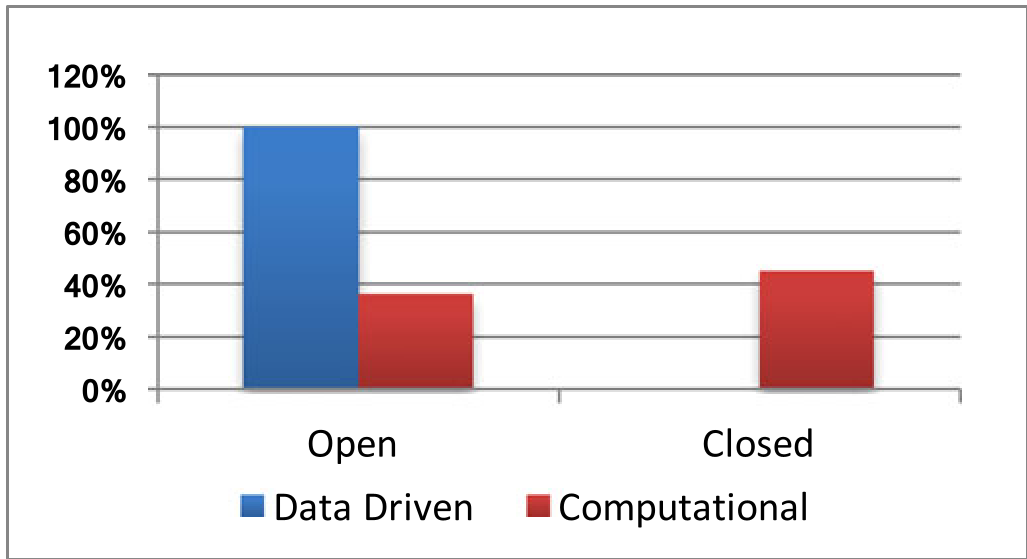 A comparison of metrics used to scale data-driven vs. computational efforts.
Critical Analysis & Conclusion
The Takeaway
This work provides the academic "coordinate system" for understanding how humans and AI will coexist. The real value is the definition of Elasticity—the idea that a system shouldn't just include humans, but should dynamically adjust how many humans it needs in real-time.
Limitations
While the taxonomy is robust, the paper notes that human-machine latency remains a bottleneck. Machines operate in milliseconds, while human response times are measured in minutes or hours. True "Mixed Elasticity" requires better predictive models to pre-fetch human resources before they are actually needed.
Looking Ahead
As we move toward a world of "Social Compute Units," we will likely see the rise of Passive Crowdsourcing, where tasks find the humans (based on their profiles and skillsets) rather than humans hunting for tasks. This transitions crowdsourcing from a gig-economy labor market into a seamless, virtualized computational component of the global cloud.