
Crowdsourcing the Edge: A Game-Theoretic Blueprint for Mobile Caching
Crowdsourcing for Mobile Edge Caching: A Game-Theoretic Analysis
The paper introduces a Mobile Crowdsourced Edge Caching (MCEC) framework using a two-stage Stackelberg game to model economic interactions between a Content Provider (CP) and edge devices (EDs). By employing evolutionary game theory, it identifies a unique market equilibrium where EDs strategically choose to be content agents or requesters based on revenue-sharing incentives.
TL;DR
This research tackles the "economic bottleneck" of mobile edge caching. By modeling the Content Provider (CP) as a leader and Edge Devices (EDs) as followers in a Stackelberg Game, the authors reveal how revenue-sharing ratios and device capacities drive the evolution of a crowdsourced market. They provide a mathematical proof for a unique market equilibrium where devices self-organize into "Agents" (cachers) and "Requesters."
The Incentive Gap in Edge Computing
Mobile Edge Caching is technically sound but economically fragile. While using smartphones or local WiFi points to store data reduces backhaul traffic, why would a user sacrifice their storage and battery? Previous works optimized how to cache but ignored why a selfish user would participate. The core difficulty lies in the dynamic interdependence: an ED's decision to be an agent depends on how many other agents exist and how much the CP is willing to pay.
Methodology: The Two-Stage Strategy
The authors break down the interaction into a two-stage hierarchical model:
- Stage I (The Leader's Vision): The CP sets a revenue-sharing ratio . This is a balancing act—too low and no one caches; too high and the CP loses profit.
- Stage II (The Follower's Evolution): Thousands of heterogeneous EDs (varying in valuation and cost ) decide their roles.
The Market Architecture
The paper visualizes the market share through analytical geometry, segmenting users into three distinct categories based on their payoffs:
- Agents: Cache content and earn a share of the revenue.
- Requesters: Download from agents to save energy or storage.
- Aliens: Opt-out of the system entirely.
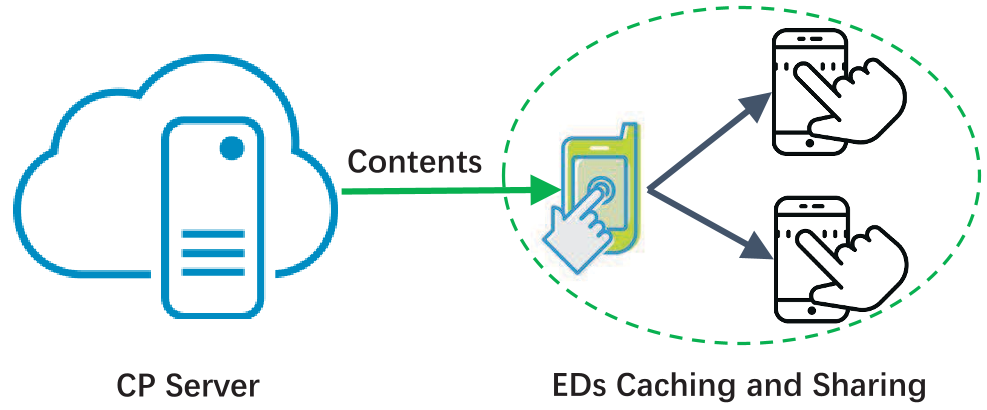
The crucial innovation is the Sharing Benefit (). It accounts for the physical reality that a single phone (agent) has a limited serving capacity (). If agents are saturated, the CP must step back in, altering the payoff for everyone involved.
Decoding the Equilibrium
The researchers prove that the market always converges to a Unique Subgame Equilibrium. They identify two distinct regimes:
- High Sharing Benefit Regime: Where incentives are strong and agents are plentiful.
- Low Sharing Benefit Regime: Where agents are scarce, and the system relies more on the central server.
By using backward induction, the CP can predict exactly how the ED population will split based on the chosen , allowing for a "piece-wise" optimization of its own profit function.
Experimental Insights & SOTA Evidence
The simulations validate several critical economic intuitions:
- The Price of Selfishness (Welfare Loss): Individual strategic behavior leads to a lower total welfare compared to a globally optimized system.
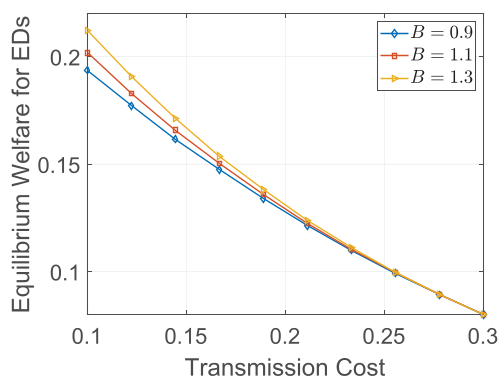
- Capacity as a Catalyst: As the serving capacity () of devices increases, the system naturally leans towards a more decentralized "crowdsourced" state, significantly increasing total user welfare.
- Content Price Sensitivity: Higher content prices () actually lead to larger welfare losses for users, as the "price of anarchy" in role selection becomes more pronounced.
Critical Analysis & Future Outlook
This work provides a rigorous theoretical foundation for MCEC. However, its reliance on Uniform Distribution for costs and valuations might oversimplify real-world social peaks.
Future Directions:
- Mobility Patterns: How does the equilibrium shift when agents move in and out of D2D range?
- Multi-CP Competition: Real markets have multiple providers (e.g., Netflix vs. YouTube) competing for the same edge storage.
In conclusion, this paper moves edge caching from a pure engineering problem to a sophisticated market design problem, proving that with the right , the "crowd" can indeed be the backbone of the next-generation internet.