
Game Theory Meets Green Buildings: A Crowdsourcing Approach to Large-Scale Retrofitting
13079_Crowdsourcing Model for Energy Efficiency Retrofit and Mixed-Integer Equilibrium Analysis.
This paper introduces a Crowdsourcing Model (CM) for Building Energy Efficiency Retrofit (BEER) that addresses multi-stakeholder incentive allocation. It leverages a Stackelberg game approach to determine optimal budgets and task distribution between a requestor (leader) and Energy Service Companies (followers) handling mixed-integer decisions.
TL;DR
Building Energy Efficiency Retrofitting (BEER) is critical for global energy reduction, yet large-scale projects often stall due to conflicting interests between building owners and contractors. This paper proposes a Crowdsourcing Model (CM) backed by Stackelberg Game theory to solve the "incentive gap," proving that decentralized competition leads to more stable and efficient energy savings than traditional centralized auctions.
The "Incentive Gap" in Green Retrofitting
Most existing BEER research operates on a "single-stakeholder" assumption—basically, an optimization problem where one owner tries to save the most energy for the least cost. However, real-world large-scale projects involve multiple Energy Service Companies (ESCOs).
The core problem is Individual Rationality: ESCOs won't participate if the cost of high-efficiency tech (like advanced HVAC or windows) exceeds their share of the reward. Traditional models fail because they don't account for this competition, leading to "irrational" allocation where contractors lose money or refuse to join.
Methodology: The Stackelberg Competition
The authors frame the problem as a Leader-Follower structure:
- The Leader (Requestor): Sets the overall budget and energy saving (ES) targets.
- The Followers (ESCOs): Decide their participation rates () to maximize their individual profit.
What makes this paper mathematically robust is its handling of Mixed-Integer Decisions. Some retrofits (like lighting) are continuous, while others (like replacing an entire facade) are binary (0 or 1).
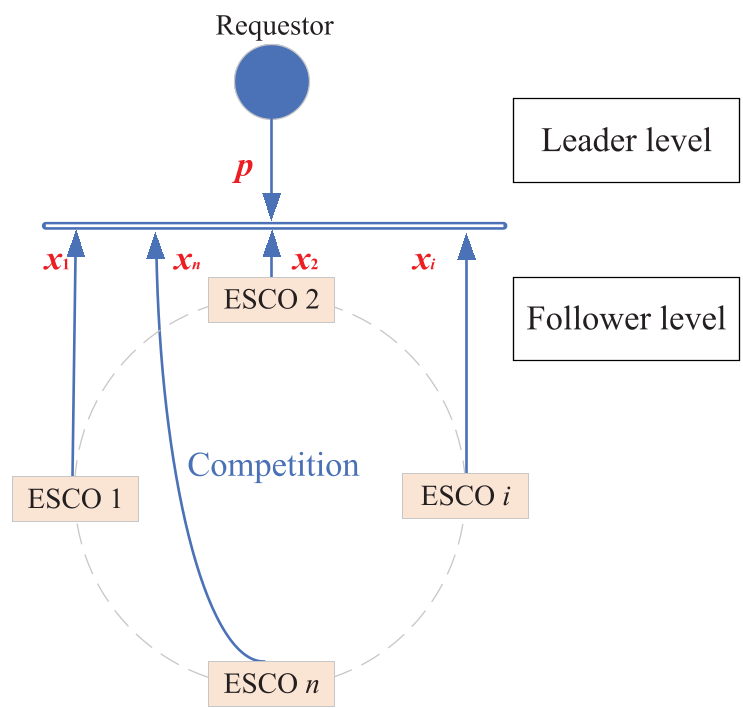
The authors prove that a Nash Equilibrium (NE) exists among ESCOs for any given budget. They developed a unique search algorithm that uses "Best Response" iterations to find the stable state where no ESCO has an incentive to change their strategy.
Experimental Proof: Superior Savings
In a simulation involving 11 heterogeneous buildings, the proposed Stackelberg Game (SG) approach was compared against heavy hitters like the Vickrey-Clarke-Groves (VCG) and Uniform Procurement (UP) auctions.
Key Findings:
- Efficiency: The SG approach achieved 7.948 million kWh in energy savings, nearly 5x more than the VCG auction under identical budget constraints.
- Flexibility: When an ESCO leaves the project mid-way, the SG model automatically re-equilibrates, redistributing the task to ensure the project meets its energy goals—a feat centralized auctions struggle to achieve.
- Robustness: The model remains stable even with communication delays (up to 6 iterations) and handles parameter uncertainty effectively.
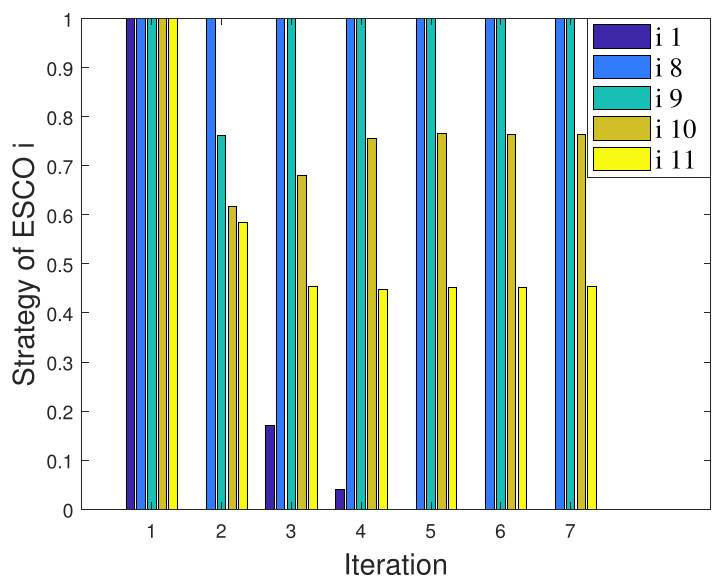
Critical Insight: Why Does It Work?
The success lies in the Marginal Cost Visibility. Unlike centralized "winner-take-all" auctions, the Crowdsourcing Model allows each participant to optimize their own "Utility Map." By ensuring that every participant is "rational" (utility > 0), the system naturally attracts the most efficient providers to take on the largest shares of the task.
Conclusion & Future Outlook
This research moves BEER from a simple engineering problem to a sophisticated economic governance problem. By proving the existence of a unique Stackelberg Equilibrium, the authors provide a "gold standard" for how governments and large corporations should manage multi-contractor energy projects.
Future Work: The authors suggest integrating human comfort metrics and greenhouse gas emissions directly into the utility functions, moving toward a truly multi-objective "Green Equilibrium."