
Multi-Dimensional Trust: Precision Information Fusion in Crowdsourcing
Crowdsourcing with multi-dimensional trust and active learning
The paper introduces a Multi-Domain Crowdsourcing (MDC) framework that utilizes multi-dimensional trust vectors and active learning to aggregate information from unreliable workers. By incorporating question metadata via Gaussian Mixture Models (MDFC) and Latent Dirichlet Allocation (MDTC), the authors jointly infer question domains, worker expertise, and ground truth labels.
TL;DR
Standard crowdsourcing assumes a worker is either "good" or "bad." This paper shatters that 1D view, introducing MDTC (Multi-Domain Topic Crowdsourcing). By modeling workers as having different expertise levels across multiple topics and using Active Learning to pair the right worker with the right question, the system dramatically reduces error rates and annotation costs.
The "Generalist" Fallacy in Crowdsourcing
In typical information fusion tasks, we aggregate labels from the "crowd" to find the ground truth. Prior State-of-the-Art (SOTA) models—like the classic Dawid-Skene model—assign a single reliability score to each worker.
However, human knowledge is specialized. A worker might be a SOTA annotator for "Legal Documents" but completely "malicious" (noisy) when asked about "Biochemistry." Treating them as a generalist leads to two major failures:
- Diluted Accuracy: High-quality input in one domain is overshadowed by poor performance in another.
- Inefficient Spending: We waste money asking biology experts to solve math problems.
Methodology: Mapping the Expertise Manifold
The authors propose a generative model where each question has a hidden concept vector () and each worker has a hidden trust vector ().
1. The Probabilistic Framework
The core innovation is the joint inference. The model doesn't just guess the label; it simultaneously learns:
- What is this question about? (Domain discovery via LDA or GMM)
- Who knows about this topic? (Multi-dimensional trust estimation)
- What is the likely answer? (Label aggregation)
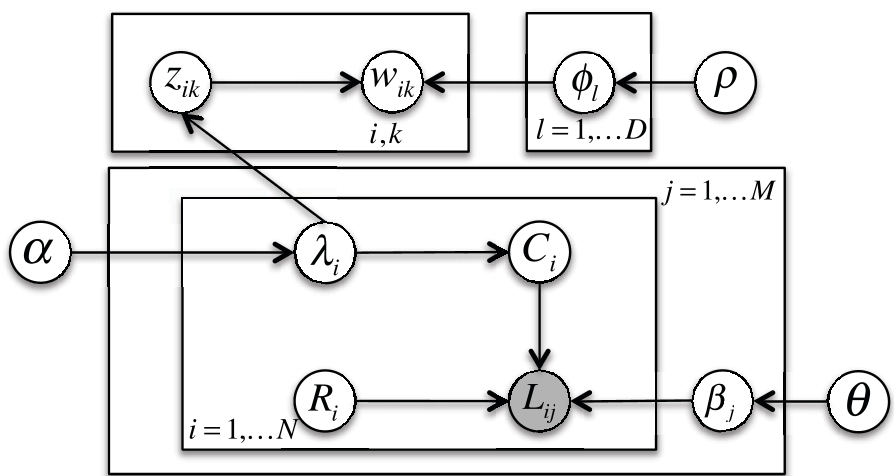 Figure 1: The MDTC Graphical Model, which integrates text features (words ) to discover latent domains () and align them with worker trust vectors ().
2. Active Learning: Surgeon-like Precision
Rather than waiting for random annotations, the authors propose an Active Learning loop:
- Question Selection: Pick questions with the highest Information Entropy (where the model is most confused).
- Worker Selection: Assign that question to the worker whose trust vector has the highest alignment with the question's domain.
Experimental Results
The researchers tested their approach on UCI machine learning data and a complex biomedical text corpus.
Performance Gains
The MDTC + Active Learning combination consistently outperformed all baselines. A key finding was the "Learning Speed": the system achieved lower error rates with significantly fewer samples than random assignment.
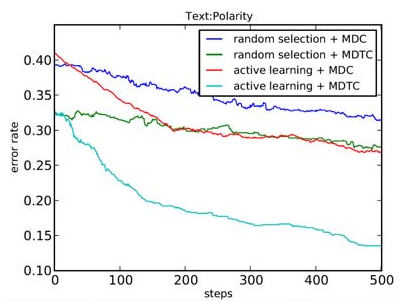 Figure 2: Error rate reduction comparison. Active learning (red/purple lines) converges to lower error rates much faster than random selection (blue/green lines).
Entropy Reduction
The active learning strategy doesn't just improve accuracy; it clarifies the system's internal state. By targeting "difficult" questions, the Label Entropy drops rapidly, and by targeting the "right" workers, the Trust Entropy decreases, meaning the system learns who the experts are much faster.
Critical Insights & Takeaways
- Flexibility is Key: The MDC framework is a "plug-and-play" model. Whether you have raw features (MDFC) or text (MDTC), the multi-dimensional trust core remains robust.
- Beyond Humans: While framed as "crowdsourcing," this is actually a generalized Information Fusion theory. It can be applied to fusing outputs from different Sensors (which might fail in specific conditions) or diverse Machine Learning models (MoE-style).
- Limitations: The model assumes that domains are relatively static and that worker expertise doesn't shift dramatically during the task. In highly dynamic environments, a temporal trust decay might be needed.
Final Recovery
This work moves crowdsourcing from "blind aggregation" to "intelligent coordination." By treating trust as a vector rather than a scalar, we can build systems that respect and leverage the inherent diversity of human (and machine) expertise.