
Crowdsourcing for Music: Decoding the New Era of Mass Collaboration
Crowdsourcing for music: Survey and taxonomy
The paper "Crowdsourcing for Music: Survey and Taxonomy" presents a comprehensive overview of how mass collaboration and "crowd computing" are redefining the music industry. It introduces a novel taxonomy classifying music-centric platforms into six categories: co-creation, decision support, collection management, marketplace, release, and crowdfunding.
TL;DR
This paper explores how the Internet has transformed music from a solo expert endeavor into a "crowd computing" phenomenon. By analyzing a decade of digital evolution, the authors establish a taxonomy of six key ways the "crowd" powers the music industry today: through Co-creation, Decision Support, Management, Marketplaces, Promotion (Release), and Crowdfunding.
Academic Positioning: This is a foundational survey paper that bridges the gap between Social Computing and Musicology, providing a structural roadmap for the "Music 2.0" era.
Problem & Motivation: Beyond the Ivory Tower of Music
For decades, the path to a musical career was a rigid hierarchy: record labels, professional studios, and expert scouts. This "expert-only" model created two major friction points:
- Cognitive Bottleneck: Creative input was limited to a few individuals.
- Financial Risk: High production costs meant investors were afraid to bet on innovative or "niche" artists.
The authors argue that the "Wisdom of Crowds" (Surowiecki, 2005) suggests that a diverse group is often smarter and more creative than its most talented individual member. The motivation of this study is to categorize how Web 2.0 tools have finally unlocked this latent "mental space of the globe" for musical production.
Methodology: The "Crowd Music" Taxonomy
The core of the paper is the definition of Crowd Computing as an umbrella term. The authors position music-based crowdsourcing at the intersection of three technical domains:
- Human Computation: Using humans to solve tasks computers cannot (e.g., Tagatune for music annotation).
- Social Computing: Facilitating social dynamics via software (e.g., MySpace, Facebook).
- Audience-Computer Interaction: Real-time feedback loops between performers and the crowd (e.g., TweetDreams).
The Taxonomy Breakdown
The authors categorize the landscape into six functional pillars:
- Music Co-Creation: Tools like Indaba Music and Kompoz allow non-professionals to record and mix tracks collaboratively across borders.
- Decision Support: Platforms like StereoPill or PicktheBand let fans choose setlists or album directions, reducing the market risk for artists.
- Crowdsourced MCM (Music Collection & Management): Utilizing the crowd to tag, classify, and organize the vast ocean of digital audio (e.g., Last.fm).
- Marketplace: Connecting "crowds of vendors" with "crowds of consumers" (e.g., Voices.com for vocal talent).
- Release: Using social networks as a viral distribution engine where users "promote" content through their own social capital.
- Crowdfunding: Financial mobilization (e.g., Kickstarter, ArtistShare) to bypass traditional label funding.
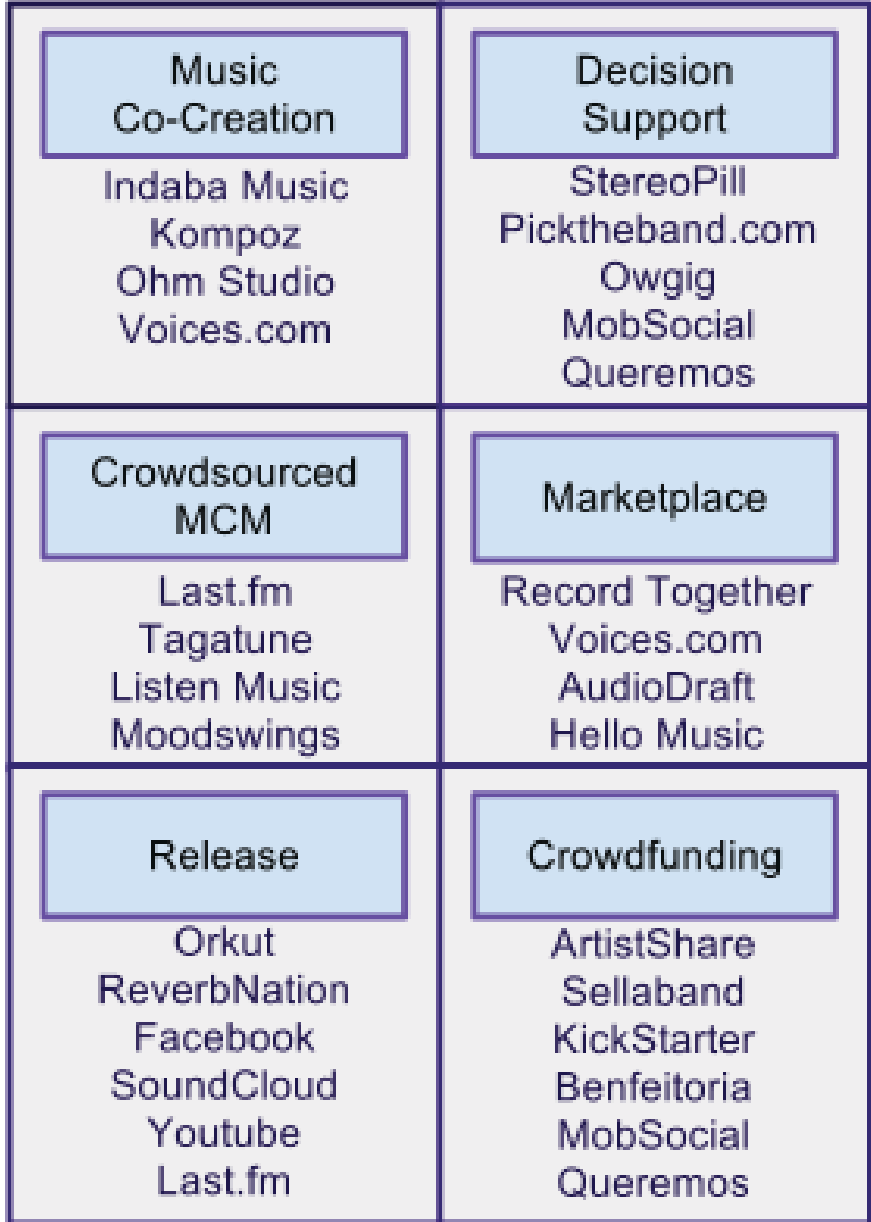 Figure: The Taxonomy of Crowdsourcing for Music Platforms.
Experiments & Results: A Decade of Disruption
The authors traced a timeline (2000–2012) showing the rapid explosion of these services.
- Case Study: Maroon 5: The paper highlights a 24-hour session where Maroon 5 used fan suggestions from Twitter/Facebook to compose "Is Anybody Out There." This served as a proof-of-concept for real-time, large-scale co-creation.
- Market Analysis: The survey notes that platforms like Indaba grew to half a million users by 2012, proving that "prosumer" (producer-consumer) interest was not just a fad but a legitimate shift in production models.
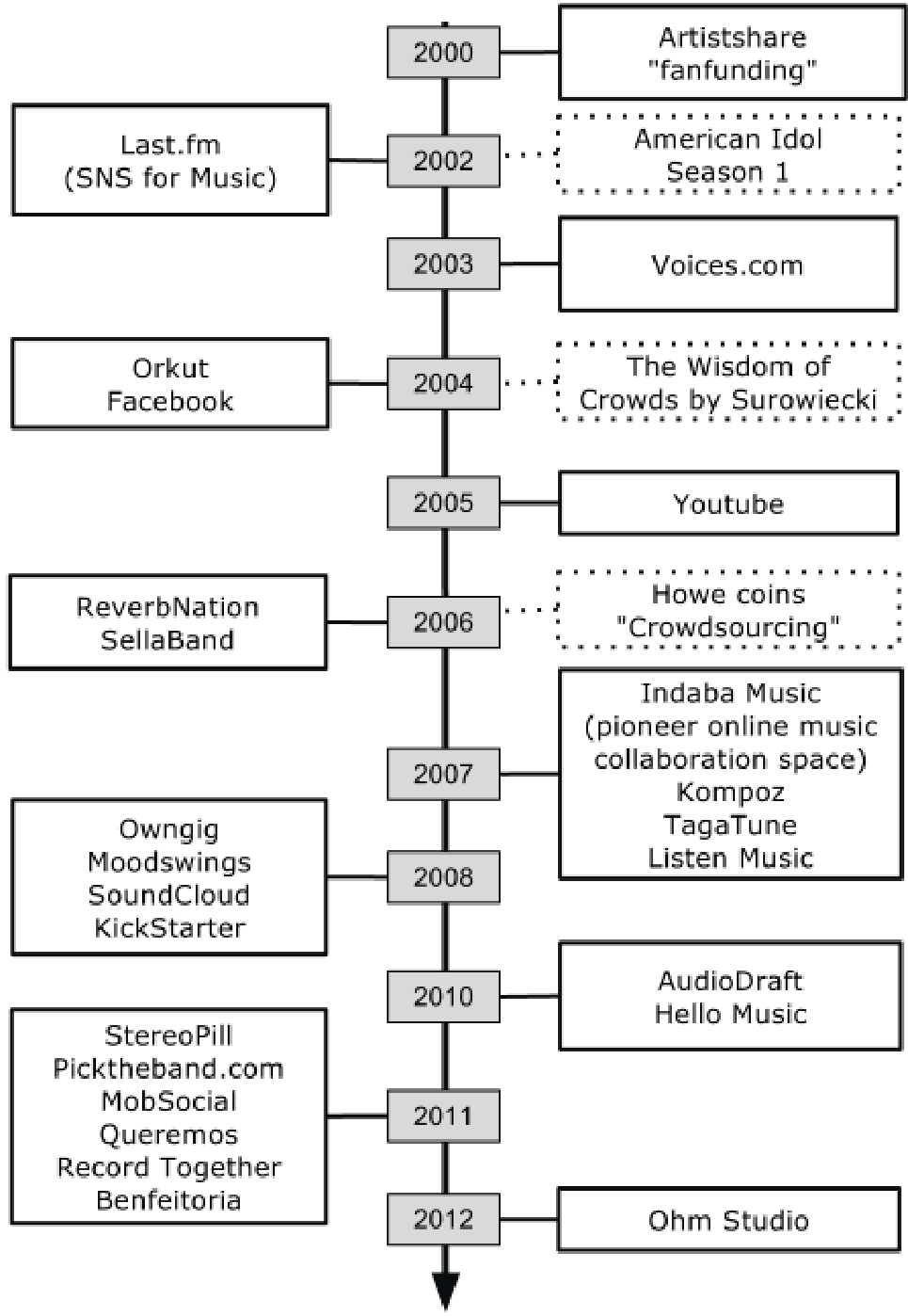 Figure: Timeline showing the evolution from early Fan-funding (ArtistShare) to complex Marketplace/Co-creation tools.
Critical Insight & Future Outlook
While the taxonomy is robust, the authors honestly identify several "open wounds" in the field:
- Crowd Management: As crowds grow, how do we prevent "noise" and ensure quality? Heterogeneity of behavior is a double-edged sword.
- Persuasive Systems: There is a need for research into what motivates a crowd to participate for free (or for small rewards).
- The Creativity Paradox: Does music made by a "committee" lose its artistic soul? The paper suggests further study into how "collective creativity" differs from individual genius.
Final Takeaway
This paper is a call to action for developers and sociologists. It proves that the music industry has moved past the "broadcast" model. In the future, the most successful music products won't just be songs—they will be the collaborative platforms that allow artists and fans to coexist in a single creative ecosystem.