
Engineering Empathy: Using Crowdsourcing to Build Authentic Emotional Support Agents
Using Crowdsourcing for the Development of Online Emotional Support Agents
This paper presents a framework for developing an online socialbot designed to provide emotional support to stressed users on Twitter. By leveraging crowdsourcing to analyze 10,000 tweets, the authors map specific stressful situations (e.g., Death, Work, School) to human-preferred emotional support strategies, creating a data-driven basis for a supportive agent.
TL;DR
Researchers from Vrije Universiteit Amsterdam are bridging the gap between human empathy and AI by analyzing 10,000 tweets to see how people actually support each other online. Their findings reveal that effective support isn't one-size-fits-all: while a "hug" (General Emotional Support) works for health issues, "reframing the problem" (Cognitive Change) is the gold standard for work and school stress.
Contextual Positioning
In the landscape of Affective Computing, this work acts as a bridge between Social Science theory (Gross’s Emotion Regulation) and Practical AI implementation. It moves away from "canned" chatbot responses toward a statistically grounded model of human-like peer support.
The Problem: The "Empathy Gap" in Digital Support
Computer-Mediated Emotional Support (CMES) is a lifeline for millions, yet human supporters often suffer from "compassion fatigue" or are simply unavailable. While Computer-Generated Emotional Support (CGES) offers a 24/7 solution, early prototypes often feel robotic or inappropriate. The core challenge is: How do we teach an agent not just what to say, but which psychological strategy to deploy based on the specific stressor?
Methodology: Crowdsourcing Human Intuition
The researchers conducted a multi-stage empirical study using Twitter data and crowdsourcing:
- Data Collection: 10,000 tweets were pulled using keywords related to Death, Finances, Health, Relationships, School, and Work.
- Categorization: Human workers classified these into stress categories.
- Strategy Selection: Participants were asked how they would respond, choosing from five strategies:
- Situation Selection (SS): Avoiding the stressor.
- Situation Modification (SM): Changing the environment.
- Attentional Deployment (AD): Distraction.
- Cognitive Change (CC): Re-interpreting the situation.
- General Emotional Support (GES): Empathy and caring.
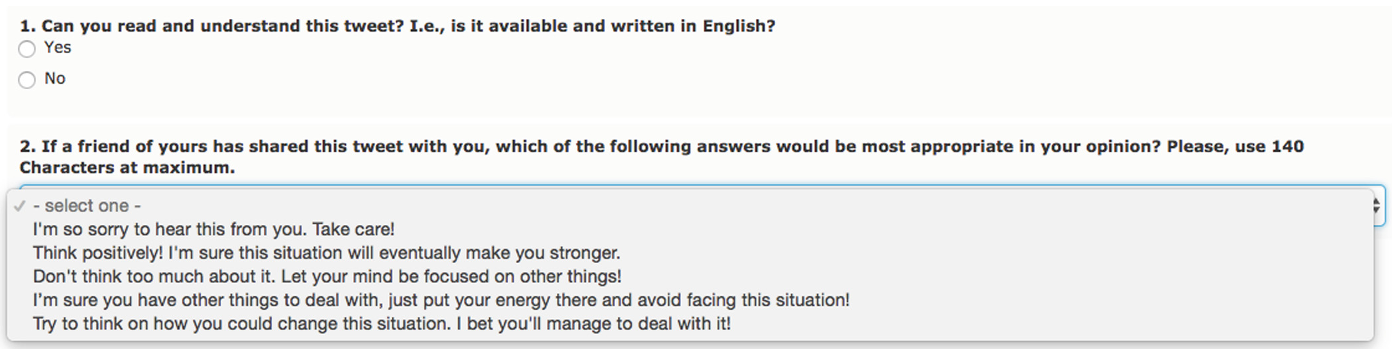 Figure 1: The experimental flow for selecting and classifying support strategies.
Key Insights: Precision Support
The study’s most significant contribution is the statistical mapping of stressors to strategies. Through 2 million simulations, the team identified where human preference deviates from "random" chance.
- Health & Death: Dominated by General Emotional Support. In these scenarios, users seek validation and comfort rather than advice or reframing.
- School & Work: These are the only categories where Cognitive Change (CC) emerged as the preferred strategy. Peer support in these domains focuses on helping the victim see the "bigger picture" or a different perspective.
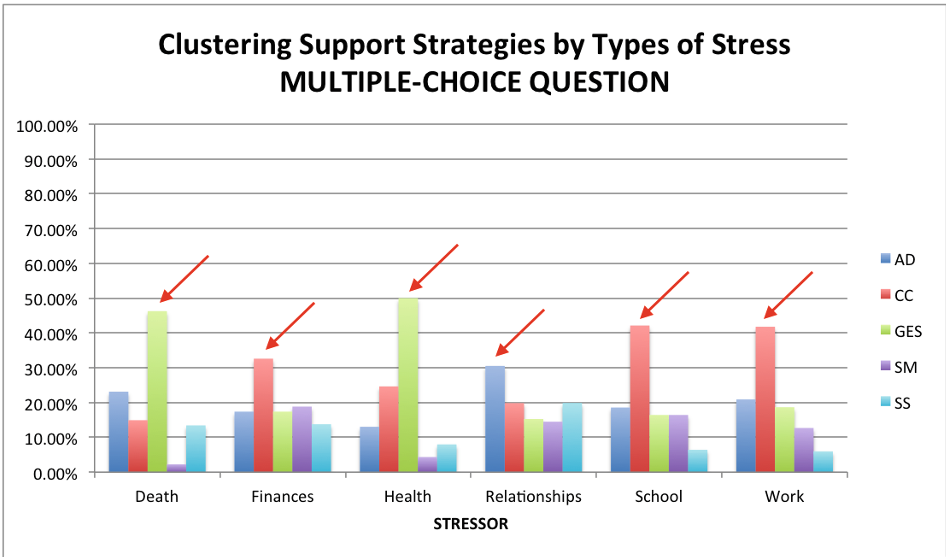 Figure 2: Distribution of support strategies across different stressors. Red arrows indicate statistically significant preferences.
Critical Analysis & Future Outlook
Strengths
The paper successfully validates that "everyday stress" requires nuanced strategy selection. By using Twitter data, the study captures high ecological validity compared to clinical lab settings.
Limitations
- The "Human-Parity" Bias: The authors aim to mimic humans, but as noted, humans aren't always perfect at providing support. An AI that mimics a "bad" human supporter might be counterproductive.
- Demographic Bias: Twitter users skew younger, which explains the high frequency of school-related stressors in the dataset.
The Future of Socialbots
The next step for this research is integrating these "contingency tables" into live Socialbots. Imagine a Telegram bot that detects a "Work" keyword and automatically switches its personality from "Empathetic Listener" to "Cognitive Reframer." This data-driven approach is the blueprint for the next generation of digital mental health companions.
Conclusion (Takeaway)
This research proves that for AI to be truly supportive, it must understand the context of the pain. By quantifying human peer-support patterns, we can move closer to "Artificial Friends" that don't just calculate responses, but choose the right psychological tool for the job.