
Bridging the Last Mile: A Crowdsourcing Architecture for Cleft Lip and Palate Care
Crowdsourcing Platform for Healthcare: Cleft Lip and Cleft Palate Case Studies
The paper presents a specialized healthcare crowdsourcing architecture designed to bridge the gap between high-level specialist platforms (Thaicleftlink) and community-level mobile health applications (Aorsormor Online). The system focuses on specific workflows for Cleft Lip and Palate patients, significantly improving follow-up rates and early diagnosis through localized volunteer networks.
TL;DR
Specialist healthcare often fails not due to lack of medical expertise, but due to logistical attrition. This paper details a novel crowdsourcing bridge connecting Thailand's "Thaicleftlink" (a specialist platform) with "Aorsormor Online" (a village volunteer app). By delegating routine follow-ups and patient discovery to local volunteers, the system ensures that children with facial clefts receive time-sensitive surgery without the burden of constant travel to distant regional hospitals.
Background: The Fragmented Care Reality
Cleft treatment is a marathon, not a sprint. It lasts from birth until roughly age 20, requiring a multidisciplinary team. In Thailand, the healthcare system is tiered into four levels. The tragedy? Most expertise sits at Level 4 (Quaternary Care), while most patients live near Level 1 (Primary Care).
The authors identified a critical "Information Silo" where specialists had no reliable way to confirm if a rural patient was healthy enough for surgery or if they even remembered their appointment, leading to wasted resources and missed surgical windows.
Methodology: The Two-Way Bridge
The researchers didn't build a new app; they built a bridge. They extended the functionality of two existing platforms to create a synergistic ecosystem.
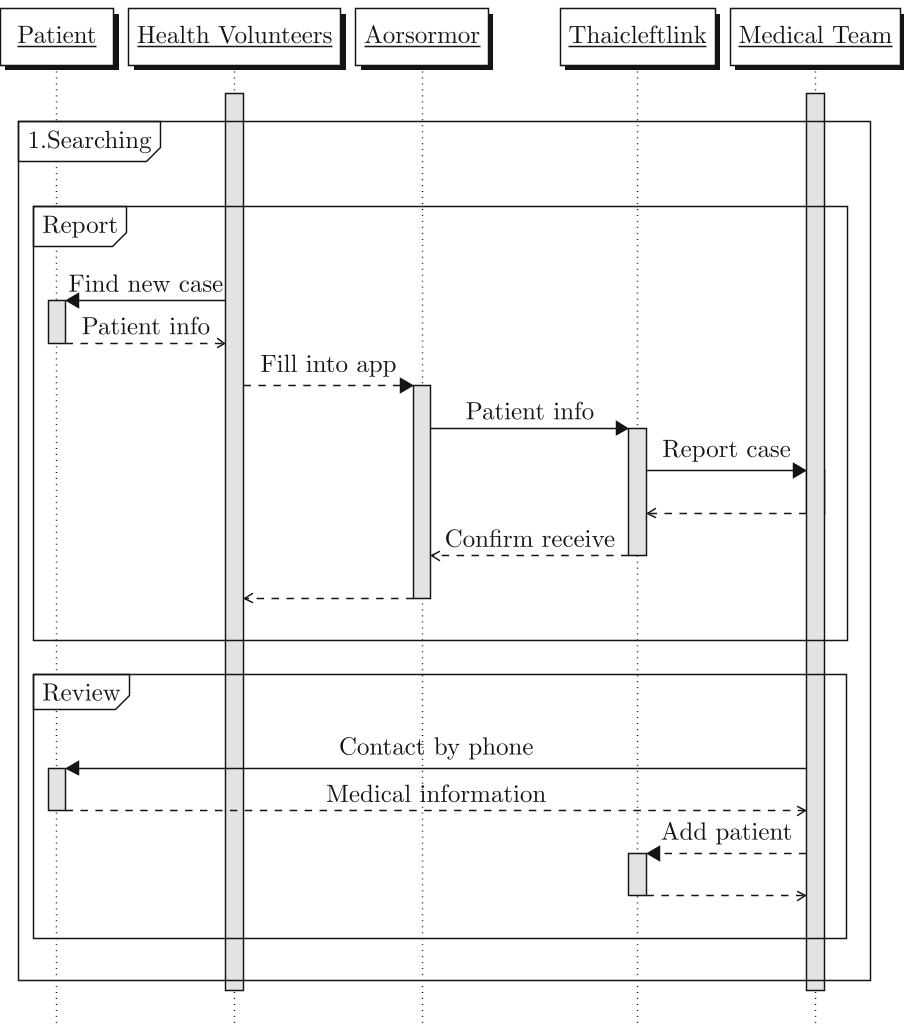
1. The Searching Module (Discovery)
Early intervention is everything—specifically for Nasoalveolar Molding (NAM), which must start shortly after birth.
- The Insight: Village Health Volunteers (VHV) are trusted neighbors.
- The Workflow: Volunteers identify infants, fill out a simple "New Patient Form" on their mobile app, and push the data directly to the specialist center.
2. The Following Module (Execution)
This is where the crowdsourcing saves the medical team hours of desk work. Instead of nurses cold-calling patients, the system pushes requests to volunteers:
- Pre-surgery check: Does the patient have a fever or cough?
- Appointment confirmation: Can the family travel next Tuesday?
- Post-surgery check: Are there signs of infection?
Technical Considerations: Privacy vs. Utility
A major challenge in healthcare crowdsourcing is Data Privacy. Volunteers do not need a patient's full clinical history. The bridge system solves this by:
- Data Sanitization: No medical history or diagnosis is shared with the volunteer app.
- Just-in-Time Access: Only the profile photo, address, and contact info are provided for the specific task at hand.
- Network Security: All communication uses HTTPS with strict IP Filtering to ensure only authorized servers can talk to each other.
Critical Insight: Why This Matters
The genius of this system lies in its recognition of Social Capital. A specialist hospital in a big city is an intimidating institution for a rural family. A village volunteer, however, is a friend. By leveraging that trust, the system overcomes the "compliance barrier" that plagues many long-term medical treatments.
Conclusion and Limitations
The system is a stellar example of Service Design in digital health. However, as the authors note, it relies heavily on the "active status" of volunteers and response times. If a volunteer is inactive, the follow-up loop breaks. Future iterations could benefit from automated escalation pathways or gamification to keep the volunteer network engaged.
Ultimately, this architecture proves that "letting the data travel instead of the patient" is a viable, scalable strategy for specialized chronic care in geographically dispersed populations.