
Crowdsourcing Science: A Framework to Solve the "Wicked Problems" of Research Funding
A Crowdsourcing Practices Framework for Science Funding Call Processes
This paper proposes a systematic Crowdsourcing Practices Framework tailored for Public Scientific Research Funding Agencies (SRFAs). By adapting open innovation models, it identifies nine critical challenge categories in the grant call and assessment process, aiming to modernize traditional "closed" peer review systems using the "wisdom of crowds."
TL;DR
Scientific funding is stuck in a "closed" era. This research proposes a Crowdsourcing Practices Framework to break down the silos of Research Funding Agencies (SRFAs). By identifying nine core challenges—from reviewer diversity to transparency—the paper provides a roadmap for integrating open innovation into the heart of science policy.
Background: The Crisis of the "Closed" Review
Public funding agencies are the gatekeepers of innovation, yet their internal processes often resemble 20th-century bureaucracies more than modern tech hubs. They face "Wicked Problems": challenges with contradictory requirements that are nearly impossible to solve through traditional, insular methods. While the private sector has embraced crowdsourcing to solve complex tasks, science funding has remained largely immune—until now.
The "Why": Motivation for Open Science
The author, Eoin Cullina, argues that funding agencies sit at a volatile intersection of government policy, academic rigor, and public expectation. Current systems fail because:
- Expert Fatigue: There is extreme competition for a limited pool of top-tier reviewers (CIII).
- Lack of Diversity: Homogeneous reviewer pools may miss high-risk, high-reward novelty (CII).
- Transparency Deficit: Traditional "shrouded" reviews foster distrust (CVI).
Methodology: Bridging IS and Science Policy
The research follows a rigorous hermeneutic approach, cycling through literature and case studies to adapt existing Information Systems (IS) frameworks to the unique constraints of SRFAs.
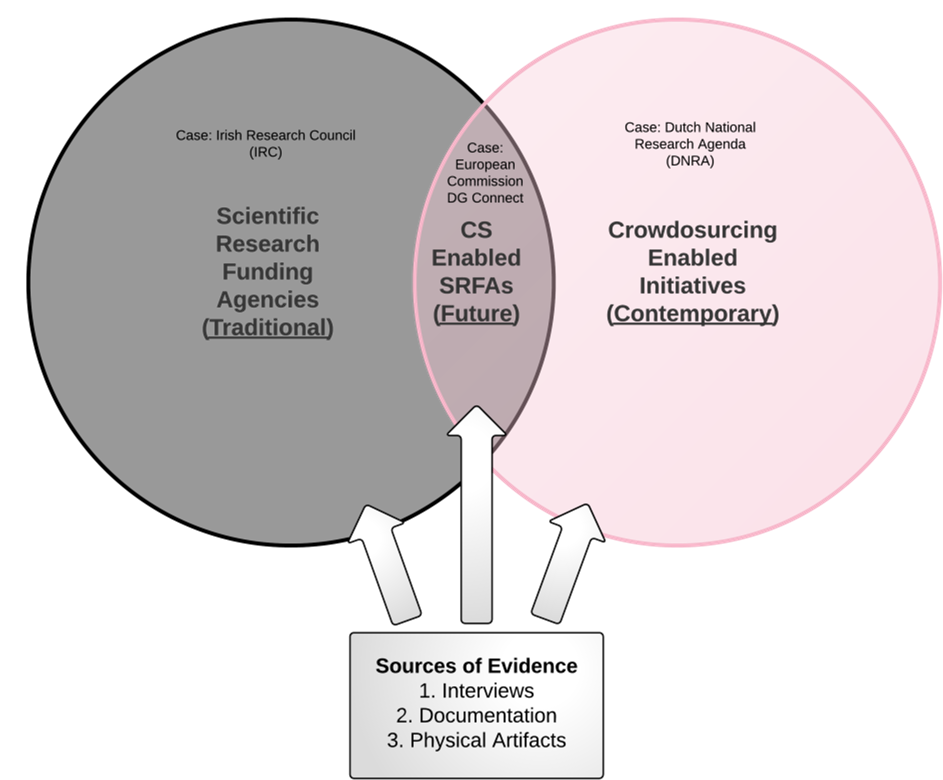 Figure 1: The multi-stage research approach involving pilot studies and case studies across three organizational categories.
The Core: 9 Categories of Challenges
The framework identifies nine strategic hurdles that funding agencies must clear to successfully implement crowdsourcing:
- CI: Stakeholder Interaction: How to align government policy with public needs?
- CII: Novelty vs. Excellence: Can a "diverse crowd" maintain the same rigor as "elite experts"?
- CIV: System Scalability: Traditional submission portals cannot handle the volume or the collaborative nature of crowd-voting.
- CVII: Cultural Shift: Moving from a "closed" institutional culture to an "Open Innovation" paradigm is perhaps the greatest non-technical hurdle.
- CIX: New Metrics: Bibliometrics (citations) are no longer enough; we need metrics for societal impact.
Critical Insight & Results
The paper highlights that "simple scoring or voting systems" (like those used in basic crowdsourcing) are insufficient for the complex needs of scientific competition. The transition requires a sophisticated middle ground—what the author calls "Crowdsourcing-Enabled Funding Agencies."
While the paper is an extended abstract and focuses on challenges, the underlying data from 38 interviews suggests a massive appetite for change, limited currently by outdated software infrastructure and institutional inertia.
Conclusion & Future Outlook
This framework is a vital first step in moving SRFAs toward Innovation 2.0.
Takeaway for the Industry: Crowdsourcing is not just about "outsourcing" work to the public; it's about increasing the surface area of participation to ensure that the most impactful science gets funded. Future work must bridge the gap between these strategic challenges and the specific technological tools (e.g., blockchain for transparency, AI for reviewer matching) that can solve them.
Limitations: The current framework focuses on the agency's strategic view. To be truly holistic, future research must incorporate the applicant's perspective—ensuring that "opening" the process doesn't simply create more administrative "noise" for the scientists themselves.