
Balancing the Lens: A Crowdsourcing Framework for Evaluating Privacy in Surveillance
Crowdsourcing approach for evaluation of privacy filters in video surveillance
This paper introduces a crowdsourcing-based subjective evaluation methodology to assess video privacy filters (blurring, pixelization, and masking). By utilizing a custom Facebook application, the researchers measured the tradeoff between privacy preservation and activity intelligibility, identifying pixelization as the most balanced technique.
TL;DR
With the surge of video surveillance, protecting the privacy of individuals without rendering the security footage useless is a critical challenge. This paper by Korshunov et al. presents a novel crowdsourcing methodology to evaluate common privacy filters like blurring and pixelization. Through a large-scale experiment on Facebook, they prove that pixelization strikes the best balance between hiding identity and maintaining "intelligibility"—the ability to see what is actually happening in a scene.
The Core Conflict: Privacy vs. Utility
In the world of surveillance, we face a paradox. If we hide everything (Complete Masking), privacy is 100% but the video is useless for security. If we hide nothing, security is high but privacy vanishes.
Previous studies were restricted to expensive, small-scale lab tests. The authors argue that these "clean" environments don't reflect the reality of a security guard watching a grainy monitor in a dark room. They sought a way to measure the subjective ground truth at scale.
Methodology: The "VideoRate" Approach
The researchers built VideoRate, a Facebook application designed to leverage social trust and authentic user IDs.
1. The Dataset & Filters
The study used 9 indoor sequences featuring normal and suspicious behaviors (e.g., someone wearing a scarf to hide their face or blinking a secret code). Three filters were applied:
- Blurring: Reducing high-frequency details.
- Pixelization: Reducing spatial resolution in specific regions.
- Masking: Replacing the person with a solid black silhouette.
2. Measuring the Tradeoff
The methodology split human perception into two distinct scores:
- Privacy Score: Can you tell the person's gender? Their race? If yes, the filter failed.
- Intelligibility Score: Can you see if they are blinking? Can you tell they are wearing sunglasses? If yes, the surveillance task is successful.
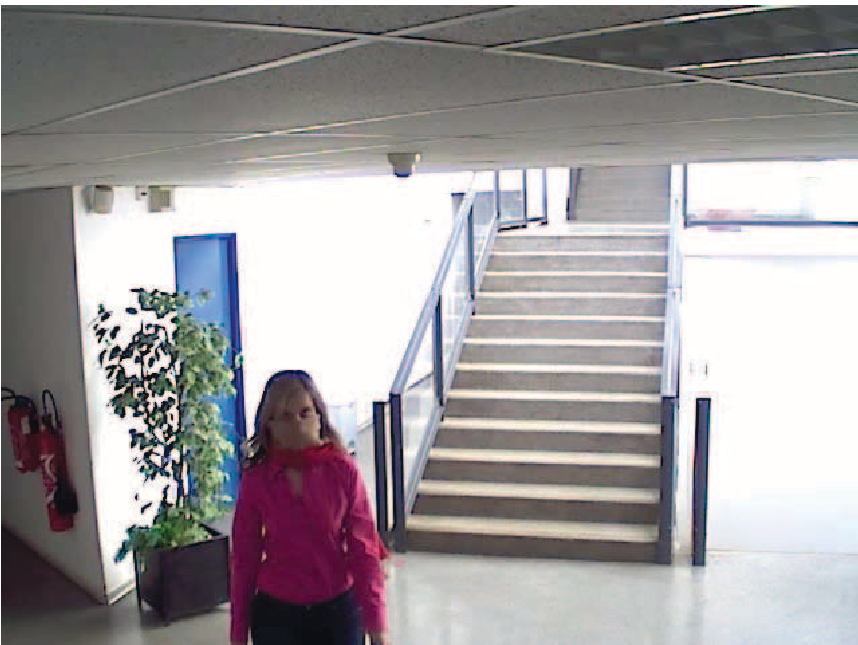 Figure 1: Examples of the original frame (top-left), Blurred (top-right), Pixelated (bottom-left), and Masked (bottom-right).
Key Findings: Why Pixelization Wins
The results from 120 participants revealed a clear winner in terms of balance.
- Pixelization provided high privacy protection while keeping activity recognition surprisingly high.
- Blurring was the weakest; while it makes the video look "softer," subjects could still accurately identify gender and race.
- Masking (Silhouettes) maximized privacy but often made it impossible to understand the person's actions, such as whether they were wearing glasses or blinking.
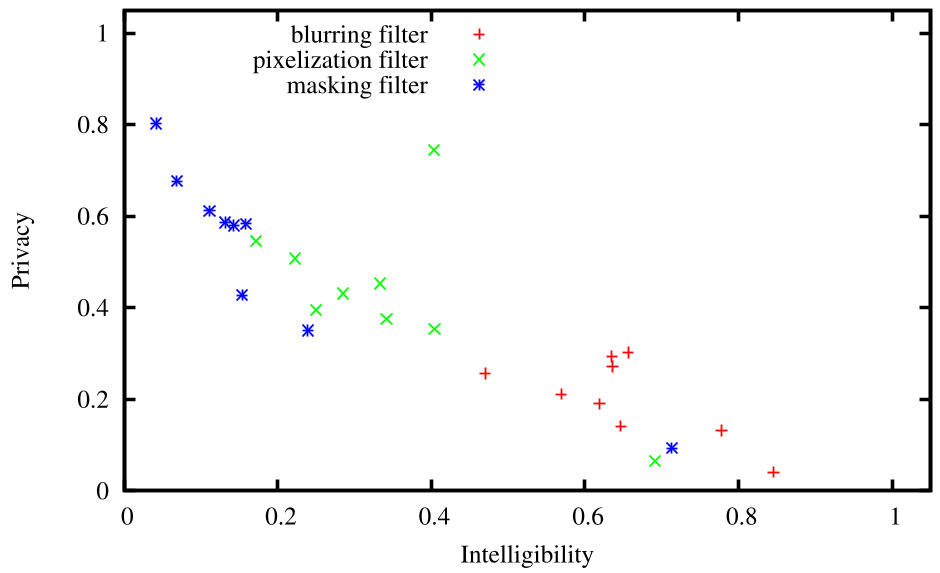 Figure 2: The tradeoff between Intelligibility (X-axis) and Privacy (Y-axis). The ideal filter should move toward the top-right corner.
Crowdsourcing vs. The Lab: Is it Reliable?
One of the paper's most significant contributions is the validation of crowdsourcing itself. By comparing the Facebook results with high-end lab tests, they found a 98% correlation in privacy scores.
However, there was a slight "resolution gap." In the lab, viewers used 1280p monitors and caught finer details (higher intelligibility). Online users often used lower resolutions or mobile devices, leading to lower intelligibility scores. This suggests that crowdsourcing is actually a better simulation of real-world surveillance, where conditions are rarely perfect.
Critical Insight & Future Outlook
The paper highlights a "brittle" side of privacy protection: if the tracking algorithm misses the face for even two frames, the subject's identity is compromised, rendering the entire filtered video useless. This emphasizes that no matter how good the filter is, the tracking and segmentation quality remains the weakest link in the chain.
Looking forward, this framework provides a blueprint for testing more modern "AI-driven" anonymization techniques (like replacing faces with deepfake-generated avatars) to ensure they are actually doing their job before they are deployed in our smart cities.
Conclusion
This work demonstrates that evaluation doesn't always need a laboratory. By bringing the experiment to the users' own screens, we gain a more authentic understanding of how privacy tools perform under the pressure of real-world constraints.