
Beyond Blind Imitation: How Quality-Based Cascades Save Crowdsourcing
Crowdsourcing Quality Control of Online Information: A Quality-Based Cascade Model
This paper introduces a Quality-Based Cascade Model to investigate how the exchange of explicit quality assessments among users moderates social influence in online environments. Using a sophisticated simulation of 1000 sequential users, it demonstrates that individual accuracy (Q) and social signals (local word-of-mouth and global lists) interact to determine the effectiveness of crowdsourced quality control.
TL;DR
Is the "wisdom of the crowd" a myth easily shattered by the first few wrong opinions? This paper argues the opposite. By introducing the Quality-Based Cascade Model, researchers at UIUC show that when users share actual quality assessments—not just blind choices—cascades actually serve to amplify truth rather than bury it. Even if individuals are only 5% better than a coin flip at judging quality, the collective system can reach near-perfect accuracy through social reinforcement.
Background: The Fear of "Bad Cascades"
In digital sociology, the "Information Cascade" is a classic horror story: the first three people pick a bad product; the fourth person ignores their own doubts and follows the crowd; soon, a "bad cascade" locks everyone into a low-quality choice. Previous models (like those by Bikhchandani) focused on imitative behavior where we only see what others do, not what they think.
This paper challenges that pessimism. What happens if we can see the "reviews" or "recommendations" of those before us? Does "word-of-mouth" make us smarter or more sheep-like?
Methodology: The Three-Signal Architecture
The authors simulated an environment with 20 websites and 1,000 sequential users. Each user’s decision is a tension between three forces:
- Private Signal (): The user's internal, imperfect judgment of whether a site is good.
- Local Signal (): The specific recommendation left by the single person immediately before them.
- Global Signal (): The "Top Recommended" list showing what the entire crowd thinks so far.
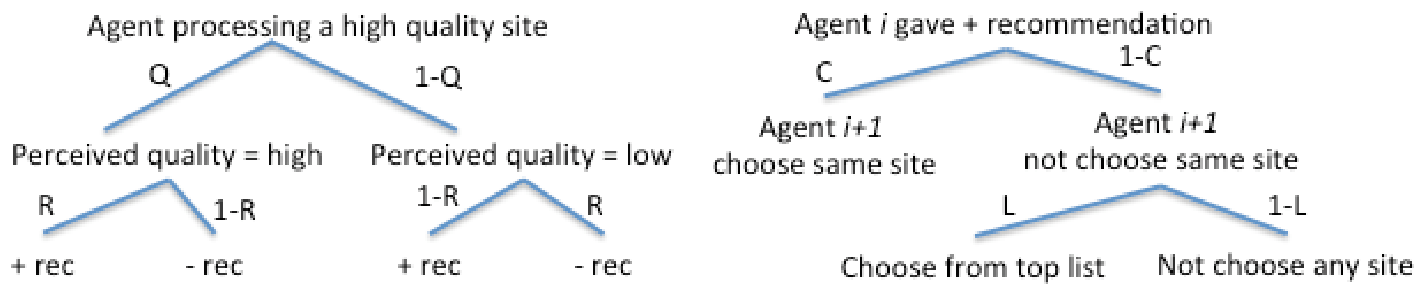 The model simulates a complex decision tree: if you don't follow the person before you, do you trust the global leaderboard or try your luck?
Key Insights: The Power of "Slightly Better Than Random"
One of the most striking findings is the sensitivity of the system to individual accuracy ().
- The tipping point: When (random guessing), the system is chaotic and "bad cascades" are permanent.
- The amplification: When increases to or , the "Global Signal" (the leaderboard) acts as a massive filter. A tiny bit of individual competence is magnified by the social structure to produce high aggregate accuracy.
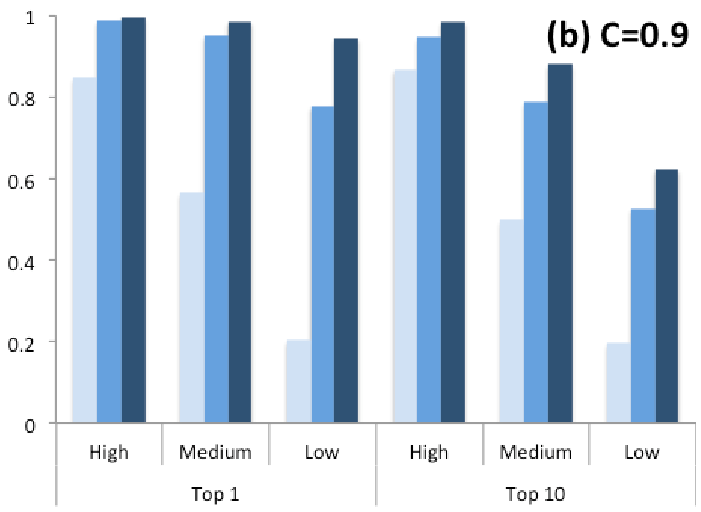 Figure 2: Notice the sharp performance jump when (individual accuracy) moves from 0.5 to 0.55, particularly in the 'Top 1' environment.
Can the Collective Correct a Lie?
The authors tested a "viral marketing" scenario where 2 low-quality sites were given 20 fake positive reviews to start.
- Results: If users have any ability to judge quality (), the crowd quickly detects the deception. Successive negative reviews act as a "correction cascade," rapidly dragging the deceptive sites off the leaderboard and replacing them with genuine high-quality ones.
Critical Analysis: Why This Matters
The fundamental takeaway is that cascades are not the enemy of quality control—they are the engine. In a vacuum, one person's opinion is noisy. In a cascade, that opinion is verified or refuted by the next person.
Limitations: The model assumes users are honest and that recommendations are easy to interpret. In the real world, "adversarial" users (bots) or complex UI layouts might degrade the (confidence) value, potentially breaking the cascade's ability to correct itself.
Conclusion
This research provides a theoretical backbone for why systems like Reddit, Amazon reviews, and community-based fact-checking actually work despite individual biases. If you want to build a better platform, don't just show what people bought—show what they valued. By facilitating the flow of quality information, we turn a herd of followers into a collective filter.