
Dynamic Thresholding: A Superior Approach to Crowdsourcing Quality Control
A crowdsourcing quality control model for tasks distributed in parallel
The paper proposes a data-driven quality control model for parallel crowdsourcing tasks, named the Training-Refinement-Classification model. It leverages user performance measures (like time and product size) and task factors to predict the validity of individual contributions, achieving 92% accuracy for valid and 96% for invalid submissions.
TL;DR
The paper introduces a statistical model for real-time quality control in parallel-distributed crowdsourcing tasks. By combining initial performance estimates (Training) with actual worker behavior (Refinement), the system filters "cheaters" or low-quality work with up to 96% accuracy, significantly outperforming simple averaging baselines.
Background & Motivation
Crowdsourcing platforms like Amazon Mechanical Turk (MTurk) often suffer from the "anonymous worker" problem, where variance in background and effort leads to inconsistent data quality. Traditional solutions either waste resources (Gold Standards) or assume worker behavior is consistent over time.
The authors argue that quality is context-dependent. A worker might be great at one task but rush through another. To catch these anomalies without invasive tracking (like keystroke logging), we need a model that understands the relationship between Task Factors (e.g., audio length) and Performance Measures (e.g., time spent).
Methodology: The Three-Stage Pipeline
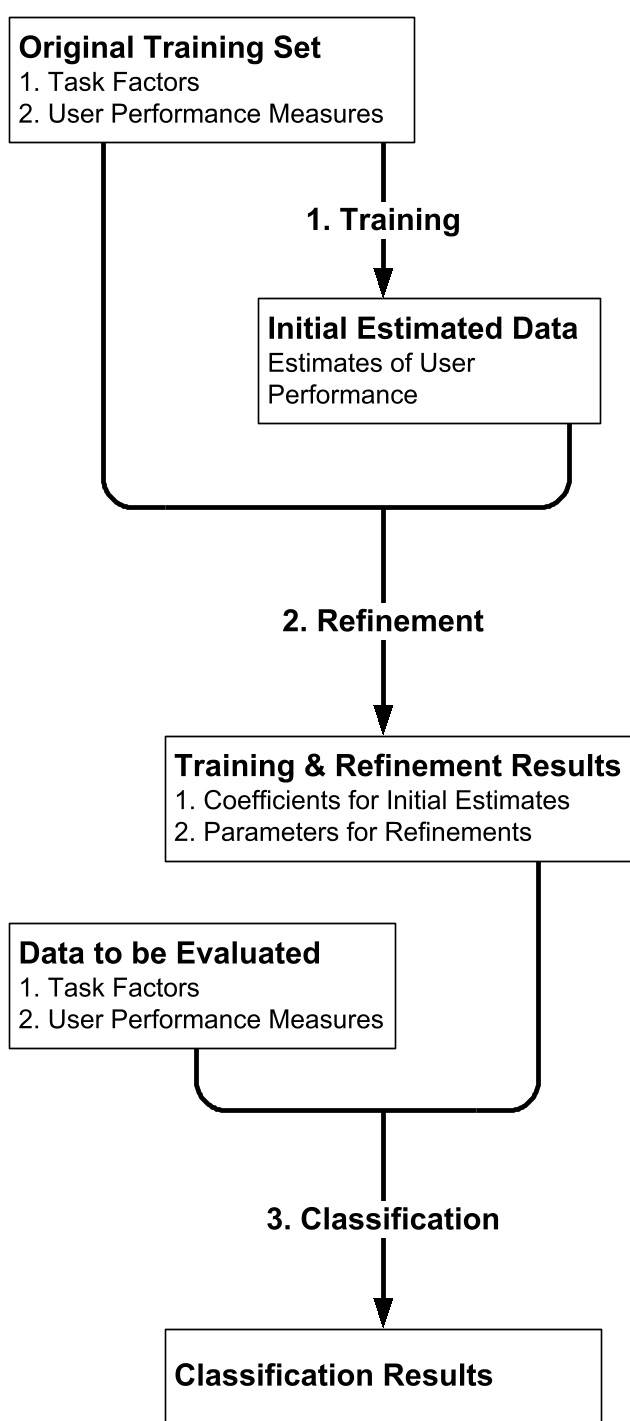
The core innovation lies in how the system "drags" its initial expectations toward the reality of the observed data.
1. Training
The system uses linear regression to establish a baseline. For instance, if an audio clip is 60 seconds long, how many edits should a "good" worker typically make? This stage produces initial estimates based on historical data.
2. Refinement (The Secret Sauce)
Initial estimates represent an "average" scenario, but every task is different. The model refine thresholds using a weighted sum formula:
Crucially, weights are assigned based on a monotonically decreasing function. Larger measures (more time/edits) are given higher weights because, in most crowdsourcing contexts, high effort correlates with honesty, while "gaming" usually involves doing the bare minimum.
3. Classification
Once the threshold is refined, the system evaluates incoming submissions. If a worker's metrics fall below the dynamic threshold, the work is flagged as "negative" (invalid).
Experimental Validation
The authors tested the model on a speech recognition correction task involving 3,360 submissions.
Key Findings:
- Accuracy: The model correctly identified valid contributions at a rate of 92.11% and invalid ones at 96.23%.
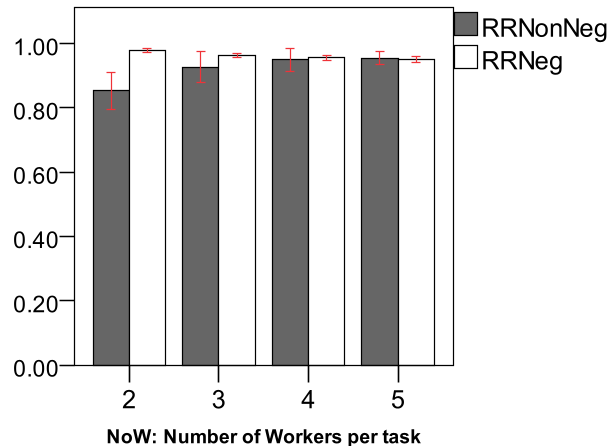
- The "Worker" Trade-off: Increasing the number of workers per task (NoW) improves the detection of valid data (RRNonNeg) but slightly decreases the detection rate of invalid data (as shown in the chart below).
- Training Saturation: The model reaches peak efficiency once it has processed approximately 60 training samples.
Deep Insight: Why This Matters
Unlike "Baseline 1" (which accepts only if all measures exceed the average) or "Baseline 2" (which accepts if any measure exceeds the average), this model uses a weighted consensus.
Previous SOTA models like Task Fingerprinting required detailed cursor logs. This model achieves comparable (and often superior) results using only the standard metadata provided by any crowdsourcing API (Time and Output Size). This makes it highly portable across platforms without requiring custom browser plugins or compromising user privacy.
Critical Analysis & Conclusion
While highly effective, the model has a notable vulnerability: Outliers. A "smart" cheater who intentionally leaves a window open to inflate their "time spent" metric could theoretically skew the dynamic threshold. Future iterations would benefit from robust statistics (like median-based filtering) to mitigate the impact of such outliers.
In conclusion, the paper provides a practical, mathematical framework for quality control that respects the variance of human effort while maintaining high filter rates for bad actors—a vital component for the scalability of modern data-driven AI systems.