
The Power of the Crowd: Deciphering Queue Waiting Times via Situated Kiosks
Crowdsourcing eue Estimations in Situ
This paper introduces a situated crowdsourcing system that estimates restaurant queue waiting times in real-time using public interactive kiosks. Deployed across four university restaurants, the system leverages human-in-the-loop estimations to provide live updates via public displays and web interfaces, achieving a mean absolute error of approximately 2 minutes.
TL;DR
Researchers from the University of Oulu have developed a crowdsourcing system that successfully predicts restaurant waiting times with high accuracy (approx. 2-minute error) without relying on expensive cameras or invasive tracking. By placing interactive kiosks in the "natural path" of a queue and correcting for the predictable psychological biases of hungry customers, the system provides a scalable, privacy-friendly solution for real-time logistics.
Problem: The Limits of Automated Sensing
Estimating queues is a classic challenge in service management. While computer vision and signal-based tracking (WiFi/Bluetooth) are the technical "standard," they face significant real-world hurdles:
- Occlusion & Lighting: Cameras struggle with long, overlapping lines or dim restaurant lighting.
- Privacy: Surveillance-style tracking often triggers user discomfort.
- Filtering: WiFi signal strength can't always distinguish between someone waiting in line and someone sitting at a nearby table.
The authors suggest a shift in perspective: Why not ask the people who are actually in the queue?
Methodology: Correcting the "Pessimism" of the Queue
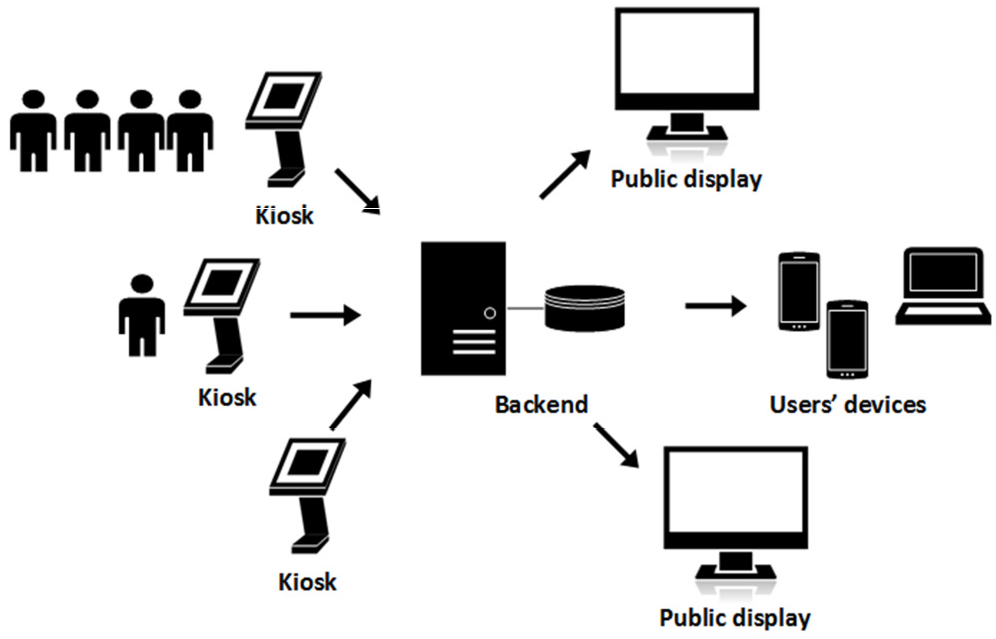
The team deployed Android kiosks in four campus restaurants. The interface was intentionally minimalist (a single sliding scale) to prevent users from accidentally slowing down the line they were trying to measure.
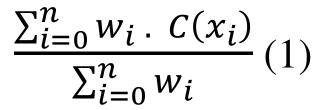
The mathematical core of the system is a weighted average of recent crowd inputs:
The Discovery of "Position Bias"
The study’s most fascinating insight is the psychological variance based on where a person stands. The researchers found:
- Entry Bias: People joining the back of the queue are "pessimistic" and overestimate the wait by about 0.89 minutes.
- Exit Bias: People at the front (having just paid) are "optimistic" (or relieved) and underestimate the previous wait by about 1.51 minutes.
By building a correction function into their algorithm, the system transforms subjective feelings into objective data.
Experimental Results: Beating the Sensors
During a 19-day field trial, the system collected thousands of data points. Even though only 7% of customers interacted with the kiosks, that "thin" slice of the crowd was enough to generate high-fidelity predictions.
Optimizing the Sliding Window was key. The team found that a window of 8 to 10 minutes provided the best balance between responsiveness to sudden rushes and smoothing out noisy, erroneous inputs.
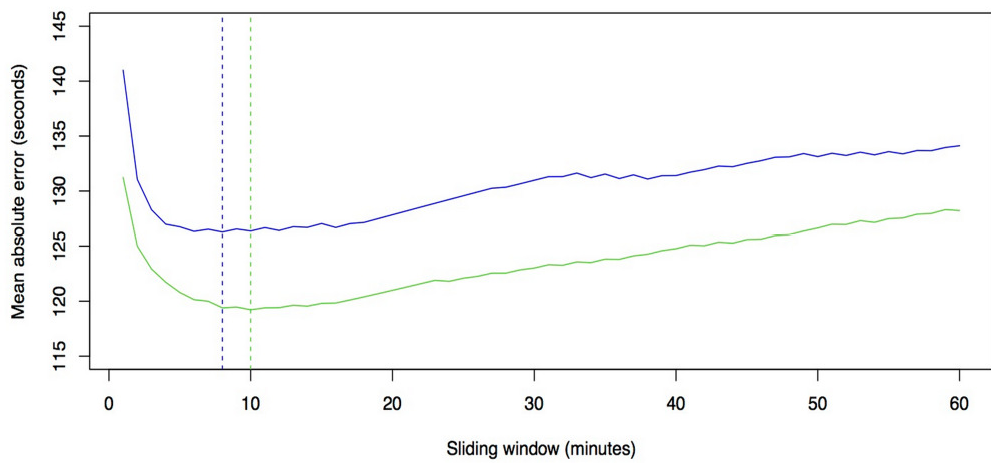
Key Outcome: The final system achieved a Mean Absolute Error (MAE) of ~2 minutes. This rivals or beats expensive sensor systems while requiring zero infrastructure beyond four tablets.
Critical Insights: Managing the "Torture" of Waiting
As noted in the discussion, "unoccupied time feels longer than occupied time." By providing these estimations on campus-wide displays, the system does two things:
- Reduces Uncertainty: Knowing the wait is 10 minutes is psychologically less stressful than not knowing why the line isn't moving.
- Redistributes Load: 40% of survey participants reported changing their lunch destination based on the system’s data, moving from congested restaurants to quieter ones.
Limitations & Future Work
The system is currently dependent on a "critical mass" of users. In very low-activity periods, the lack of fresh input can lead to stale predictions. Future iterations could explore "default" values based on historical trends to bridge these gaps.
Conclusion
This study proves that crowdsourcing is not just for digital tasks like labeling images—it can be successfully "situated" in physical spaces to solve mundane but universal problems like the lunch rush. By accounting for the human factor, we can build smarter cities that are both efficient and respectful of privacy.