
REACT: Transforming the "Human Crowd" into a Real-Time Computational Engine
Crowdsourcing under Real-Time Constraints
The paper introduces REACT (REAl-time schEduling for Crowd-based Tasks), a middleware system designed to assign crowdsourcing tasks under strict real-time constraints. It utilizes a novel Online Weighted Bipartite Graph Matching (WBGM) algorithm combined with a probabilistic execution-time estimation model to achieve up to a 61% improvement in deadline-meeting tasks compared to traditional platforms like Amazon Mechanical Turk (AMT).
TL;DR
While crowdsourcing is excellent for tasks requiring human intelligence (like image labeling or traffic monitoring), it is notoriously "slow and flaky." REACT is a middleware breakthrough that treats human workers as dynamic nodes in a real-time distributed system. By using a clever matching algorithm and probabilistic "fail-fast" reassignments, it ensures tasks get done before their deadlines expire—outperforming traditional platforms like AMT by over 60%.
The Problem: The Chaos of the Human Factor
In a standard distributed system, you can estimate a CPU's latency. In crowdsourcing, your "nodes" are humans who might get distracted, lose connectivity, or simply work at a snail's pace.
Current systems like Amazon Mechanical Turk (AMT) use a "pull" model where workers pick tasks. This leads to two major failures:
- Zero Guarantees: There is no mechanism to ensure a task is finished by a deadline.
- Skill Mismatch: Workers pick tasks based on preference, not necessarily their demonstrated accuracy or speed.
Methodology: High-Speed Matching & Probabilistic Reassignment
REACT bridges the gap between human unpredictability and real-time requirements through two core pillars:
1. The Weighted Bipartite Matching (WBGM)
Instead of waiting for workers to pick tasks, REACT's Scheduling Component builds a graph connecting available workers to unassigned tasks. Each edge has a weight () representing the worker's historical quality and likelihood of meeting the deadline.
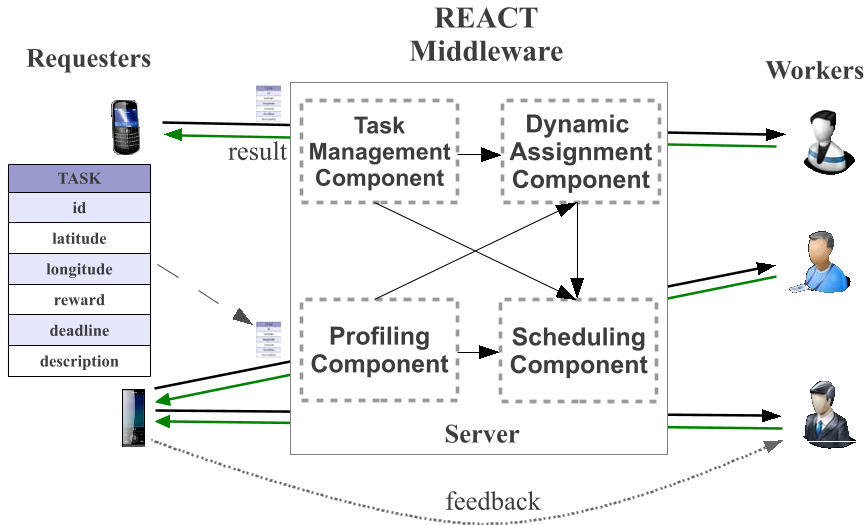
The algorithm uses a stochastic search (Algorithm 1 in the paper) that doesn't seek the "perfect" matching (which is too slow) but finds a "high-quality" matching in time, ensuring the system remains responsive even with 1,000+ active workers.
2. The Power Law "Guardian"
The most innovative part of REACT is the Dynamic Assignment Component. It recognizes that human behavior follows a Power Law Distribution. As a worker processes a task, REACT constantly calculates:
If the probability that a worker will finish on time drops below 10%, the system doesn't wait for them to fail. It immediately yanks the task and reassigns it. This "fail-fast" logic is what allows REACT to accommodate tight deadlines ( seconds).
Experimental Results: Speed Without Sacrificing Quality
The researchers tested REACT on PlanetLab and compared it against Greedy and Traditional (AMT-like) approaches.
Key Findings:
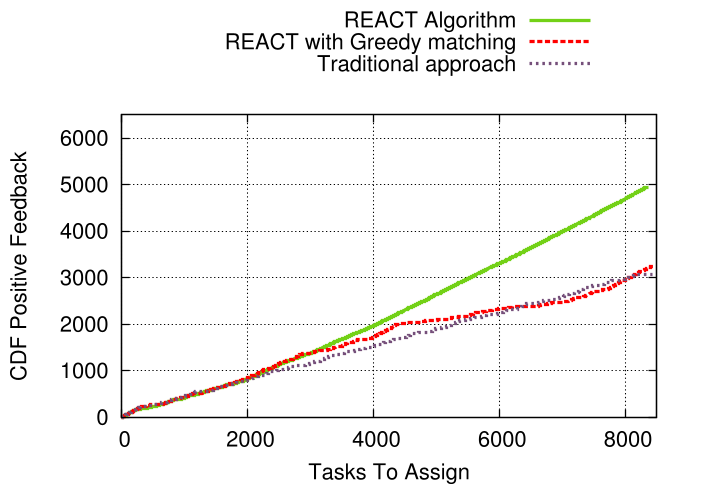
- Deadline Performance: REACT successfully completed 6091/8371 tasks on time. The "Traditional" approach failed miserably by comparison because it couldn't adjust to worker delays.
- The "Greedy" Trap: While a Greedy algorithm looks good on paper, it causes massive queuing as the graph grows. As seen in the performance charts, the Greedy approach eventually becomes so slow that tasks expire while waiting to be assigned!
- Efficiency: REACT achieved a 45% reduction in total execution time by proactively reassigning tasks that were likely to lag.
Critical Insight: Why REACT Wins
The genius of REACT isn't just in the math; it's in the Inductive Bias of the system design. It acknowledges that in a human-centric system, waiting for success is a losing strategy. By treating task assignment as a dynamic, probabilistic resource allocation problem rather than a static marketplace, REACT enables a new class of "Real-Time Crowdsourcing" applications like live traffic congestion mapping or emergency response validation.
Conclusion & Future Look
REACT proves that the "Wisdom of the Crowd" can be disciplined into a real-time service. However, the system faces limitations during extreme "overload" conditions where the incoming task rate exceeds the total human capacity of the region. Future work in this space likely involves Hybrid Architectures—where AI agents handle the overflow when human "nodes" are saturated.
Senior Editor's Note: This paper is a foundational read for anyone looking to build "Human-in-the-loop" systems where latency is a dealbreaker.