
Crowdsourcing in NLP: From Cheap Labor to Hybrid Intelligence
Crowdsourcing Research Opportunities: Lessons from Natural Language Processing
The paper explores the transformative role of crowdsourcing in Natural Language Processing (NLP) research, categorizing methods like mechanized labour (MTurk), Games with a Purpose (GWAPs), and altruistic volunteering. It identifies how these techniques move beyond cost reduction to enable SOTA achievements in resource acquisition for low-resource languages and complex linguistic phenomena.
TL;DR
This seminal paper analyzes how crowdsourcing—ranging from paid micro-tasks to "Games with a Purpose"—is revolutionizing Natural Language Processing. It argues that the "Crowd" is no longer just a source of cheap labels but a fundamental infrastructure for scaling AI, enabling research in niche languages and complex subjective phenomena that were previously economically impossible to study.
The "Data Bottleneck" Problem
Historically, NLP research has been hamstrung by the "Expert Paradox": high-quality linguistic resources (like annotated corpora) traditionally required expensive, trained experts. At costs reaching 100 million.
The authors identify three main limitations of the pre-crowdsourcing era:
- Cost Prohibition: Expert labor is not scalable.
- Language Bias: Resources were heavily skewed toward high-resource languages (English, Chinese, etc.).
- Subjectivity Gap: Tasks like sentiment or irony detection were difficult for small expert groups to reach consensus on.
Methodology: High-Quality Data from Noisy Sources
The core insight of the paper is that diversity and volume can compensate for individual lack of expertise, provided the right "meta-algorithms" are in place. The authors categorize crowdsourcing into three distinct genres:
- Mechanized Labour (e.g., MTurk): Breaking complex tasks into "Human Intelligence Tasks" (HITs).
- Games with a Purpose (GWAPs): Disguising data labeling as entertainment (e.g., "Phrase Detectives").
- Altruistic Crowdsourcing: Leveraging community passion (e.g., "Galaxy Zoo").
To ensure scientific rigor, the authors highlight the "Create-Verify" workflow, where one group of workers generates data and another validates it.
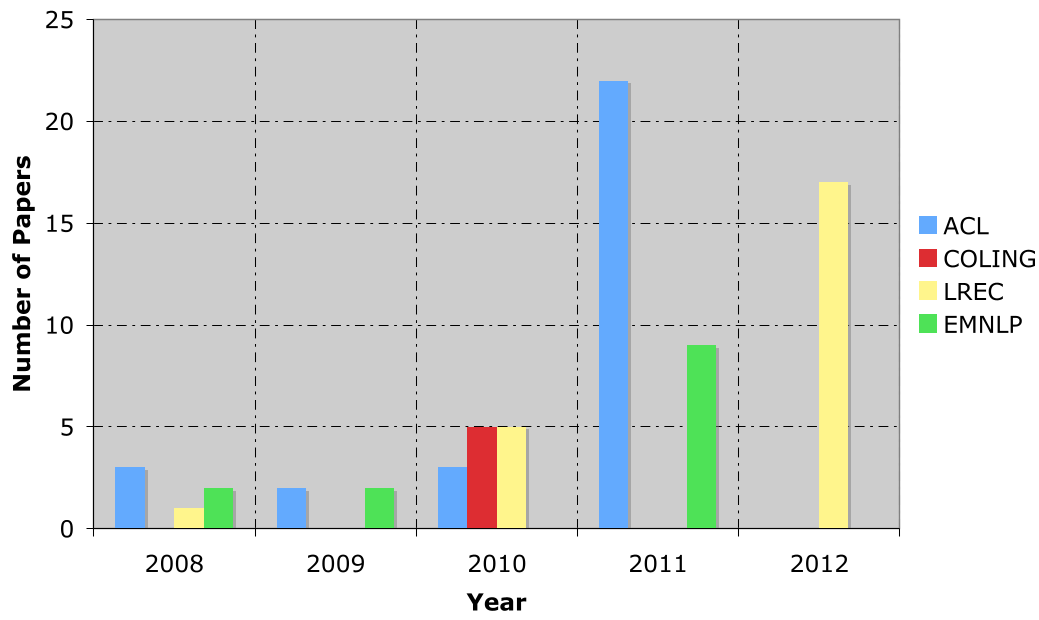 Figure 1: The exponential rise of Amazon Mechanical Turk usage in major NLP conferences (ACL, NAACL, EMNLP).
Experimental Impacts: Diversification and Scalability
The paper provides a comprehensive mapping (Table 1) of how these genres impact various scientific stages.
- Cost Efficiency: Games with a Purpose (GWAPs) can reduce the cost of expert-based annotation to as low as 20% of the original budget.
- Rare Languages: Researchers successfully used MTurk to build lexicons for nearly 40 rare languages that lacked commercial interest but held high scientific value.
- Algorithmic Support: The emergence of "Active Learning," where a model identifies "hard" samples and asks the crowd for help in real-time, marks the transition to hybrid-computing structures.
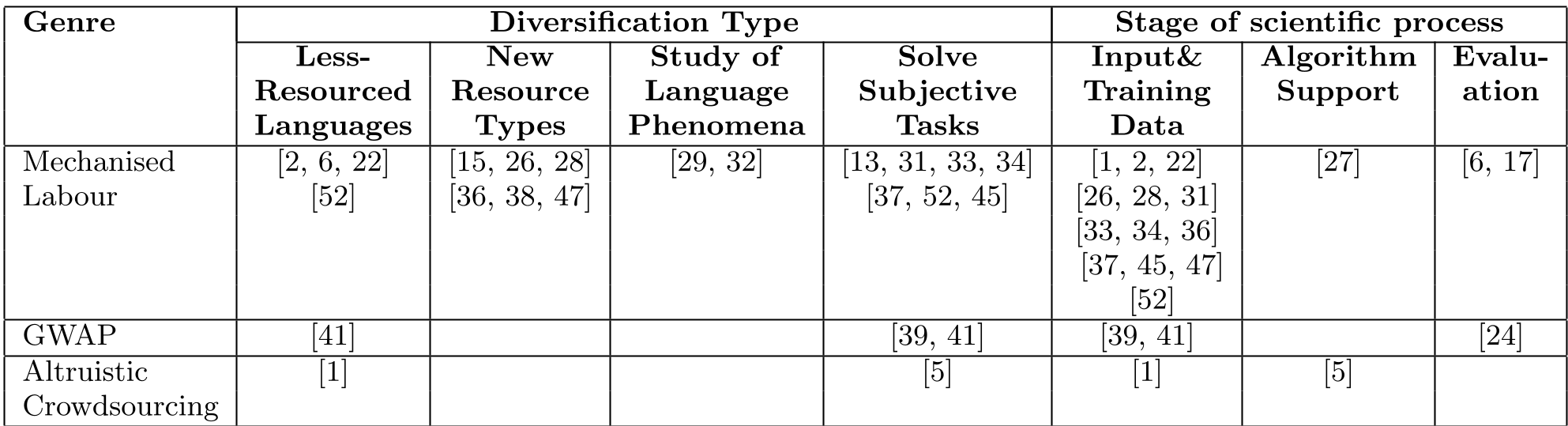 Table 1: Classification of NLP approaches by crowdsourcing genre and scientific stage.
Critical Insight: The Ethical and Technical Frontier
While the paper champions crowdsourcing, it issues a stark warning regarding Ethical and Legal issues. Specifically:
- Worker Rights: The "coal mine" vs. "gold mine" debate—ensuring fair pay and preventing exploitation in mechanized labor markets.
- Contributor Bias: A small percentage of "power users" often contribute the majority of data, which can introduce systematic biases if not carefully monitored.
- Transparency: The need for open licenses (e.g., Creative Commons) to ensure the data created by the crowd remains a public good.
Conclusion: Toward a "Global Brain"
The paper concludes that we are witnessing the birth of a hybrid-computing infrastructure. The future of NLP and broader AI lies in "programming the global brain"—a seamless integration where machines handle the brute-force computation and humans provide the nuanced, linguistic, and visual intuition required to solve the most difficult scientific problems.
Takeaway for Researchers
Don't just use the crowd for labeling; design "create-verify" loops and explore GWAPs to lower costs and increase engagement. The goal is not just more data, but a more diverse and ethically sourced dataset.