
Beyond the Lab: Navigating the Five Uncertainties of Crowdsourced Research
Crowdsourcing as a Tool for Research: Implications of Uncertainty
This study investigates the systematic barriers to the adoption of crowdsourcing in academic research through semi-structured interviews with 18 multi-disciplinary researchers. It identifies five key dimensions of "uncertainty"—process, data, knowledge, delegation, and quality—proposing a framework for when and how crowdsourcing can effectively scale scientific inquiry beyond traditional expert teams.
TL;DR
While crowdsourcing promises to "parallelize" science, researchers often resist it due to deep-seated professional uncertainties. This paper identifies five core dimensions—Process, Data, Knowledge, Delegation, and Quality—that determine whether a research project is a "match" for the crowd. The key takeaway: for crowdsourcing to go mainstream, platforms must support the messy, iterative, and "non-linear" reality of scientific discovery rather than just static task execution.
Background: The Myth of the "Mechanical" Scientist
The public often perceives scientific research as a Holmesian progression of logic. In reality, as modern researchers argue, it is an iterative, serendipitous process. The friction between the "crowd" (often viewed as a black box of labor) and the "researcher" (who views data handling as "an act of thinking") has prevented crowdsourcing from becoming a standard methodology.
The Suitability Matrix: When Does Crowdsourcing Work?
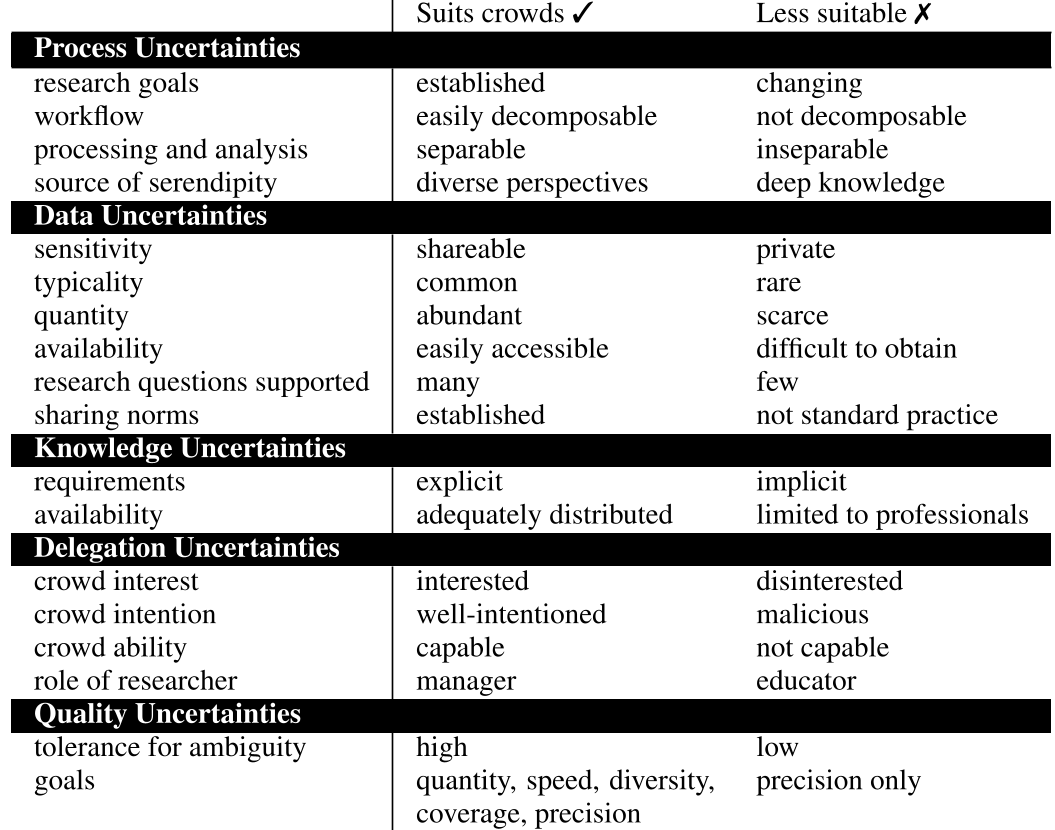
The authors categorize the hesitation of researchers into five specific "Uncertainties." This framework serves as a diagnostic tool for any PI (Principal Investigator) considering a move to the crowd.
1. Process Uncertainties (Serendipity vs. Structure)
If early-stage research is too fluid, setting up a crowdsourcing pipeline is a waste of resources.
- External Serendipity: If the "needle in the haystack" can be found by anyone (e.g., spotting a "Green Pea" galaxy), crowdsourcing is a superpower.
- Internal Serendipity: If patterns emerge only through the "drudgery" of a single expert transcribing 1,000 documents (e.g., Historical Latin analysis), the crowd might actually "take the fun out of discovery" and miss the matrix of connections.
2. Data Uncertainties: Scarcity vs. Abundance
The paper introduces a fascinating dichotomy of the "two worlds" of research:
- The World of Abundance: Astronomy or Ecology, where there are more questions than hands to answer them. Here, sharing data is a benefit.
- The World of Scarcity: Rare fossils or sensitive sociological data. In these fields, exposing data too early risks "scooping" or ethical violations.
Methodology: The Expertise Trap
A major hurdle identified is the "Apprenticeship Model." Many research tasks require Implicit Knowledge—the kind you gain by "riding a bicycle" or working in a lab for years.
- If a task is Explicit (e.g., "Is this a galaxy?"), it's crowdsourcable.
- If a task is Implicit (e.g., "Is this mouse 'sleepy' or just 'zoning out'?"), traditional crowdsourcing often fails because the cost of training and verifying the crowd exceeds the cost of just doing the work.
Results & Comparison: Mapping Success
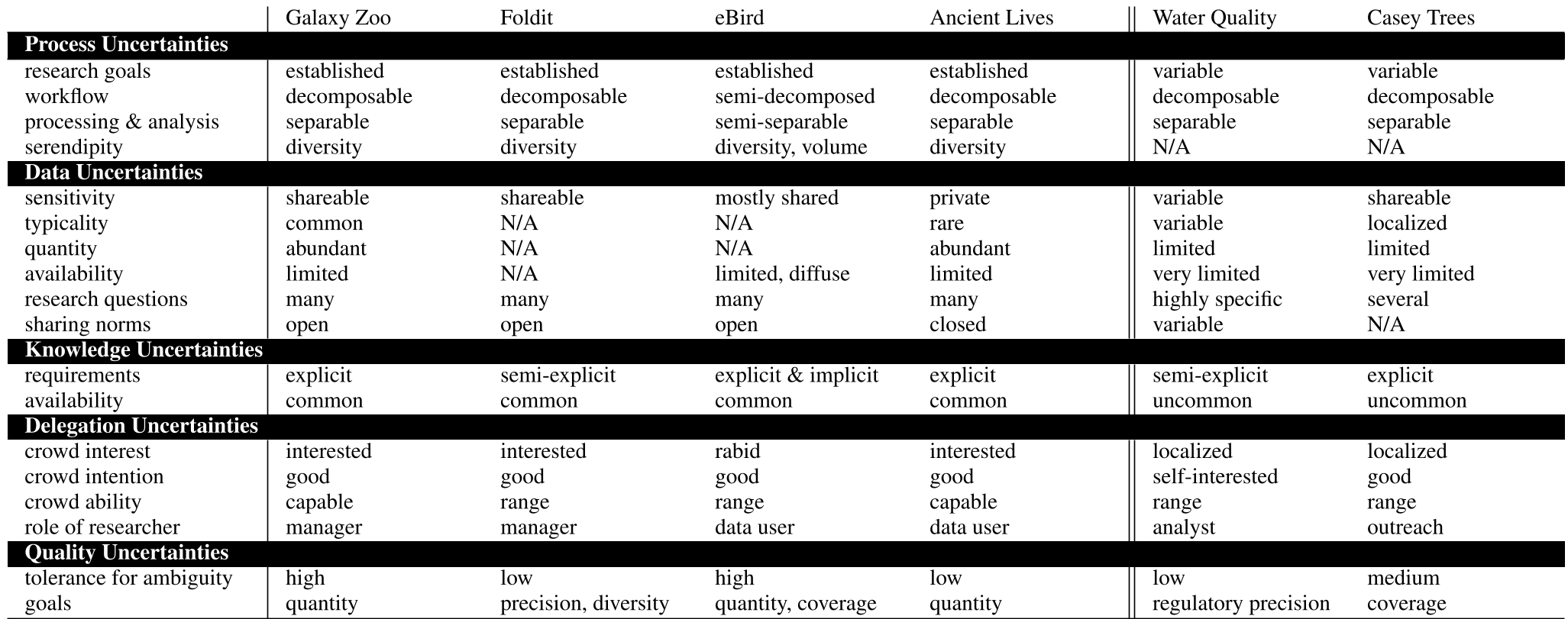
The researchers mapped existing projects to see where they land on the uncertainty scale. Galaxy Zoo and eBird succeed because they have established goals and decomposable workflows. In contrast, "Water Quality" projects often struggle because their goals are too localized and their knowledge requirements too high for a general crowd.
Critical Insight: The "Faceless" Problem
One of the most profound findings is the Delegation Uncertainty. Researchers feel a "moral dilemma" about delegating "drudgery" without the educational quid pro quo of an apprenticeship. Furthermore, the "facelessness" of online workers triggers fears of sabotage—especially in sensitive fields like animal research.
Summary & Future Outlook
The study concludes that for crowdsourcing to evolve, platforms must allow for "Scaffolded Collaboration."
- Start Small: Tools should function first for the PI and their students.
- Scale Gradually: Only when the "process" is fixed should the project be opened to the broader world.
- Support Triangulation: Instead of just seeking consensus (redundancy), systems should help researchers use the crowd to validate findings via multiple different techniques.
The Takeaway: Crowdsourcing isn't just a technical challenge; it's a sociological one. To "massively scale" science, we must build systems that respect the researcher's need for control, professional credit, and the "joy of discovery."