
Crowdsourcing Rock N’ Roll: Bridging the Semantic Gap with Human-in-the-Loop Retrieval
Crowdsourcing rock n' roll multimedia retrieval
The paper presents a specialized multimedia search engine for rock n' roll concert archives, integrating Automated Speech Recognition (ASR) and visual concept detection. The core innovation is a crowdsourcing mechanism via a timeline-based video player that allows users to verify, correct, and share automatically indexed video fragments.
TL;DR
This research demonstrates a real-world multimedia search engine designed for the Pinkpop festival archives, a 40-year collection of rock n' roll history. By combining automated visual concept detection and speech recognition with a unique crowdsourcing timeline player, the authors transform a static video archive into a searchable, interactive semantic experience where fans help improve the AI's accuracy.
Background & Positioning
In the landscape of 2010 multimedia research, a significant gap existed between academic "toy" datasets and real-world utility. While algorithms were getting better at identifying "drums" or "singers," they weren't being used by the public. This work is a demonstrative bridge, moving technology out of the lab and into the hands of rock n' roll enthusiasts, effectively positioning crowdsourcing as a corrective layer for imperfect automated analysis.
Motivation: The Problem with Pure Automation
Existing video search on the web (even today) relies heavily on user-provided tags or titles. Searching inside a 2-hour concert for a specific guitar solo or an interview segment remains a challenge.
- The Problem: Visual concept detection is prone to errors (False Positives).
- The Insight: Rock fans are passionate and knowledgeable. By lowering the friction for these fans to "correct" the machine, the system can achieve high-quality semantic indexing that neither a computer nor a professional archivist could achieve alone at scale.
Methodology: The "Rock N' Roll" Tech Stack
1. Visual Concert Concepts
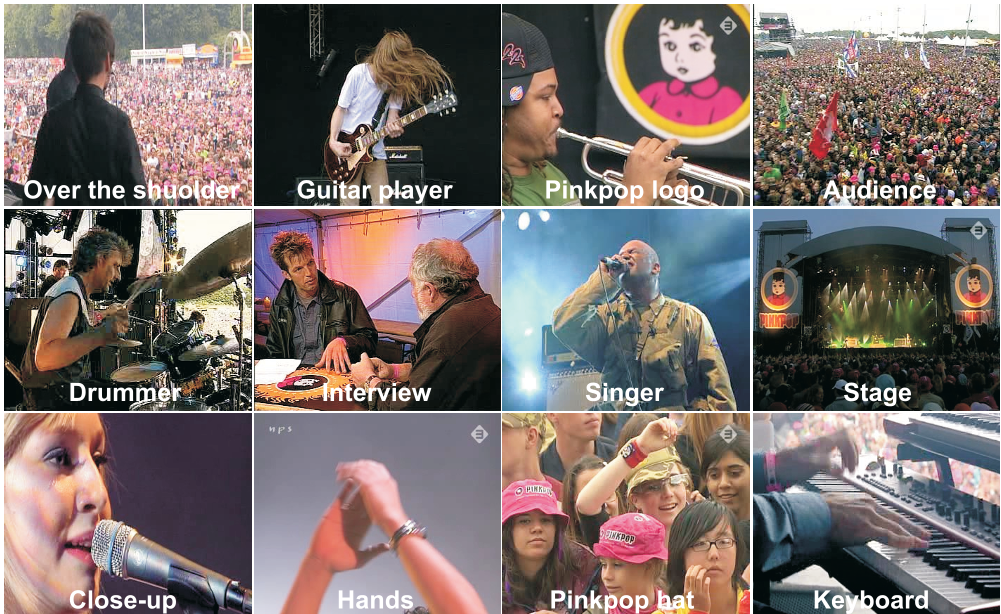
The authors identified 12 domain-specific concepts (e.g., lead singer, guitarist, drums, keyboard) that are standard across rock performances. They used Weibull and Gabor features paired with Support Vector Machines (SVM) to scan every frame of the video.
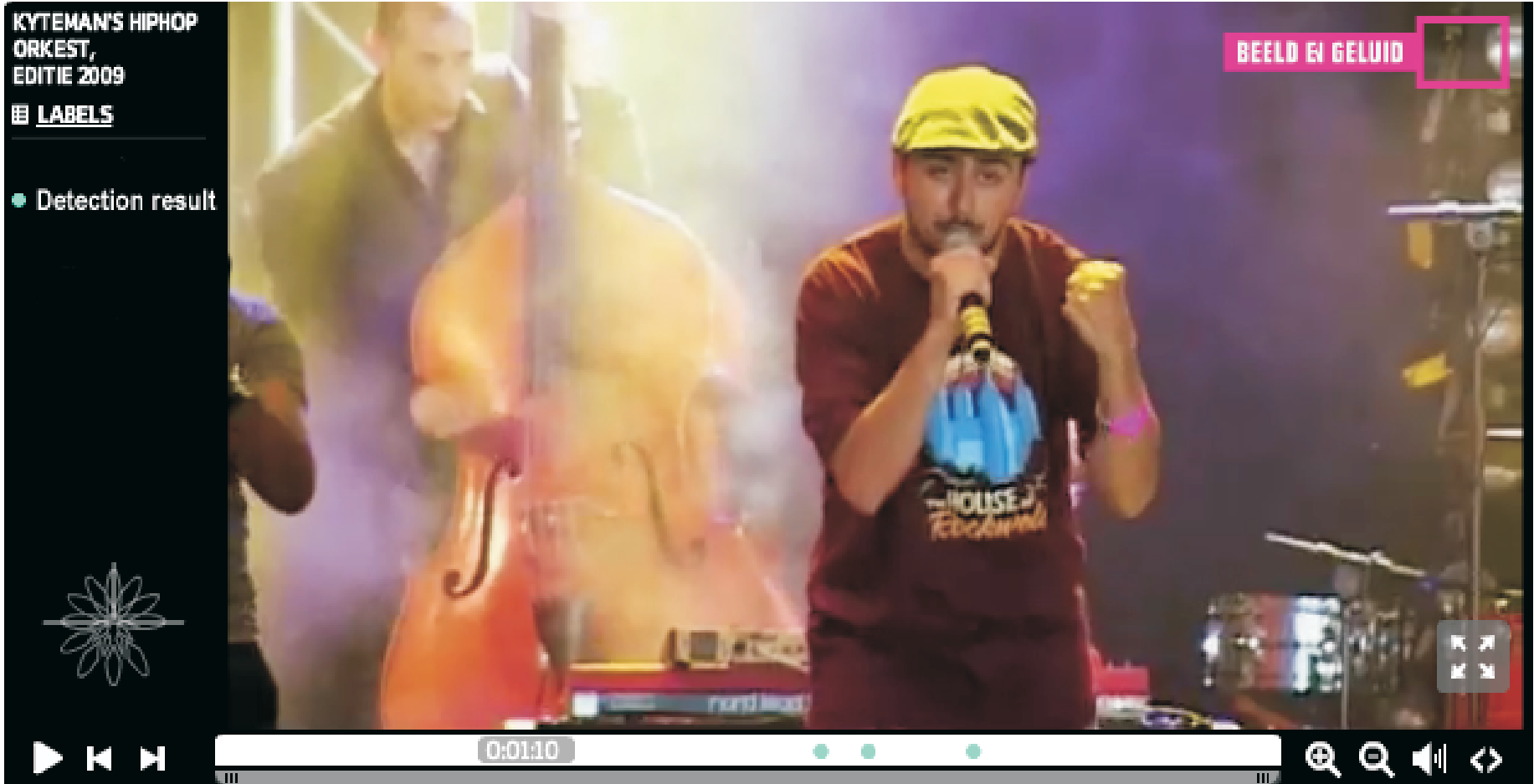
2. The Timeline-Based Video Player
This is the "crown jewel" of the system's UX. Instead of a standard seek bar, the player features a timeline marked with colored dots.
- Each dot represents an automatically detected fragment (e.g., a "guitar solo").
- Hovering provides a preview; clicking jumps to the start.
3. The Crowdsourcing Loop
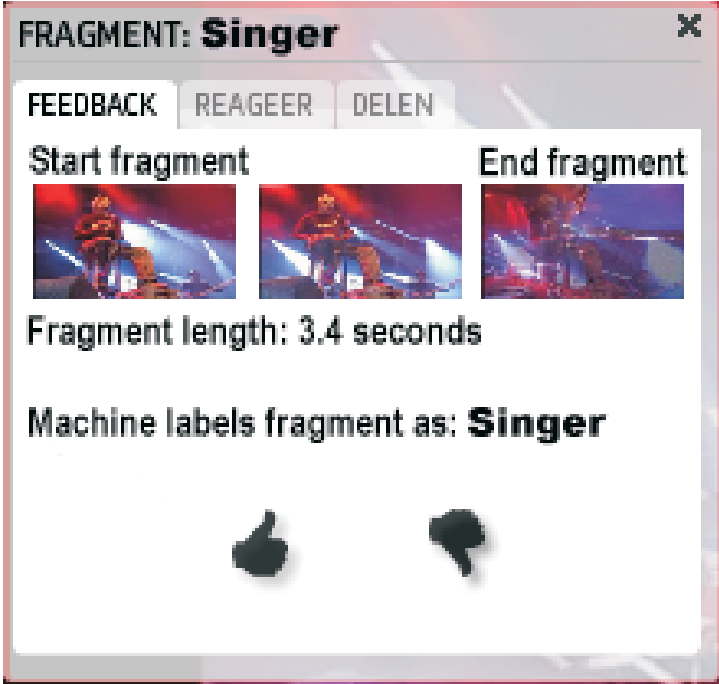
To refine the results, a simple overlay appears during playback. Users can provide a Thumbs-Up (confirming the AI was right) or a Thumbs-Down (triggering a prompt to correct the label). This low-barrier interaction incentivizes data collection without requiring a formal "sign-up" process.
Experiments & Results: Real-World Deployment
The engine was populated with 32 hours of video from the legendary Pinkpop festival.
- ASR Processing: Using the SHoUT toolkit, they generated clickable word clouds for interviews, allowing users to jump to specific spoken topics.
- Database Efficiency: All detection scores were handled by MonetDB, a high-performance system that enabled real-time fragment generation based on the highest average confidence scores for a concept.
- Visual Indexing: The system successfully mapped the 12 key concert concepts across decades of varying video quality.
Critical Analysis & Conclusion
Takeaway
The genius of this work isn't just in the SVM or the ASR; it’s in the user-centric design. By recognizing that automated labels are "educated guesses," the authors created a system where the AI provides the breadth (scanning hours of footage), while the crowd provides the truth (verification).
Limitations
As a 2010 era paper, the visual features (Gabor/Weibull) are now largely superseded by Deep Learning (CNNs/Transformers). Furthermore, the 12-concept limit is quite narrow; modern systems could theoretically detect thousands of nuanced actions.
Future Outlook
This work pre-dates the massive "Human-in-the-loop" movement in AI training. Today, this methodology is the backbone of how we train autonomous vehicles and RLHF (Reinforcement Learning from Human Feedback) for LLMs. The "Rock N' Roll" search engine was an early, vibrant ancestor of the data-centric AI revolution.