
Empowering the Digital Frontline: A Taxonomy of Crowdsourcing in Disaster Management
Crowdsourcing roles, methods and tools for data-intensive disaster management
This paper proposes a comprehensive conceptual framework for crowdsourcing in disaster management, introducing a taxonomy of four roles (sensor, social computer, reporter, microtasker). It surveys 38 state-of-the-art platforms and mobile applications (e.g., Ushahidi, AIDR, MyShake) to analyze their efficacy across the disaster management cycle (DMC).
TL;DR
In an era where social media data is described as a "deluge" or "exaflood," traditional emergency response is evolving. This seminal work by Poblet et al. deconstructs how crowdsourcing transforms from passive data collection into high-level human computation. By defining four distinct roles—Sensor, Social Computer, Reporter, and Microtasker—the paper provides a roadmap for integrating digital volunteers into the formal Disaster Management Cycle (DMC).
Background: The Paradigmatic Shift in Crisis Data
Disaster management is no longer a centralized, one-way broadcast. From the Nepal earthquake to the European refugee crisis, tech-savvy populations are generating millions of georeferenced data points in real-time. The challenge is no longer obtaining data, but making sense of it without overwhelming formal responders.
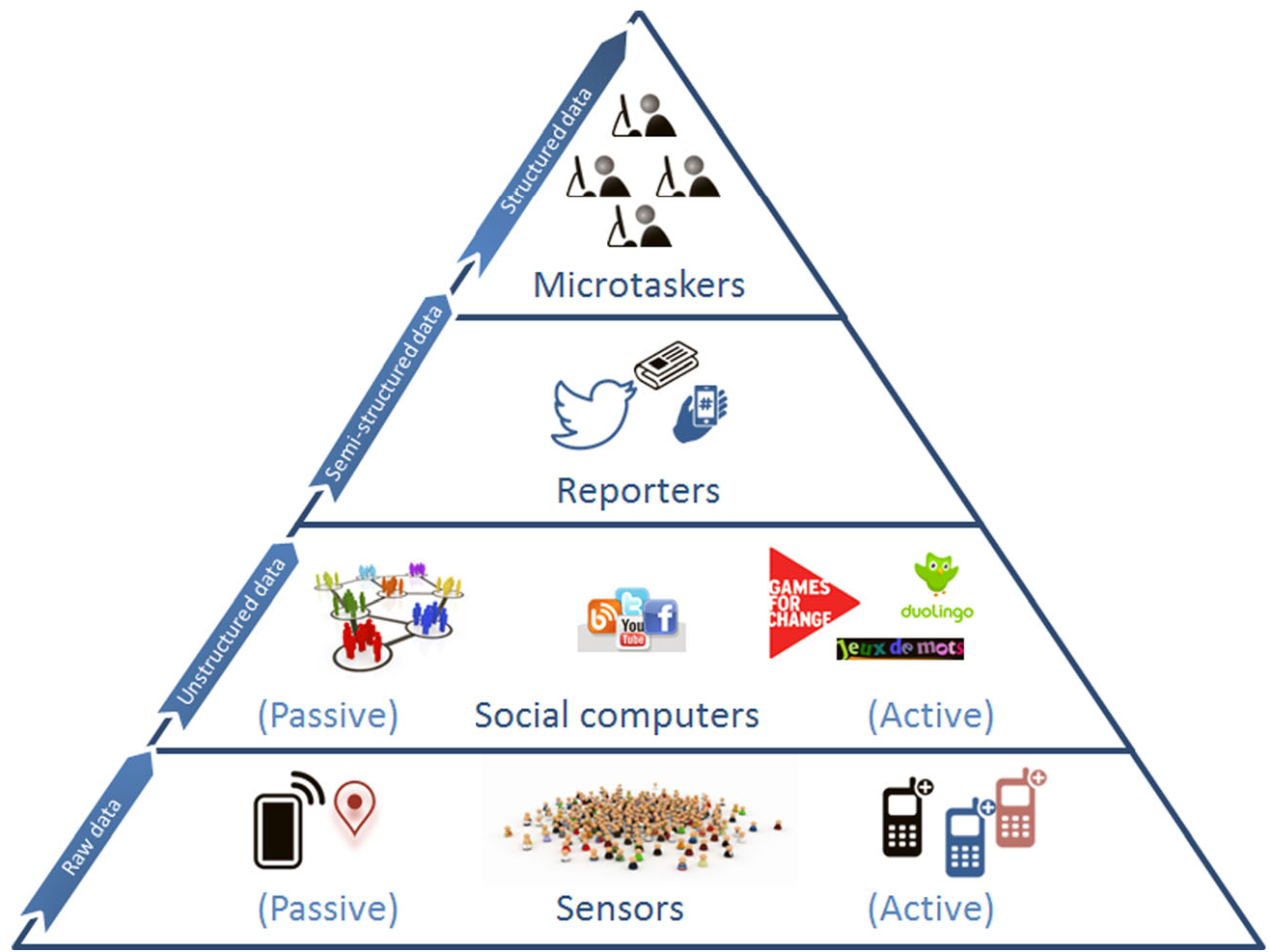
The Crowdsourcing Hierarchy: From Passive Sensors to Expert Microtaskers
The authors propose a breakthrough conceptualization of how crowds interact with data. This is not a monolith; it is a pyramid of involvement:
- Crowd as a Sensor (Passive/Active): Leveraging the "people as sensors" concept. This includes raw data like GPS coordinates or accelerometer readings (e.g., MyShake app for seismic detection).
- Crowd as a Social Computer: Unintentional processing where social media posts are mined for situational awareness.
- Crowd as a Reporter: Active users providing first-hand, semi-structured information (e.g., using hashtags to report structural damage).
- Crowd as a Microtasker: The highest level of involvement, where complex problems are broken into unit tasks, such as tagging satellite imagery (e.g., Tomnod).
Methodology: Mapping Tools to the Disaster Cycle
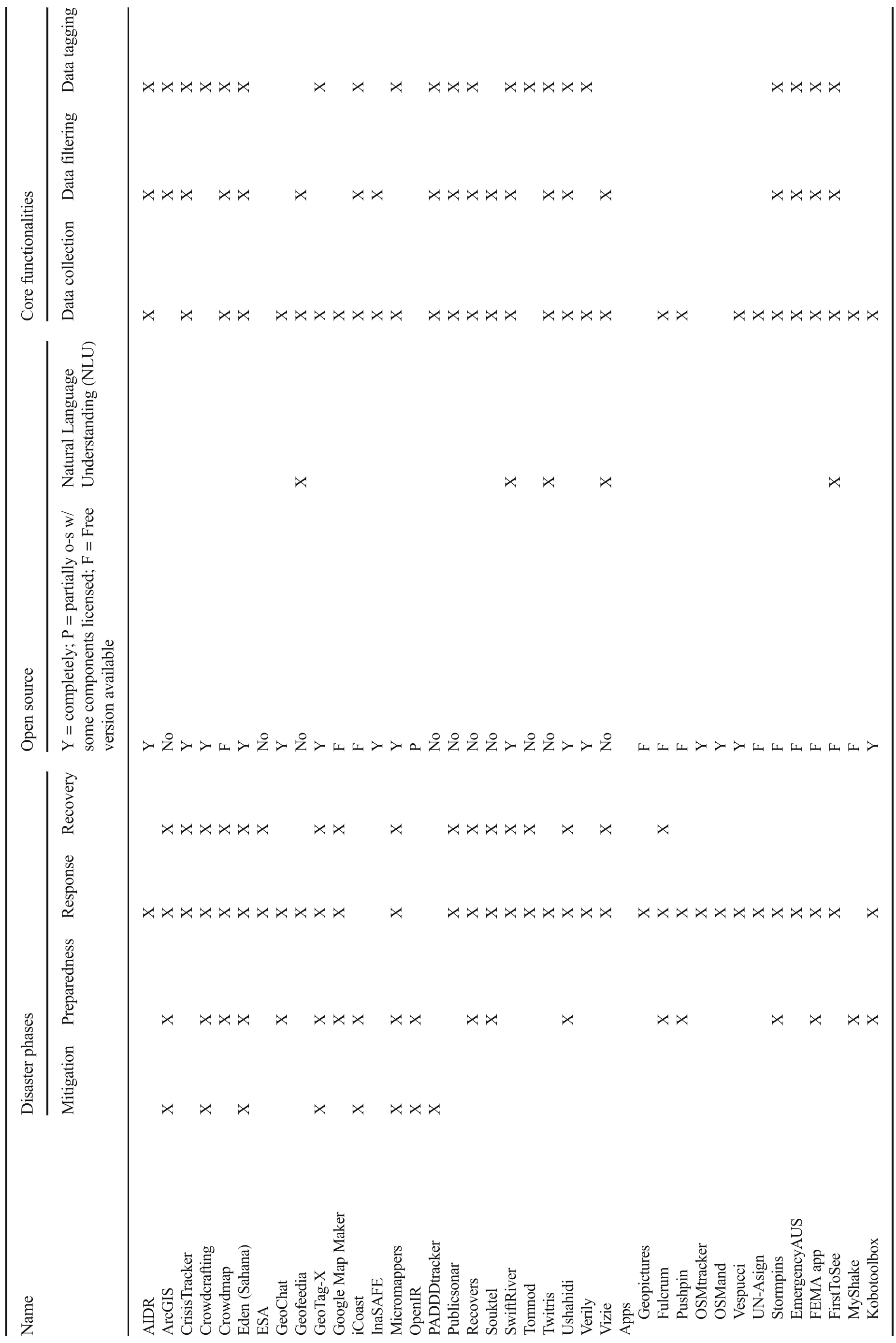
The researchers surveyed 38 tools, categorizing them by their functionality (NLU, Data Tagging, Mapping) and their application in the four phases of the DMC: Mitigation, Preparedness, Response, and Recovery.
Key Findings in the Tool Landscape:
- Response Dominance: Most tools (22 of 25 web platforms) focus on the high-pressure "Response" phase.
- Functional Gaps: Natural Language Understanding (NLU) is still a rare feature in most open-source stacks, often requiring manual integration of external libraries like FreeLing.
- The Power of Open Source: Platforms like Ushahidi and Sahana Eden remain the "gold standard" due to their modularity and ability to incorporate third-party machine learning algorithms.
The Role of Ontologies: The "Soft Regulation" of Data
A critical insight of this paper is the emphasis on Ontologies. To prevent a "second disaster" (where aid requests and offers fail to match due to terminology differences), standardized representations like HXL (Humanitarian eXchange Language) and MOAC are essential. Currently, there is a significant gap between academic research into ontologies and their actual implementation in software platforms.
Critical Analysis & Conclusion
While crowdsourcing offers unprecedented scalability, the authors warn of liability and veracity issues. Who is responsible if a crowdsourced tag leads a rescue team to the wrong location?
The Takeaway
The future of disaster management lies in Boundary Organizations—entities designed specifically to bridge the gap between formal policy and the informal "digital neighborhood." Crowdsourcing is not a panacea, but a complementary mechanism that requires rigorous socio-technical design to be sustainable.
Future Outlook: As AI continues to evolve, the distinction between "human computation" and "machine learning" will further blur, necessitating a new generation of "Hybrid Crowdsourcing" tools that can automatically verify the credibility of a digital reporter in seconds.