
Crowdsourcing Resilience: Can SMS Messages Fix Rural Cell Towers?
Crowdsourcing Rural Network Maintenance and Repair via Network Messaging
This paper introduces a "crowdsourcing" model for the maintenance and repair of rural communications infrastructure. By leveraging a Community Cellular Network in the Philippines, researchers used SMS broadcasts to recruit local residents for technical troubleshooting, achieving a 37% response rate and demonstrating successful community-led repairs for common hardware failures.
TL;DR
In remote rural areas, when a cell tower breaks, it stays broken for weeks. This paper challenges the "expert-only" maintenance dogma by proving that local villagers—mostly non-experts—can effectively repair infrastructure if prompted via SMS. By treating the community as a distributed pool of "latent expertise," the researchers achieved a 37% response rate and near-perfect success in solar-related repairs.
The Scalability Trap of Rural Networks
The "digital divide" is often a "maintenance divide." Centralized telcos hate rural deployments because sending a technician 60km over rough terrain for a simple fix is a financial disaster. Current alternatives, like training one local "village technician," often fail because that person eventually leaves for a higher-paying job in the city.
The authors ask a radical question: What if we stop treating users as passive consumers and start treating them as a distributed maintenance crew?
Methodology: The SMS "Bat-Signal"
Researchers deployed this experiment in San Andres, Philippines. They tested whether simple SMS messages could trigger a "situated crowd" to perform physical labor.
The Experiment Design
- The Hook: SMS messages were sent to 63 active users.
- The Variants: They tested "Individual" vs. "Group" vs. "Specific Tech" messaging logic.
- The Test: Respondents faced three "mock failures" representing real-world rural issues.
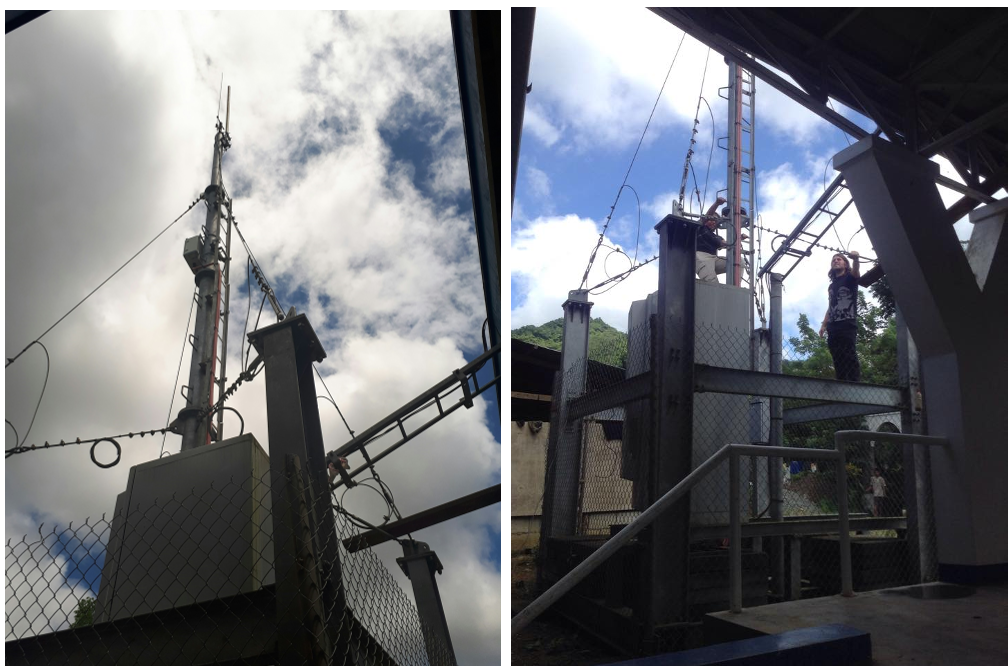 Figure 1: The San Andres cell site. Note the solar panels (power), the BTS (processing), and the antenna (broadcast).
Deep Dive: Mapping Knowledge to Lived Experience
The study's most profound insight is that repair success is proportional to technological analogy.
- Solar Panels (High Success): Since many villagers own small solar sets for home lights, 95% knew exactly how to fix a "Low Power" alert (cleaning debris/leaves off the panels).
- Antennas (Medium Success): Familiarity with satellite TV (GSAT) helped, but the height and "professional" look of the tower created a psychological barrier.
- CPU Overheating (Low Success): Most residents treated the base station like a TV—their only solution was to "turn it off and let it rest," failing to recognize the need for active ventilation or fans.
 Figure 2: The photos shown to participants during mock failures. Visual cues often triggered "aha!" moments based on household chores.
The "Authorization" Barrier
Technical skill wasn't the biggest bottleneck—authority was. Even when residents knew how to fix a problem, they were terrified of being held liable for "breaking" expensive equipment. Many stated they wouldn't touch the tower unless "The Captain" (local leader) or a specific "Sir" from the telco authorized it.
This suggests that rural infrastructure isn't just a technical challenge; it's a social contract. To make crowdsourced repair work, we must design "permission-less" interfaces or formalize the community's "license to repair."
Critical Insight: The Power of the Group
The "Group" SMS variant ("Can one of you come help?") outperformed individual requests. Why? Because it triggered social recruitment. Villagers who received the message discussed it with neighbors, often delegating the task to the person they perceived as the "local expert" (e.g., an engineering student or a confident solar owner).
Future Outlook: Designing for the "Repair Crowd"
The paper concludes with a call to action for hardware designers:
- Use Familiar Affordances: Use standard household switches (like breakers) rather than obscure industrial toggles.
- Visual Signage: Put big, simple stickers on antennas ("This Side Up") to bridge the gap between "expert" and "crowd."
- Inclusive Engagement: Interestingly, 75% of respondents were women, often because men were away working in cities. Maintenance systems must target the people actually on-site in the village, not just the "official" (and often absent) technicians.
Conclusion
This work shifts the narrative of rural ICT from "high-tech charity" to "local empowerment." By leveraging existing social networks and basic technical analogies, we can build networks that don't just survive failures but are actively cared for by the communities they serve.