
Crowdsourcing the Eye in the Sky: Parallel Consensus vs. Iterative Refinement
Crowdsourcing Satellite Imagery Analysis: Study of Parallel and Iterative Models
This paper evaluates two organizational strategies for crowdsourcing satellite imagery analysis: the Parallel Model (independent tasking with aggregation) and the Iterative Model (sequential refinement). Utilizing Amazon Mechanical Turk as a simulator, the study introduces the Democratic Clustering Algorithm (DCA) to improve result accuracy for non-expert image labeling.
TL;DR
When non-experts analyze satellite imagery for disaster relief or urban planning, how do we organize them for maximum accuracy? This paper benchmarks Parallel (independent voting) versus Iterative (sequential improvement) models. The discovery? Parallel models are great for "filtering out lies" (Type I errors), while Iterative models are "hunters" that find hidden details (Type II errors) through collective knowledge.
Background: The Reliability Crisis in VGI
In the wake of disasters like the Haiti earthquake, the world saw a surge in Volunteered Geographical Information (VGI). However, the "crowd" is often noisy. Experts either had to re-check everything (wasting time) or trust unverified data (risky). The authors identify a core organizational trade-off: Exploration vs. Exploitation.
Methodology: The Parallel and Iterative Mechanics
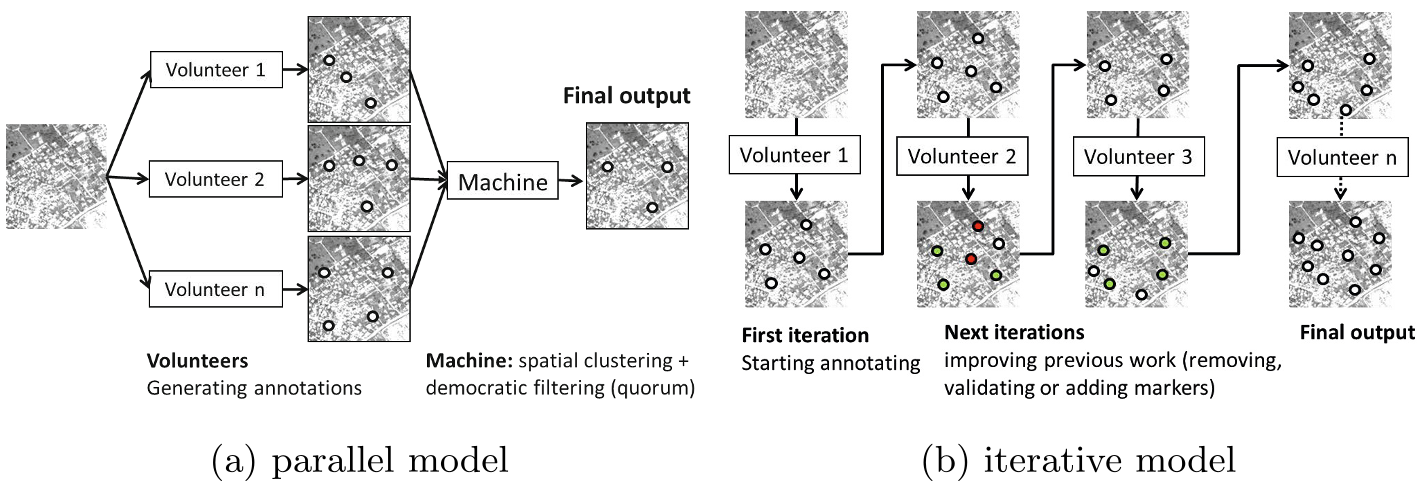
The study defines two architectures for collective problem solving:
- Parallel Model: volunteers work in silos. Their outputs are merged using an aggregation function. This maximizes diversity and independent decision-making.
- Iterative Model: A chain where volunteer sees and improves the work of volunteer . This utilizes knowledge diffusion but is susceptible to "path dependency"—where early mistakes are blindly copied by later workers.
Introducing the Democratic Clustering Algorithm (DCA)
To aggregate parallel results, the authors found standard algorithms like DBSCAN flawed—DBSCAN could validate a point simply because one hyper-active user clicked it multiple times.
The DCA enforces a "democratic" constraint: A cluster is only validated if points are close together and originate from a minimum threshold of different users.
Experimental Insights
The researchers used Mechanical Turk (MTurk) to simulate these models on three maps of varying complexity (Sparse to Dense buildings).
1. The Majority Rule is Sub-optimal
Interestingly, the common "Majority Voting" () was not the best threshold. Because non-experts are more likely to miss a building than to invent one, the optimal agreement threshold is actually lower ( to ). In signal theory terms: the crowd generates low noise, so we can lower the filter to boost detection.
2. Diminishing Returns (Linus' Law)
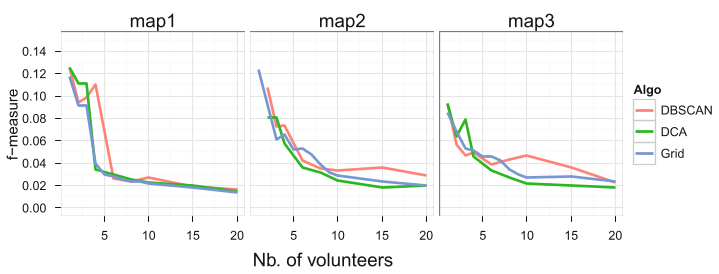
The study found that in parallel models, after about 5 volunteers, the F-measure plateaus. Adding more people doesn't improve the consensus; it just wastes resources. This challenges the "Linus' Law" (many eyes = shallow bugs) by proving that parallel redundancy has a saturation point.
Parallel vs. Iterative: The Final Verdict
- Parallel Wins on Consistency: It is robust against vandalism and random errors. It effectively filters out false positives by only keeping what citizens agree on.
- Iterative Wins on Discovery: In dense, difficult maps (Map 3), the iterative model outperformed DCA. Why? Because as volunteers see what others found, they can focus their attention on "empty" spots, increasing spatial coverage and recall.
Critical Insight & Future Outlook
The authors suggest a Hybrid Model. Use an iterative structure to accumulate knowledge, but implement "uncertainty gates." If a newly identified building has low consensus (high disagreement), it should be sent to a parallel committee to "lock" the decision before the next iterative step.
Conclusion: Crowdsourcing is not just about the number of people; it's about the topology of their interaction. For satellite imagery, we need to balance the independent "filters" of parallel work with the "accumulators" of iterative chains to achieve expert-level results at scale.