
Crowdsourcing the Silo: Why Human Eyes Still Beat Algorithms in Industrial Tomography
Using Crowdsourcing for Scientific Analysis of Industrial Tomographic Images
This paper introduces a specialized crowdsourcing system designed to analyze industrial tomographic images for particle-tracking in bulk solid flow. By leveraging non-expert human computation to identify tracer particles in low-quality X-ray images, the method achieves superior performance compared to traditional automated algorithms, specifically outperforming the Hough Transform-based state-of-the-art in precision and scalability.
TL;DR
Understanding the physics of bulk solids in silos is critical for preventing industrial collapses, yet current algorithms struggle to track particles in low-quality X-ray imagery. This paper reveals a surprising solution: by packaging complex scientific analysis into a directive crowdsourcing workflow, non-expert workers can outperform PhD-level algorithms in both accuracy and cost-effectiveness.
The "Silo Challenge": A Data Nightmare
In industrial processing, silos are more than just containers; they are complex environments where 1% of structures fail or collapse due to uneven flow. To study these flows, scientists use X-ray Tomography to track "tracer particles."
The problem? The resulting images are grainy, noisy, and blurred. Traditional Computer Vision, specifically the Hough Transform, often fails because:
- SNR is abysmal: The contrast between sand and metal tracers is inconsistent.
- Shape Deformation: Moving particles don't look like perfect spheres; they appear as distorted "halos."
- Temporal Blindness: Algorithms struggle to maintain particle identity between frames when objects overlap or momentarily disappear.
Methodology: Designing for Human Intuition
The researchers didn't just ask people to "find the dot." They built a sophisticated Directive Crowdsourcing System that capitalizes on human visual memory.
The Workflow
- Iterative Refinement: Instead of one-shot labeling, the system uses "sequenced tasks." A worker in Round 2 sees the marks from Round 1 and simply adjusts them to account for slight particle movement.
- Redundancy & Aggregation: To eliminate "lazy" workers, the system requires multiple workers to agree on a particle position. A machine algorithm then merges these coordinates into a final trajectory.
- Visual Aids: Workers are given controls to toggle brightness and contrast, allowing them to spot patterns that rigid binarization algorithms would miss.
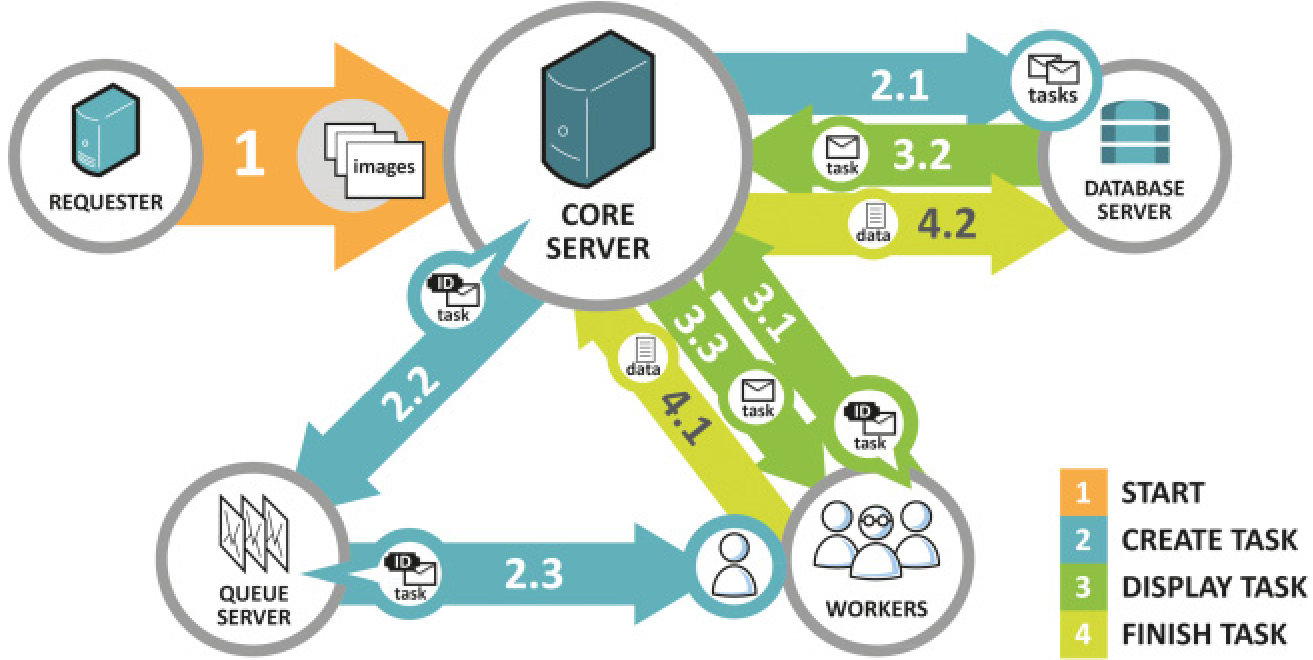 Figure 1: The generalized system architecture for scientific crowdsourcing.
Experiments: The Human vs. Machine Showdown
The team compared their crowd (non-experts) against two benchmarks: Experts (ground truth) and a State-of-the-art Algorithm (a refined Circular Hough Transform).
Key Metrics:
- Precision: The crowd was significantly more precise. In "Loose" flow datasets, the crowd achieved a precision of roughly 0.78-0.83, while the algorithm lingered around 0.44.
- Scalability: When the researchers introduced a new dataset (Sandpaper silo), the algorithm's performance plummeted. The human workers, however, adapted almost instantly, requiring zero "re-programming."
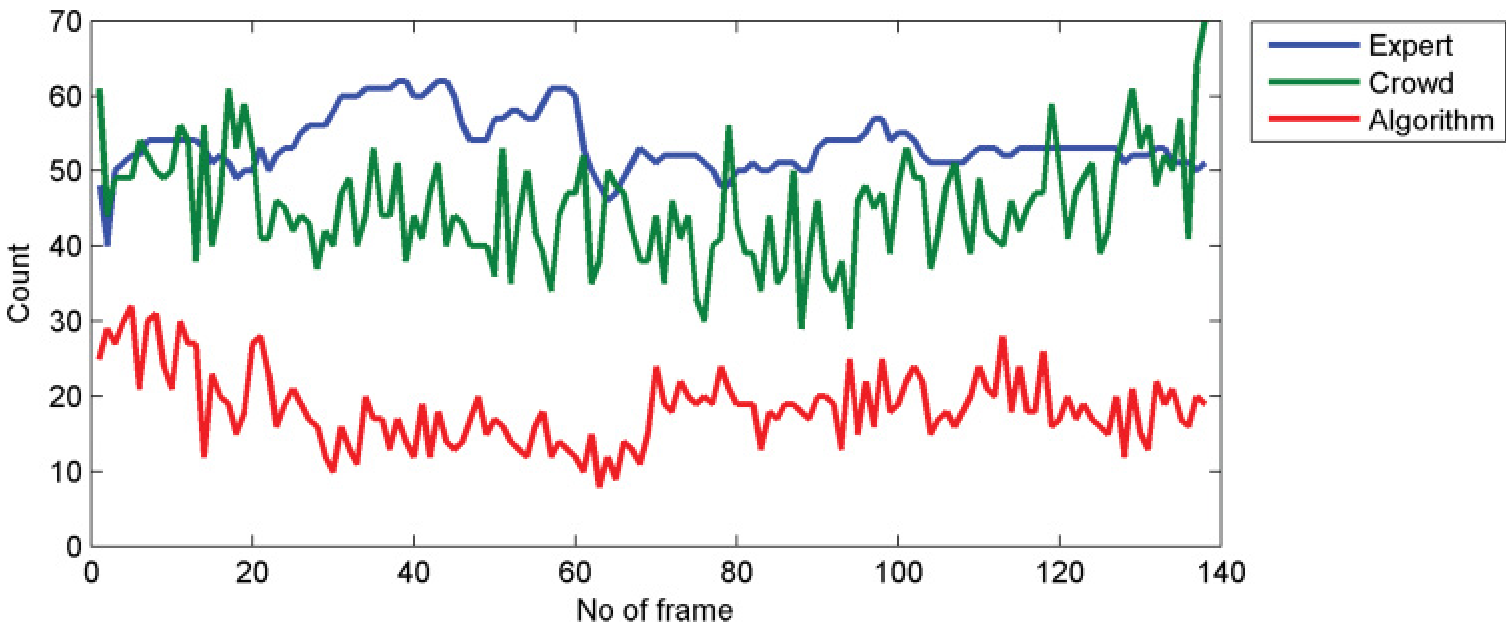 Figure 2: Particle detection count over time. Note how the crowd (green) closely tracks the expert ground truth (blue) compared to the erratic algorithm (red).
Critical Insight: The Economic Argument
One of the most profound takeaways of this paper is the cost-benefit analysis. Developing a specialized algorithm took roughly 100 hours of PhD-level work. In contrast, processing a dataset via the crowd cost a mere $13.74.
This work suggests that for many "unsolved" scientific problems, the path forward isn't necessarily better code, but better Human Computation design.
Conclusion & Limitations
While the crowd was slower per-frame than the computer, their ability to "understand the story" of a particle's movement provided a level of nuance that 2016-era algorithms couldn't touch.
Future Outlook: The authors identify that this crowd-generated data is the perfect "gold standard" for training the next generation of Deep Learning models. By using the crowd to bridge the gap today, we build the automated systems of tomorrow.
Takeaway for Researchers: If your algorithm is stuck at 50% accuracy on complex imagery, stop tuning parameters and start designing a crowd workflow. You might find that the "Black Box" of human perception is exactly what your pipeline is missing.