
Augmented Intelligence: Fusing Crowdsourced "Soft" Reports with "Hard" Sensors for Urban Tracking
Crowdsourcing soft data for improved urban situation assessment
The paper introduces a hybrid Bayesian framework for urban Situation Assessment (SA) that fuses "hard" physical sensor data (bearing-only) with "soft" crowdsourced reports (categorical labels). By combining Particle Filtering (PF) with learned Softmax likelihood models, the system significantly improves tracking accuracy in environments with intermittent sensor coverage.
TL;DR
In the complex "canyons" of modern cities, traditional sensors like radar or cameras often lose sight of targets. This paper reveals a sophisticated way to fill those blind spots by treating human observers as "soft sensors." By using a Bayesian framework coupled with Softmax learning, the authors demonstrate that even vague human reports (e.g., "The car is near the North landmark") can drastically reduce tracking errors when physical sensors fail.
Background: The Limits of Hard Sensing
In urban Situation Assessment (SA), we typically rely on "Hard" data—quantitative, binary, or real-valued signals from physical hardware. However, these systems struggle with:
- Obscuration: Buildings and infrastructure creating "blind zones."
- Data Association Errors: Difficulty in distinguishing targets in crowded spaces.
The authors propose Crowdsourcing as the solution. By outsourcing observation tasks to a human task force (via platforms like Amazon Mechanical Turk), the system gains "Soft" data: subjective, categorical, and linguistically descriptive observations.
Methodology: The Fusion of Logic and Intuition
The challenge is purely mathematical: How do you update a continuous probability distribution (the target's location) with a categorical word (the human's report)?
1. The Motion Model (Particle Filter)
The system uses a Particle Filter to track objects along a road network. Unlike Kalman Filters, Particle Filters excel at "multi-modality"—the phenomenon where a target reaches an intersection and could be in one of three places at once. Each particle represents a possible state of the object.
2. The Softmax Likelihood Model
To bridge the gap between "location" and "language," the authors use a Softmax function. This treats a human report as a classification problem. The likelihood is modeled as: This allows the system to learn the "fuzzy" boundaries of what a human means by "near" or "far" through training data.
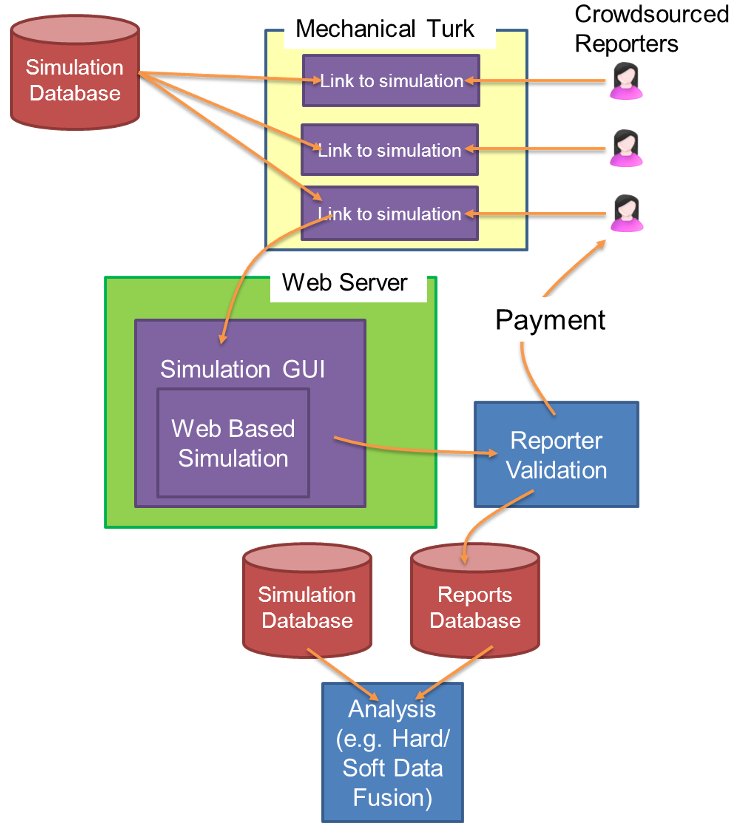 Fig 1: The proposed crowdsourcing workflow, integrating human reporting via web-based tasking into the central data fusion engine.
Experiments and Results
The authors tested four scenarios, comparing "Good" vs. "Poor" hard sensor coverage, with and without periodic soft reports.
Key Findings:
- Drift Correction: In "Poor" coverage scenarios (only one sensor at the start), the target's position estimate quickly drifts into chaos. Adding one soft report every 50 time steps anchors the estimate back to reality.
- Robustness to Noise: Even when simulated humans were "noisy" (error in their range perception), the Bayesian update logic effectively filtered the uncertainty, provided the reporting wasn't biased.
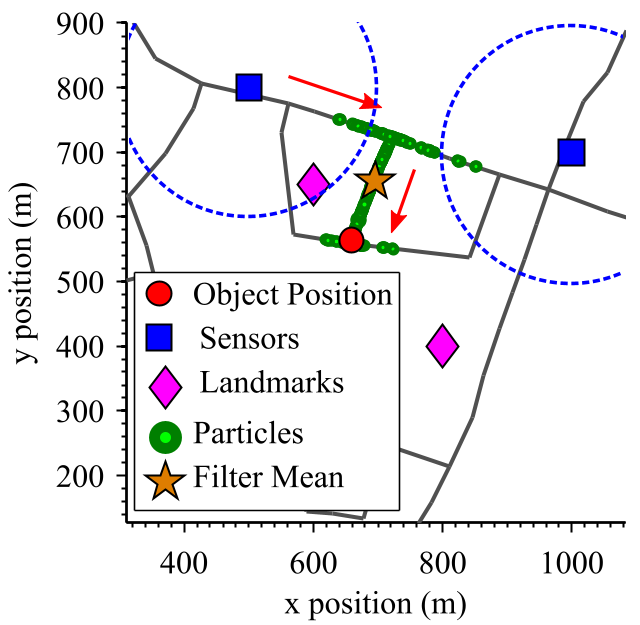 Fig 2: A visual representation of a 'Soft' update. (a) shows the dispersed particles (uncertainty) when a target turns a corner. (b) shows how the Softmax likelihood contours (heat map) collapse those particles back onto the target's true path.
Critical Insights & Future Directions
While this paper provides a robust proof-of-concept, several academic hurdles remain:
- The Trust Variable: This study assumed "honest but noisy" reporters. In real-world crowdsourcing, malicious reporting or systemic bias (e.g., everyone overestimating distance) must be handled through Computational Trust Models.
- Scalability: Training a Softmax model for every landmark in a city is expensive. Future work should look into Zero-shot Transfer, where a model learned at Landmark A can be applied to Landmark B.
- The "Human" Bottleneck: While human data is rich, it is slow compared to a 10Hz radar. The trade-off between latency and accuracy is the next frontier for this research.
Conclusion
This work marks a shift from "Sensor-Centric" to "Human-Centric" information fusion. By mathematically formalizing the "vagueness" of human language, the authors have shown that the best way to understand a city is to listen to the people inside it.