
Crowdsourcing the Airwaves: Smart Spectrum Monitoring at Scale
Crowdsourcing-based Spectrum Monitoring at A Large Geographical Scale
This paper proposes a crowdsourcing-based spectrum monitoring system designed for large geographical scales, utilizing portable mobile devices (Secondary Users - SUs) to monitor Primary User (PU) activity. The system integrates intelligent task scheduling and pattern discovery algorithms to maximize monitoring coverage while minimizing the energy consumption of mobile devices.
TL;DR
Spectrum monitoring is essential for Dynamic Spectrum Access (DSA), but fixed stations are too costly to cover large areas. This paper introduces a crowdsourcing system that transforms ordinary mobile devices into a distributed spectrum observatory. By intelligently predicting Primary User (PU) patterns and scheduling tasks accordingly, the system achieves high coverage and low energy consumption, even when dealing with previously unknown signal patterns.
Background: The Infrastructure Bottleneck
In the world of wireless communication, the spectrum is a finite resource. While much of it is "owned" by licensed Primary Users, literal "white spaces" of unused spectrum exist. Dynamic Spectrum Access (DSA) aims to let Secondary Users (SUs) use these gaps.
The bottleneck? We need to know where the gaps are in real-time. Traditional fixed sensors are like expensive guard towers—they see far but can't be everywhere. The authors propose a "crowd of scouts" approach, using the smartphones in everyone's pockets to monitor the airwaves.
The Core Insight: Signals Have Rythms (Patterns)
The researchers observed that PU behavior is not random; it follows semi-regular patterns in both time and frequency. By recording history, we can generate a Probability Density Function (PDF) for when a signal is likely to appear next.
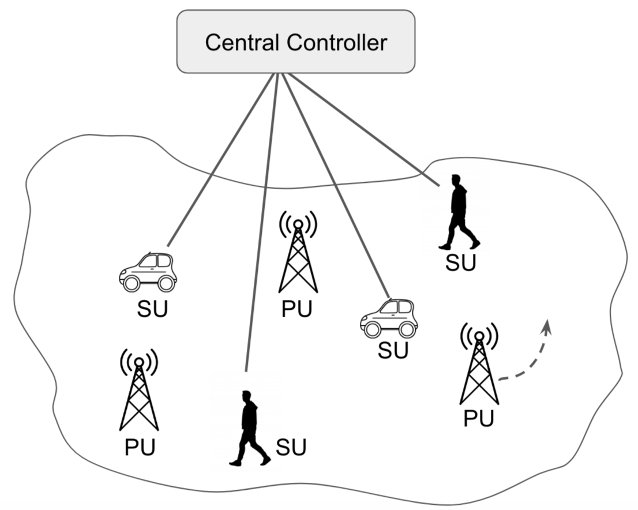 Fig 1. Real-world PU activity shows clear time-frequency blocks (Top) and predictable interval distributions (Bottom).
Methodology: Existing and Unknown Patterns
The system architecture handles two distinct scenarios:
1. Monitoring Known Entities (Existing Patterns)
For PUs already in the database, the system doesn't waste energy scanning 24/7. Instead, it uses a Fast Heuristic Algorithm. It divides the signal's PDF into 7 "sigma" segments. It then assigns SUs to specific segments based on a reward metric that considers:
- Proximity: Can the SU actually hear the PU?
- Energy: Does the phone have enough battery left?
- Urgency: Are there other SUs nearby who could do this job instead?
2. Discovering the New (Unknown Patterns)
What if a new PU starts transmitting or moves? The system uses Random Monitoring for idle SUs. Once a few hits are detected, it quickly builds a rough Gaussian model of the new interval and transitions to Targeted Monitoring to refine the model. This allows the system to remain "evergreen" and adaptive.
Quantitative Results
The authors validated their approach using San Francisco taxi GPS traces and real TV band spectrum data.
- Coverage Efficiency: The Greedy and Heuristic models achieved nearly the same coverage as the "Ideal Optimal" (theoretical maximum) while operating in realistic, uncertain environments.
- Energy Management: As the number of SUs increases, the total energy used for sensing stays stable because the workload is distributed among more devices, reducing the burden on any single phone.
- Discovery Power: The system captured nearly 80% of unknown patterns, whereas a standard random scanning approach captured only about 20%.
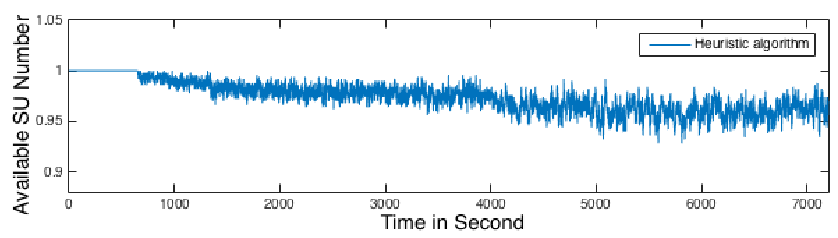 Fig 2. As the number of Secondary Users (SUs) grows, the existing pattern coverage drastically improves, reaching ~85%.
Critical Insight & Conclusion
The genius of this work lies in its probabilistic scheduling. By treating spectrum monitoring as a statistical prediction problem rather than a continuous sensing task, the authors solved the energy-coverage paradox of mobile crowdsensing.
Limitations: While the system is robust, it assumes SUs are willing to participate. In a real-world deployment, Incentive Mechanisms (like payments or data credits) would be crucial to keep users from opting out. Additionally, the system must address the privacy concerns of sharing an SU's precise location.
Future Outlook: This framework paves the way for a dynamic, "living" map of the electromagnetic spectrum, potentially enabling much higher efficiency in 5G/6G networks and beyond.